Online Reporter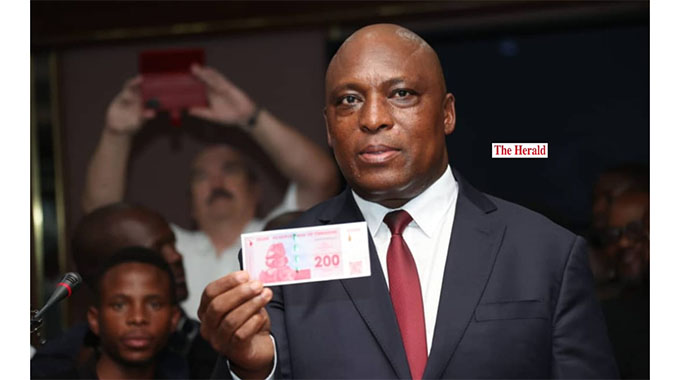
TWO main goals from the Reserve Bank of Zimbabwe (RBZ)’s Monetary Policy Statement presented last week are to increase use of an ever-more-stable ZiG and to reinforce the measures of the Ministry of Finance, Economic Development and Investment Promotion to effectively formalise the informal sector.
In his 2025 Monetary Policy Statement, RBZ Governor Dr John Mushayavanhu was building on the successes since the introduction of the new ZiG local currency on April 5 last year, particularly the strong control of liquidity and building of reserves to ensure all ZiG in circulation are exceptionally well covered so that the ZiG is actually a fundamentally stronger currency than the interbank market, let alone the black market, suggests.
The growth in reserves saw gold holdings of the Reserve Bank increase last year from 1,5 tonnes to 2,7 tonnes, and with the rising prices of gold and the other reserves, mainly foreign currency, the value of the reserves has now reached around US$500 million.
This will increasingly allow the RBZ to perform the important central bank function of being able to intervene in the market through purchases and sales of foreign currency to even out fluctuations in exchange rates and simply allow the general trend to be seen.
The tight monetary policy of the Reserve Bank, backed by the Government, has seen the growth in ZiG money supply to be low, significantly below the growth in reserves, and so removing one of the major inflationary pressures that have bedevilled the economy for so long.
This has also resulted in tighter liquidity in the economy, with businesses complaining about this.
The business sector was complaining in the past about the results of too much liquidity, the high inflation rates and the dramatically declining exchange rate for the local currency although it enjoyed swimming in the flood of extra liquidity.
Dr Mushayavanhu has found a clever way to boost liquidity, without increasing money supply and without seeing that extra liquidity being channelled into consumer spending and so feeding inflation.
Banks have to deposit with the central bank a fixed percentage of the deposits, 30 percent of their demand deposits and 15 percent of their savings deposits. This means they cannot lend that money.
However, Dr Mushayavanhu is now willing to see at least some of these statutory reserves being lent out, but only to productive borrowers who want to borrow to increase capacity rather than just spend the money on consumption or use it for speculation. The statutory reserves will now be used to fund the new Targeted Finance Facility that opened last month.
This means that there is no “printing” of money, that is no increase of money supply, to finance the facility, but at the same time the new use of the pool of statutory reserves cannot fuel inflation. Retailers can now also benefit from the facility, presumably to increase working capital which has been eroded in real value. In effect the statutory reserves pool is now being used as a way for the Reserve Bank to control consumer spending while boosting productive borrowing.
Banks have tended to allow a far higher percentage of their loan book to be used for consumer spending, with the salary-backed loans being the most obvious, and borrowers were also abusing these consumer loans for speculation. To keep the consumer loans within limits, the Reserve Bank is maintaining the 35 percent bank rate, the minimum interest that a bank can charge for a loan.
As part of the gradual movement to having the ZiG being the normal currency in Zimbabwe, exporters can now only retain 70 percent of their export earnings in the foreign currency accounts, rather than the 75 percent that has been the norm for some years. The extra 5 percent of export earnings will be used to feed the foreign currency markets. However, in case an exporter does not want to use the extra ZiG from the compulsory sale immediately, they can now deposit that 5 percent in a new special US dollar-denominated deposit facility until they need the ZiG which will be withdrawn at the prevailing rate on that date.
This will protect exporters from exchange rate fluctuations from a weaker ZiG, although not from fluctuations from a falling US dollar. That is possible as last month saw for the first time in Zimbabwe a higher rate of inflation in US dollar terms than in ZiG terms, and the desired policies of the new US Government might see more tariffs in the US as a permanent economic policy, which is likely to push up US inflation.
The general improvement in foreign currency availability is expected to continue, with the balance of payments rising to a surplus of more than US$500 million this year. This is the positive gap between inflows, largely from exports and diaspora payments, and outflows, mainly imports and foreign currency payments by Government, such as for debt servicing.
The combination of a lower export retention percentage and a larger surplus on the current account means that the Reserve Bank has been able to remove the previous limits on weekly trading and has increased the amount that can be spent using international foreign currency cards to US$1 million a year. While the tight controls on how much can be taken out of the country in banknotes remain, both formal and informal traders can take out more in a card, although the informal traders will need to open bank accounts to do this, something they will be having to do as they formalise.
Dr Mushayavanhu was also keen on seeing more people using bank accounts. Transactions below US$100 will no longer attract bank charges, and point of sale transactions below US$5 will no longer attract charges, meaning that electronic purchases with a card can be used for even tiny sums, as these are not subject to the transaction tax by Zimra.
Dual currency PoS machines are now compulsory for all businesses, no matter how small, under the new rules in the Monetary Policy Statement, with banks required to issue them and the traders formalising to avoid the new ultra-high presumptive taxes compelled to accept them before they can be licensed. The problem of traders continuing to demand banknotes is being tackled by making banks report those customers who are not using their machines.
Zimbabweans wanting to keep their money in US dollar banknotes have been hit in recent times by armed robbers, who see them as easy targets. Some have wanted to use banks for security, but not bank accounts that can be tracked, and so stack their banknotes in safe deposit boxes.
Dr Mushayavanhu has killed this option.
The upshot of the changes announced in the statement are to continue the normalisation of the economy towards using more and more local currency, to move away from cash towards near universal electronic payments, and to make sure that any easing of liquidity is reserved for production, not consumption.