dyton mupawaenda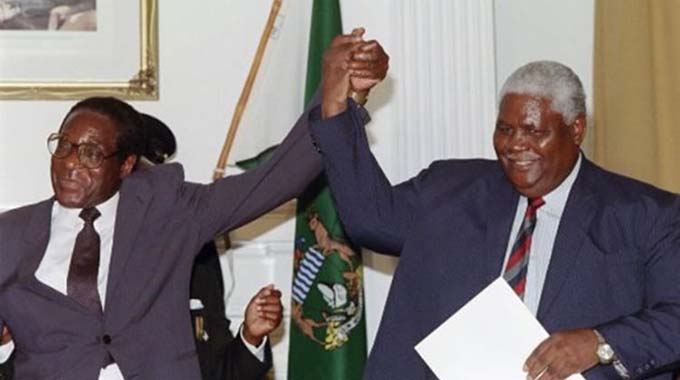
Today we celebrate National Unity Day, an exceptionally important day since it marks the agreement in 1987 when the freedom of Zimbabwe won more than seven years before on 18 April 1980 was converted into the realisation that we were a single country, a single nation and a single people.
Those first seven years had shown that this concept of a united nation, where people could and would disagree but remain bound together, had yet to become the centre of our independent existence.
And while the accord in 1987 was between the leaders of the two major political parties, who were in essence the wings of the nationalist movement and liberation movement that had won freedom and independence, the declaration of National Unity Day as a public holiday moved it far beyond a political arrangement to reunite the nationalist movement, and instead made national unity a cornerstone of the future Zimbabwe, regardless of future politics.
The incomplete unity at independence and in the seven years that followed have many origins, from the tactics of divide and rule by the colonialists, who had to falsify history to even conquer the country in the first place, to the serious meddling by the dying apartheid regime determined to have a bad example on its northern border that would be totally ineffective in supporting the final push of African freedom.
The achievement of 22 December 1987 was the recognition that we, as Zimbabweans, had to move forward ourselves and start living together as Zimbabweans and take responsibility for creating our own future and our own nation, as one people. We had to move away from what we inherited and start the journey to what we all wanted, together.
And over the past 36 years, since 1987, we have achieved that aim of a united nation. Of course we differ on a wide swathe of policy, of course most people are proud of their city, their district and their province.
But we also see that people in their political and personal passions are putting Zimbabwe first, and that is the fundamental victory of the agreement hammered out at a very difficult time in our history.
Our Constitution, the one we drafted ourselves without outside interference just over a decade ago, recognises that between us we speak a lot of languages and entrenches these as official languages, recognises a wide range of diversity and entrenches right to express that diversity, recognises that local communities through devolution have a right to have a major say in the development of their areas. It makes the middle layer of government, the provincial councils, more representative and important.
But it also defines Zimbabwe as a unitary state, a single country, and defines one flag, one national anthem, one central Parliament and one Government. So we get the best of both worlds, the recognition of our linguistic, cultural and other diversity along with effective ways of preserving and even enhancing that diversity, but all of us belonging together as one people, one nation, one country.
This unity provides the framework for the Gukurahundi hearings that begin early next year and which will be presided over by the traditional leadership in the Matabeleland Provinces, which in a sign of our national unity also includes the president of the National Council of Chiefs, Chief Mtshane Khumalo.
By empanelling the traditional leadership of Matabeleland to preside over the hearings, there is clearly no attempt to whitewash anything, or sweep anything under the carpet. Voices will be heard and reported accurately before people they trust. So facts and truth will be out in the open. Most of the chiefs lived through that era so there will be no attempt to manipulate the facts.
At the same time, because traditional leaders have to be above the political fray, there will be no grandstanding, no point scoring. That could be a danger in some circumstances, but not the way the hearings have been planned. The facts will be unadorned, and the testimony will be far more effective as a result.
A major reason for the hearings is the need for healing, and this is far more than healing within the communities most affected but must involve national healing, and all of us will have a part to play here. It is part of the national unity that we have now created that we must all understand that what happened harmed our nation as a whole, and that we all have to be involved in the healing process. It may not be easy.
Healing does need to go beyond just words. Already the Government has taken steps so people in the most affected communities can get the paperwork they need, the raft of birth certificates, identity cards and death certificates, even when the source materials are missing. The Second Republic has made a special effort to include the western districts and provinces in the national development process, making sure that they are not left behind.
What will probably come out of the hearings is a vivid picture of what happens when we do not work together as a united nation and just how precious national unity is and must be.
The achievement of Robert Mugabe and Joshua Nkomo will, by National Unity Day next year, be seen as more crucial and more important once all the testimony has been collected.
And the need to make sure our national unity is a living force will surely be emphasised as we understand the phrase “never again”.



 Online Reporter