Online Reporter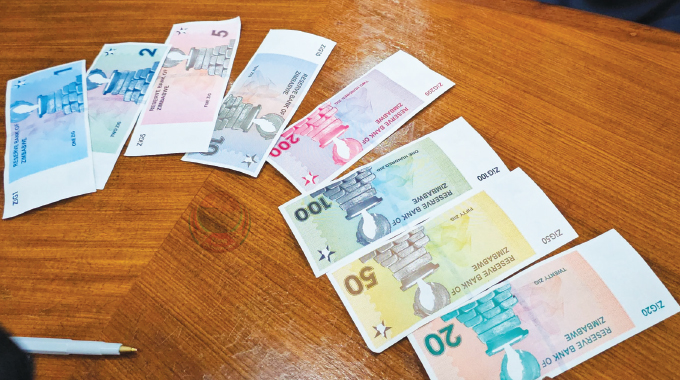
MANY in the private sector have been reluctant to support local currencies over the years. Instead, they have been among the more vociferous exponents of dollarisation, largely due to the bouts of exceptional inflation in local currency and the resulting turmoil in exchange rates.
Now the Confederation of Zimbabwe Industries, representative of at least most of the larger manufacturers in the formal private sector, has acknowledged the stability of the new ZiG currency introduced last year after major and successful efforts by the Government and the Reserve Bank of Zimbabwe to enforce tight fiscal and monetary policies and track down and eliminate all money creation.
With monthly inflation in ZiG terms at below 1 percent continuously since February, and for longer once that curious year end spike last year driven by an even higher spike in US dollar prices is taken into account, the CZI is moderately optimistic about the future of the ZiG.
Acceptance of the ZiG does depend on those who should be using it, the business sectors of Zimbabwe as well as the people as a whole. The CZI is quite correct that maintaining the ZiG as a real useful and usable currency must be a priority of the authorities and that as their successes become more pronounced over the months, so will confidence increase.
The CZI monthly report on currency and inflation developments does refer to past efforts to use and stabilise the two incarnations of the Zimbabwe dollar, but also talks about the apparent success of efforts to create and maintain a stable and useful ZiG. The report talks about the success of the monetary policy in restoring price discipline.
Running an internal economy on two currencies, in Zimbabwe’s case the US dollar and the ZiG, produces its own distortions and this is why almost all countries enforce a single currency, generally their own. Zimbabwe is now in a careful process, largely driven by market forces, to resume a single currency internal market by 2030.
The success of the ZiG, which is now used for almost half of internal transactions, will see sometime this year more than half of all business in local currency, a major milestone. What we are now seeing from the CZI is that this is regarded as a positive move, or at least not as a negative one, by leading businesses.
This is a sea change in private sector feelings. The continued use of the US dollar as the main unit of account has been strongly supported in the past by the private sector, despite the liquidity problems and lack of real growth that resulted. But hanging onto the dollar was driven by a desire for stability, and with the ZiG, backed by serious fundamentals, exhibiting that stability, businesses are prepared to be looking at a ZiG economy without blinking.
For the first time in many decades, businesses are now allowed to set their own exchange rates rather than have these set by the Government. That followed the earlier liberalisation of exchange rates within the banking sector as the interbank rate became driven by market forces rather than fiat. The success of the ZiG was stressed by the trivial adjustments by most businesses in exchange rates when the Government stopped enforcing a rate.
The changeover to markets rather than statutory instruments to set exchange rates could have been seen as a risk, but the private sector businesses were then forced to look at actual values, rather than listen to outsiders, and they found out that the ZiG was already so close to its final official value that there was no real need for anything exciting in adjustments.
That particular change in outlook, based on reality rather than loose talk, was perhaps the most important when it came to the private sector, and that in turn has perhaps brought about the more optimistic outlook expressed by CZI.
Despite the very low monthly inflation for the past few months, the CZI, like many economists who should know better, is besotted by the annual inflation figures. When there is no continuity in economic terms, annual inflation is nothing more than a description of what has happened over the past 12 months, rather than a useful tool to describe what is happening now and what is likely to happen.
Everyone recognises that there was an inflationary surge after the devaluation of the ZiG in September last year, a devaluation caused largely by setting too high a value for the new currency when it was first introduced.
The necessary correction has seen a reasonably stable exchange rate against the US dollar and there will be a sudden and substantial slump in annual inflation as soon as the September jump of last year is removed from the calculations as the October figure is calculated this year. The CZI acknowledges the progress since October last year, but still likes to give more emphasis to previous performance that it deserves.
There should be another, but more modest fall in annual inflation when that curious December jump in US dollar prices is removed from the calculation, and we can then see the serious progress already obvious in the monthly figures now spread over 12 months.
This should calm those who see annual inflation rates as always useful, rather than looking at the annualised monthly inflation rates after a discontinuity. With a fairly continuous progress over that 12 months, the annual figure will at long last start reflecting what is happening, rather than just what has happened.