dyton mupawaenda
Mukudzei Chingwere-Herald Reporter
Zimbabwe’s heritage-based Education 5.0 model, should start right from primary school, if it is to attain the desired results that will boost economic development, Vice President Dr Constantino Chiwenga has said.
He said this in his remarks at the inaugural National Research, Science, Technology and Innovation conference opened by President Mnangagwa in Harare yesterday.
Since the coming in of the Second Republic in November 2017, President Mnangagwa has been championing a “local solutions for local problems” approach, which resulted in the rejigging of the education sector to innovate and foster economic development.
Zimbabwe has already started reaping the rewards of the Education 5.0 model, with some students producing top-notch innovations that are helping the country in various spheres of life.
But to attain the best possible results from the education sector, VP Chiwenga said Zimbabwe should expose children to Education 5.0 from a much younger age.
“May I propose that the 5.0 Heritage-based education (model), which is currently being emphasised at universities, be extended to primary and secondary levels,” said VP Chiwenga.
“This will create an effective identification and grounding for our children to be scientists at an early stage.
“Therefore, I urge stakeholders to burn their midnight candles to come up with the curriculum for primary and secondary levels that suits the President’s vision.”
VP Chiwenga encouraged the conference to ensure that national research efforts were synchronised with the national Vision 2030, and social economic policies as well as asserting the Research Council of Zimbabwe as an apex institution in the research, science, technology and innovation ecosystem.
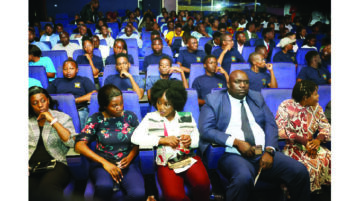
A section of young delegates at the National Research, Science, Technology and Innovation Conference in Harare, yesterday.
“I appreciate the efforts of bringing together stakeholders in the research, science, technology and innovation ecosystem to interface with an aim to fulfil the national goal of transforming Zimbabwe into a knowledge-based society.
“This is the only way we can build the Zimbabwe we all want. Research, science, technology and innovation is a critical and inevitable cogwheel of industrialisation and growth of the economy,” said VP Chiwenga.
He added that President Mnangagwa has always stressed for a knowledge-based economy, and implored stakeholders to join hands in coming up with research that is able to turnaround the country’s fortunes.
The stakeholders, said VP Chiwenga, should direct themselves towards collaborative research that dovetails with Zimbabwe’s vision of an empowered upper middle economy by 2030.
VP Kembo Mohadi said the mere presence of President Mnangagwa at yesterday’s conference was testimony to the value he attaches to research.
“What we draw from this conference, Your Excellency, (is that) as a nation that you lead, and as a nation whose path you have travelled, we say to you, the thinkers here will definitely work towards innovative ideas so that Zimbabwe can prosper.
“Your (President Mnangagwa) presence is a measure of the value that you attach to research as a frontier for new knowledge and skills to build a strong Zimbabwean economy.
“This conference is a reminder that as a nation, we can continuously improve our research, science, technology and innovation ecosystems,” said VP Mohadi.
Government’s hope, he added, was for researchers to come up with innovations that address local needs for the attainment of Vision 2030.


 Online Reporter