dyton mupawaenda
Edgar Vhera-Agriculture Specialist Writer
THE country has notched another milestone after achieving 100 percent self-sufficiency in its table potato requirements from local production and making it only necessary to import seed potato, as farmers collaborate with agro-processors through off take arrangements for enhanced production, market access and sustainability.
This comes as the Government adopted an import substitution policy that promotes the use of locally produced materials ahead of imports.
The breakthrough comes at a time the country is still basking in glory after achieving wheat self-sufficiency giving credence to the effectiveness of the policy and the raft of measures put in place towards making it a reality.
News of this latest achievement came in during a panel discussion on sustainable collaborations between farmers and food processors at the recent Zimpapers Agri-Business Forum held in Harare.
Local agro-business food processing company, Cairns Holdings is among business entities championing the push to establish collaborations with farmers aimed at cost optimisation and value addition of raw materials into finished products.
Its chief operations officer Karen Jiri said her organisation was taking Government’s call for import substitution seriously and was securing at least 40 percent of raw materials by contracting farmers.
“At the moment we are having offtake agreements with farmers as a way of granting them access to finance as well as promoting import substitution. In 2016 our company was importing most of its potatoes, but now we get all our table potatoes for making products such as spuds and chompkins among others from local farmers,” Mrs Jiri said.
She said they had since extended the programme to Michigan pea bean production.
“A couple of years ago we used to import Michigan pea bean from countries like Ethiopia. We started by contracting 68 local farmers at two irrigation schemes. This number has since increased to 11 to boost raw material supplies and sustain local requirements,” the Cairns boss said.
Government declared potato a strategic crop to enhance food security at household and national level and instituted a number of measures to prop its production, chief among them a ban on table potato imports since 2010.
This was a deliberate move to protect local potato farmers from unfair competition from cheap potato imports from neighbouring countries.
Government allowed supervised importation of certified potato seed by seed houses to complement local seed production.
Seed Services Institute (SSI) head Mr Edmore Mtetwa recently said the move attracted foreign breeders who started to engage local seed houses to register their varieties with SSI.
“Consequently, in the last 10 years, various seed houses registered a total of 25 high yielding, table, chipping and crisping potato varieties after going through the necessary multi-locational adaptability trials.
“To further incentivise local potato production Government facilitated registration of new players in the seed supply side and to date the number of seed houses for seed potato had grown from a single active one in 2009 to 12 by 2022,” said Mr Mtetwa
Government has formerly registered 25 new and high yielding potato varieties over the past nine years after they passed mandatory local adaptability tests.
“This brings the total number of potato varieties registered in Zimbabwe to 32, giving farmers a wide choice for planting materials. Among these new varieties are specialised ones for the processing industry being used for crisping and chipping,” Mr Mtetwa continued.
Kutsaga has been designated as a certifying potato seed agent mandated to produce and market potato seed under the auspices of the Zimbabwe Potato Micro-Propagation Association (ZPMA).
It has a state-of-the-art laboratory and purpose-built green-house hardening facilities for commercial production of clean disease-free potato plantlets using tissue culture technology into mini tubers, which are later transferred to the field as generation one (G1) to generation four (G4) for the production of ware and table potatoes.
ZPMA has contracted potato seed growers in suitable areas to assist in the seed multiplication programme
The potato seed multiplication programme is meant to truncate the critical shortage of the potato seed, which had seen the country importing 60 percent of its requirement as a result of depressed volumes of seed coming from the Nyanga quarantine area.
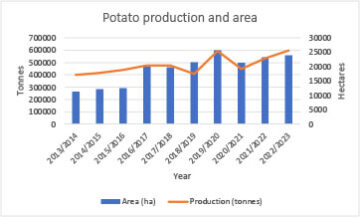
The evident result of the above Government interventions is the exponential increase in potato production from 52 000 tonnes in 2010 to 599 550 tonnes in 2022. The area under potato production also rose 111 percent from 11 600 hectares in 2013 to 23 982 in 2023.
Meanwhile, statistics from the Zimbabwe National Statistics Agency (ZimStats) show that there was a 37 percent drop in the value of seed potato imports from US$9 814 212 for the period January to August in 2022 to US$6 141 750 in the same period this year.
In volume terms seed potato imports dropped 35 percent from 12 900 062 to 8 445 311 kilogrammes.



 Online Reporter