admin
admin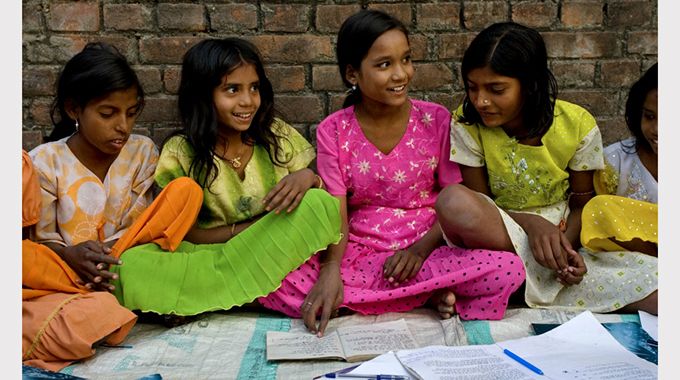
Flora Teckie
The advancement of civilisation requires the full participation of everyone, including women and girls.
For this to happen, both girls and boys must be valued in our families and our communities and must be given equal opportunities for education, and in all other fields of human endeavour.
Despite positive efforts made in the last few decades to ensure equal rights and education for girls, various forms of discrimination against them still persist.
In many parts of the world, girls have a lower status and enjoy fewer rights and opportunities than boys — both in their families and within their communities.
Even in terms of education, sons still often get preference over daughters.
The Bahá’í Writings state: “Until the reality of equality between man and woman is fully established and attained, the highest social development of mankind is not possible” and that “men and women are equal in the sight of God … The only difference between them now is due to lack of education and training.
“If a woman is given equal opportunity of education, distinction and estimate of inferiority will disappear”.
Education is a fundamental human right
The education of every child – the development of their personality, talents, mental and physical abilities and spiritual qualities to their fullest potential – is the right of every child – whether boy or girl.
Education of girls is not only a human right. It is also in the best interests of society as a whole. The way must be open for women and girls to enter equally all spheres of human endeavour.
In a statement entitled: ‘The Promise of World Peace’, the governing council of the Bahá’í international community asserts: “The cause of universal education … deserves the utmost support that the governments of the world can lend it. For ignorance is indisputably the principal reason for the decline and fall of people and the perpetuation of prejudice. No nation can achieve success unless education is accorded to all its citizens”.
Moreover, because the mother is the first educator of children, the education of girls assumes a special importance.
According to the Universal House of Justice, the governing council of the Bahá’í International Community: “The decision-making agencies involved would do well to consider giving first priority to the education of women and girls, since it is through educated mothers that the benefits of knowledge can be most effectively and rapidly diffused throughout society”.
Educating our daughters is very important for the advancement of our families, our communities, and our nation.
Without using the potential, the skills and talents of both women and men, the full social and economic development of the planet will not be possible.
The benefits of educating our daughters are not only in terms of social economic development, as material well-being is only one of the many benefits our communities will derive from their education.
Mother as the first educator of humanity
Although both the father and the mother share in the overall responsibility of educating their children, the mother is given recognition as the first educator of humanity, and she must be carefully prepared for this task.
A child needs a nurturing environment and wise guidance particularly in the first years of life, to develop a well-trained mind and a sound character.
The Bahá’í Writings state that: “If the mother is educated then her children will be well taught. When the mother is wise, then will the children be led into the path of wisdom. If the mother be religious she will show her children how they should love God. If the mother is moral she guides her little ones into the ways of uprightness”.
Our challenge today is to create the conditions in which girls can develop to their full potential.
The creation of such conditions will involve not only deliberate attempts to change various structures of society, but, equally important is the transformation of all individuals – men and women, boys and girls.
The empowerment of women and girls and their equality with men will bring about a more balanced world, the one in which the more masculine qualities of strength and courage will be balanced by intuition, love and service: qualities in which women and girls are strong.
“Women and men,” the Bahá’í Writings state, “have been and will always be equal in the sight of God”. Our rational soul has no gender, race or nationality or tribe and whatever social inequities may have been dictated by the survival requirements of the past, they clearly cannot be justified at a time when humanity stands at the threshold of maturity.
The Bahá’í vision of gender equality rests on the central spiritual principle of ‘the oneness of humanity’. In this context, gender equality is not only a requirement of justice, but it is a pre-requisite for peace and prosperity.



 Online Reporter