daniel chigunwe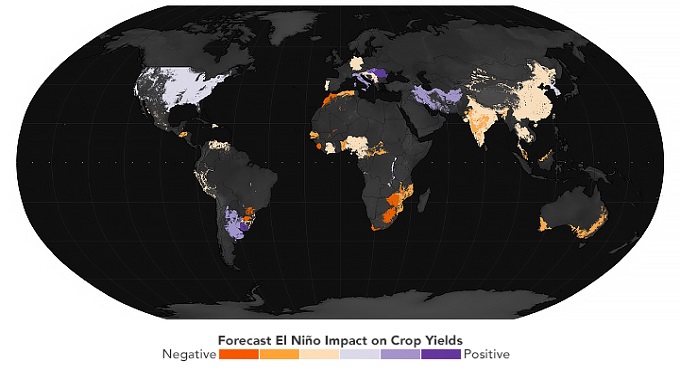
The ongoing El Niño is disrupting rainfall patterns across the planet, with mixed consequences for food production.
Too much rain in some places, and too little in others, is projected to affect crop yields and leave 110 million people in need of food assistance, according to scientists who are part of the Famine Early Warning Systems Network (FEWS NET).
El Niño is a natural climate phenomenon characterised by warmer-than-normal sea surface temperatures in the central and eastern tropical Pacific Ocean. This cyclical warming of surface waters functions like a boulder in the middle of a stream, disrupting atmospheric circulation in ways that shift rainfall patterns.
Wetter conditions are expected in the southern United States and the Horn of Africa and drier conditions are likely over southern Africa, Latin America, Australia, and parts of southeastern Asia.
This year’s El Niño event, which is forecast to continue gaining strength through the end of 2023 before it dissipates by mid-2024, is expected to contribute to high levels of food insecurity in certain regions.
“El Niño events are estimated to affect crop yields on at least a quarter of global croplands,” said Weston Anderson, an assistant research scientist with the FEWS NET science team.
“And while there’s uncertainty in how crop yields will be impacted this year, because they vary from one El Niño event to another, we know how the dice are loaded.”
Based on Anderson and colleagues’ analysis of historical crop yields, El Niño is likely to bring poor maize yields in southern Africa and Central America due to drought.
Wheat yields in Australia and rice yields in Southeast Asia are also typically reduced. On average, global soybean yields improve during an El Niño event.
Meanwhile, above-average rainfall is expected to facilitate the gradual recovery from three-year droughts in much of the Horn of Africa and Afghanistan.
FEWS NET food security analysts develop scenarios of how regional rainfall deficits or surpluses could affect crop yields, and in turn food security, and use this information to help the US Agency for International Development (USAID) understand food assistance and humanitarian needs.
This work is especially key in regions where many people rely on growing their own crops to meet their daily needs.
This is the case in some countries in southern Africa, which was identified as a region of concern in a recent FEWS NET release.
Negative impacts of El Niño are typically strongest within southeastern areas of Africa, including in Zimbabwe, southern Zambia, southern and central Mozambique, and northeastern South Africa. During past years with a moderate to strong El Niño, these areas have often received below-normal rainfall and above-average daytime temperatures during the key months of the growing season.
Maize is the single most important cereal crop in southern Africa, accounting for almost 70 percent of the region’s cereal production.
In past El Niño years, maize production in Zimbabwe and South Africa saw average deficits of 10 to 15 percent relative to expected yields.
Some years saw deficits of over 50 percent, leading to sharp, regional food price spikes. In southern Madagascar, 2023 maize harvests have already performed poorly due to cyclone events and irregular rainfall. – NASA Earth Observatory



 Online Reporter