admin
admin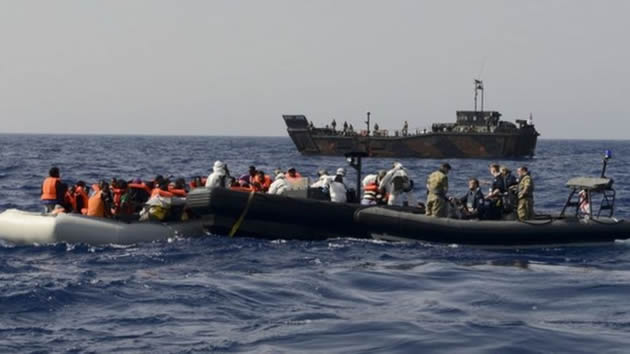
 EU ministers have approved plans to establish a naval force to combat people-smugglers operating from Libya. The aim is to launch the operation next month, with a headquarters in Rome under an Italian admiral, EU foreign policy chief Federica Mogherini said.
The EU is struggling to cope with a surge in illegal migrants from Africa and the Middle East crossing the Mediterranean Sea to reach Europe.
Mogherini was speaking after talks with EU foreign and defence ministers.
The UK is playing the lead role at the UN Security Council in drafting a resolution that would give the EU a legal basis for using military force against people traffickers.
There would be three phases in the naval operation, the EU foreign policy chief explained: Intelligence gathering on smugglers; Inspection and detection of smugglers’ boats; Destruction of those boats.
“It’s not so much the destruction of the boats but the destruction of the business models of the (smugglers’) networks themselves,” she explained.
Mogherini stressed that co-operation with officials in Libya, a country torn apart by feuding militias, would be vital to make the operation succeed.
“We are looking for a partnership — there is a responsibility the Libyans themselves have to take on their territory, for the land and sea borders.”
The EU would have to work closely not only with the recognised government in Tobruk — represented at the UN — but also with rival officials in Tripoli and Misrata, to dismantle the smuggling networks, she told a news conference in Brussels.
“The (Libyan) municipalities might have an important role to play,” she said.
The Mediterranean mission will be led by Adm Enrico Credendino, an Italian commander who ran the EU’s anti-piracy mission off Somalia, Operation Atalanta.
More than 1,800 migrants have died in the Mediterranean in 2015. That is a 20-fold increase on the same period in 2014.
Disrupting the people-smuggling networks is part of a wider EU plan for tackling the migration crisis. The European Commission has urged EU states to adopt national quotas for housing migrants, to ease the pressure on Italy, Greece and Malta.
The EU also aims to tighten co-operation with migrant transit countries in Africa, to make it easier to send economic migrants home. Too many irregular migrants with no right to asylum manage to stay in Europe, the Commission says.
Much will depend on when Britain is able to shepherd a resolution through the UN Security Council, and what precisely the resolution approves.
The mission will begin with intelligence-gathering (which is already taking place) and operations against smugglers on the high seas.
But then comes the most risky part — naval operations within Libyan territorial waters, close to or on the Libyan coastline.
EU officials have said repeatedly that there will be “no boots on the ground”.
But there will need to be an effort to disrupt the onshore operations of the smuggling gangs if the mission is to achieve its objectives. That could well involve the use of special forces — something that will not be advertised in advance. — BBC.


 Online Reporter