Business Reporter
The European Union has launched a major regional initiative to switch Eastern and Southern Africa toward a circular economy, bringing together EU Member States and international partners to tackle policy, people and finance gaps across the region.
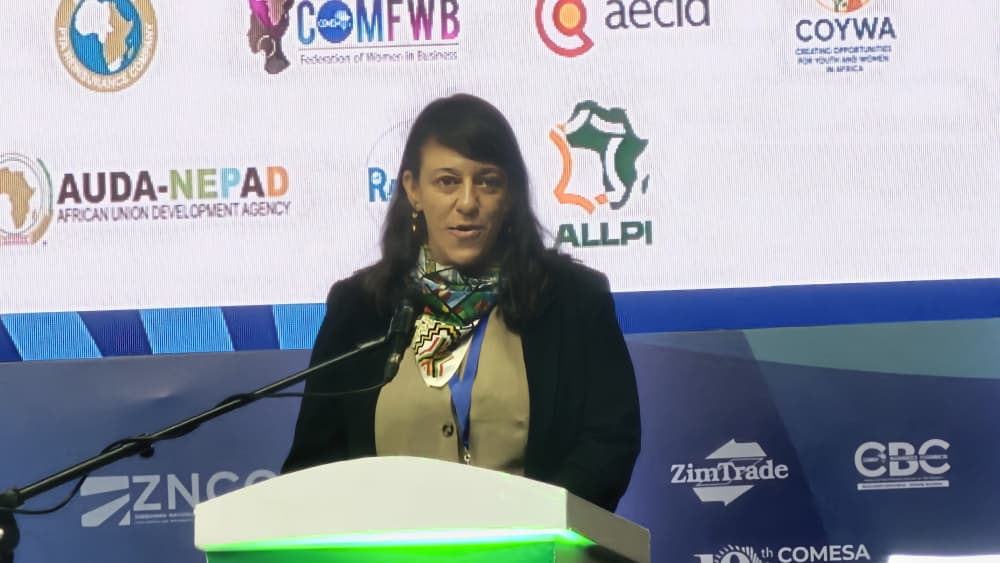
Speaking at the official opening of the COMESA Green Industries Connect forum at the Harare International Conference Centre, Ms Lana Zutelija, Team Leader for Environment and Climate at the EU Delegation to Zambia and COMESA, announced the bloc’s co-funded programme with Germany and its implementation partnership with France.
“We are very proud to be co-funding with Germany and also implementing with Germany and France,” Ms Zutelija said.
Outlining the initiative’s three-pillar approach, she said the programme focuses on policy, people and finance, with specific attention to plastics and electronic waste as the major circularity challenges facing Africa, Europe and the wider world.
Ms Zutelija called for enabling regulatory frameworks, particularly Extended Producer Responsibility (EPR) rules, urging governments and institutions across the region to establish clear and enforceable frameworks.
She also emphasised the need to invest in workers, skills development, youth and women, including technical and vocational education and training (TVET) to build the workforce required for a circular economy transition.
On finance, she said: “Without access to finance, there is not really much we can reach and achieve altogether,” underscoring that capital mobilisation is a precondition for the transition’s success.
Ms Zutelija also stressed the need for coordinated action across all levels of governance to unlock the continent’s resource potential for the benefit of its citizens.
“We need to do this altogether. We need to connect the national, regional, continental and global level; and the EU is a very strong partner in this endeavour,” she said.
Highlighting the paradox of Africa’s resource wealth, she noted that too much value is currently being lost through waste and exported without benefiting local communities.
“Eastern and Southern Africa, and more broadly the African continent, is extremely rich in resources. And those resources need to be value-added locally — for the communities and citizens,” she stated. “Too much waste is being lost. The value is gone. Young entrepreneurs do not see the benefit of all these resources, and the value is being created elsewhere.”
She emphasised that the EU is committed to reversing this trend by promoting local value addition accompanied by strong environmental protection, green industrialisation, economic growth and job creation.
Turning to circularity, Ms Zutelija described it as a practical solution to the region’s economic and environmental challenges.
“Circularity brings a solution to this equation. It really helps us to keep the resources within this circle of production and consumption. It helps us to reduce pollution, and most importantly, it helps us to reduce costs — and this is what also matters to the businesses concerned,” she said.
She added that circularity brings new opportunities for youth, women and the informal sector, which she noted is already at the forefront of recycling.
Ms Zutelija pointed to the African Continental Free Trade Area (AfCFTA) and COMESA as key vehicles for pioneering these opportunities at a scale that makes sense globally.
Reaffirming the EU’s commitment, she explained that the bloc’s Global Gateway Strategy is the framework through which it interacts with partners at regional, international, continental and worldwide levels.
“This is the way we bring investment between the private sector, but never at the expense of the environment, our natural resources or our planet,” she said.
Ms Zutelija urged regional governmental institutions to establish stable, predictable, transparent regulatory frameworks as demanded by the private sector.
Her remarks cemented the EU’s position as a lead partner in the region’s green transition and set a clear agenda for the day’s discussions on policy development, skills development and blended finance.