Business Reporter
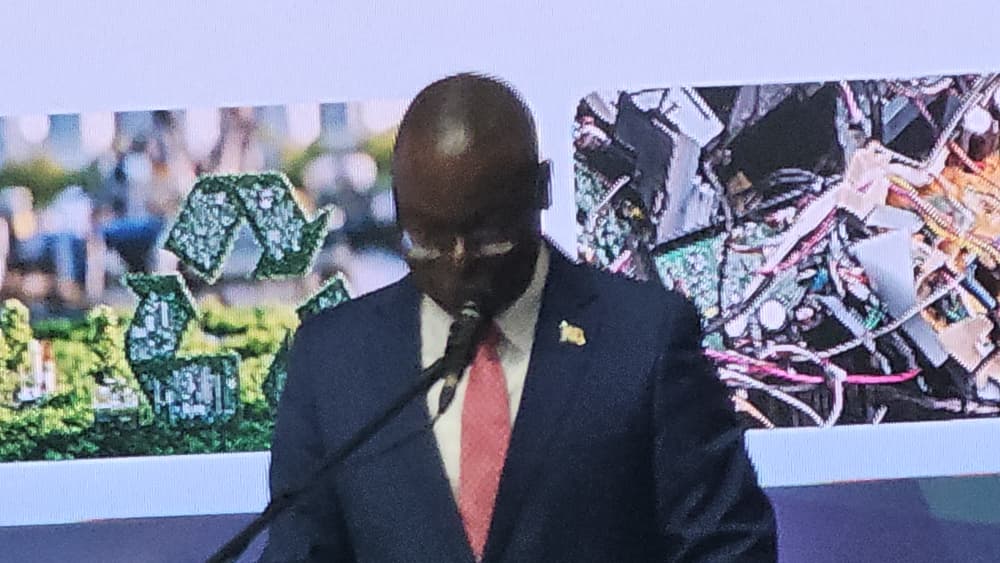
Africa must abandon outdated colonial-era economic rules, return to indigenous circular practices and build industrial capability rather than relying solely on natural resources, Hon Prof Amon Murwira, Zimbabwe’s Minister of Foreign Affairs and International Trade, has said.
A circular economy is an economic model that keeps materials and resources in continuous use for as long as possible through reuse, repair, refurbishment and recycling, minimising waste and extracting maximum value from natural resources before they are discarded. Minister Murwira argued that such a model is not a foreign, sophisticated concept but a return to indigenous practices that were displaced by colonial rule. “Degradation is a departure from circular economy practices. We do not see circularity as sitting in the corner as something very sophisticated — it was always done. So it is a matter of removing colonial rules,” he said.
He invoked the historical context of Africa’s economic governance, noting that before colonial imposition, African polities already operated sophisticated systems of production and exchange. “If you quote a section of the law of 1952, you have to be reminded that by 1950, except for Ethiopia, there was no kind of record that African polity had such law,” he said. “It is time for new rules. This is the liberation of the mind. This can only lead us to export sophisticated work through stable, sustainable industrialisation that implements the circular economy.”
Minister Murwira stressed that Africa’s industrialisation cannot be achieved simply by possessing natural resources. “For Africa, industrialisation shall not simply be the existence of factors. It must be in the form of an organisation, a uniform or systematic vision of knowledge and natural resources,” he said. He warned that the global economy is being reorganised around strategic sectors — including sustainable energy security, digital technologies and industrial capacity — and that Africa must build matching capabilities or risk being left behind. “No country, not even one on this day, can go beyond the level of what they know they wanted,” he said. “Capability is up here,” he added, pointing to the mind.
Minister Murwira also called for the removal of tariff and non-tariff barriers, insisting that COMESA’s founding commitments must be honoured. “By forming COMESA, we are saying all trade, all tariffs and non-tariff barriers must fall. Otherwise, why did you sign it? Africa cannot be your enemy. We do all this integration to achieve the sustainable improvement of human needs. If, in the end, the people do not see the benefit, then the union means nothing,” he said.