Online Reporter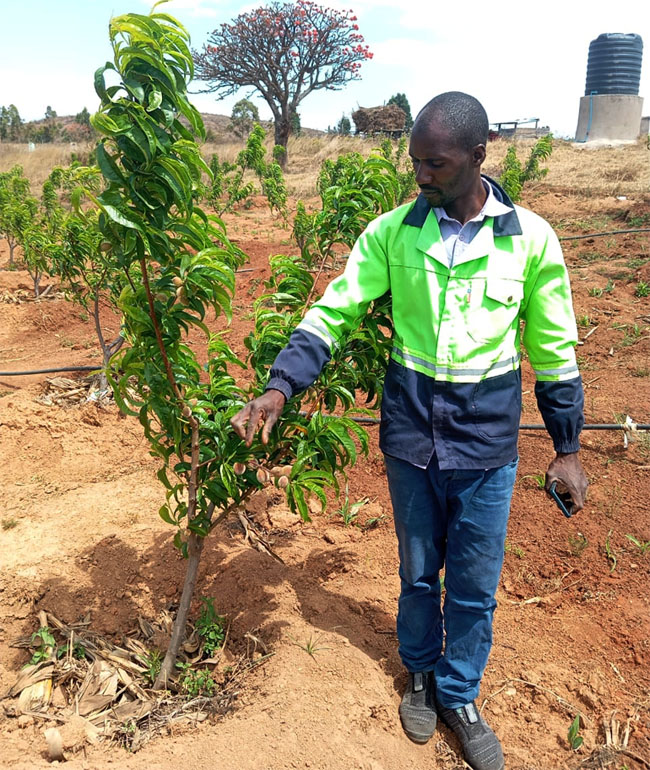
Tendai Gukutikwa
Post Reporter
WHEN Mr Tawanda Bukuta returned home from South Africa in 2012, he came back with little more than experience and a determination to build a future for his family.
The 41-year-old farmer had spent years working in orchards around Cape Town, pruning fruit trees and learning the intricacies of orchard management. Back in Mawadza Village under Chief Mutasa, however, those skills were all he had.
There was no formal job waiting for him.
With six children to support, two in high school, three in primary school and one still a toddler at the time, Mr Bukuta faced the daunting challenge of providing for his family in a community where economic opportunities were limited.
Yet he had two valuable assets: access to land and water, and years of experience working with fruit trees.
Instead of seeing those as modest resources, he saw them as the foundation of a new beginning.
More than a decade later, that decision has transformed his life.
What started as a small backyard nursery and orchard has grown into a thriving enterprise that now generates between US$1 000 and US$1 500 a month, a remarkable jump from the roughly US$100 he once earned from rain-fed maize production on degraded land.
Today, Mr Bukuta operates a fruit-tree nursery, manages an orchard and works with 73 small-scale and commercial farmers across Manicaland, supplying seedlings and sharing the knowledge he acquired while working in South Africa.
“When I came back from South Africa, life became very difficult. I had a family to take care of and there was no source of income. I had land and water, and the one thing I knew was fruit trees. I had worked in people’s orchards in Cape Town, pruning trees and taking care of them, so I decided to use that experience to start something of my own,” said Mr Bukuta.
What began as a survival strategy gradually evolved into a business.
Mr Bukuta started by producing fruit-tree seedlings and establishing a modest orchard on his land.
The returns did not come overnight.
Fruit trees require years of investment, patience and careful management before they begin generating meaningful income.
But while the orchard grew, so did his vision.
He soon realised that the land around him could offer much more than seasonal maize harvests.
“I started by planting seedlings for fruit trees. As time went on, other farmers began joining me.
“With funding from the Southern Alliance for Indigenous Resources (SAFIRE), the project grew. Today, I work with farmers from different parts of Manicaland. Some are now commercial farmers. We grow peaches, apples and strawberries, and I also operate a nursery where I produce and supply fruit-tree seedlings,” he said.
His work has since expanded across four districts in Manicaland, creating opportunities for dozens of farmers and contributing to rural economic development.
Beyond generating income, Mr Bukuta believes fruit production and tree growing can help restore degraded landscapes while strengthening rural livelihoods.
“I have learnt the importance of protecting and nurturing our forests. There is life in these ecosystems. A nursery can provide seedlings, but it can also create a chain of economic activity involving farmers, labourers, traders and consumers. A farmer who once depended almost entirely on rain-fed crops can diversify income while helping restore the land on which his family depends,” he said.
For many rural households, environmental conservation is not merely a matter of protecting nature.
Healthy forests support water sources, improve soil fertility and enhance agricultural productivity. When ecosystems are degraded, farming communities are often the first to feel the consequences through lower yields, declining incomes and increasing vulnerability to drought.
Mr Bukuta’s story illustrates how conservation and livelihoods can reinforce each other.
His experience has gained added significance following recent developments in Zimbabwe’s environmental policy framework.
The Parks and Wildlife Amendment Act No. 4 of 2025 strengthened community environmental rights and broadened opportunities for communities to participate in conservation and benefit from natural-resource management.
While community-based natural resource management has existed in Zimbabwe for decades, the new legal framework provides stronger recognition of the role communities play in protecting and benefiting from environmental resources.
For Mr Bukuta, however, conservation remains a practical issue rather than a policy debate.
It is about securing the future of his family and ensuring that the land continues to support future generations.
“I came back from South Africa because I wanted to build a life at home. I did not know that the experience I had gained working in other people’s orchards would one day allow me to create something that could support my own family and help other farmers,” he said.
His journey reflects a broader reality confronting many rural households across Zimbabwe.
Agriculture remains highly susceptible to erratic rainfall, climate change, rising input costs and fluctuating markets. Diversifying into orchards, nurseries and other natural-resource-based enterprises can provide an important buffer against these challenges.
Although orchards demand patience, technical skills, water and access to markets, they offer long-term returns that can sustain families for years.
“My nursery became a source of seedlings, the seedlings became orchards, the orchards became businesses and the businesses became a source of household income,” said Mr Bukuta.
For the Southern Alliance for Indigenous Resources, Mr Bukuta’s success story reflects the potential of community-based natural resource management to improve livelihoods while promoting environmental stewardship.
SAFIRE director, Ms Estella Toperesu, said the organisation’s approach seeks to help communities build sustainable enterprises around natural resources while reducing pressure on forests and fragile ecosystems.
“Our work seeks to address that connection by helping communities develop enterprises around natural resources while reducing pressure on forests and other ecosystems.
“Over the past decade, our programmes have reached more than 33 000 households across the country, while average monthly household income among beneficiaries increased by about US$165,” she said.
She added that communities supported through SAFIRE programmes have planted more than 500 000 trees, restored approximately 50 000 hectares of degraded land and protected a further 5 600 hectares of arable land.
Ms Toperesu said the organisation was recently honoured with the provincial Environmental Stewardship and Social Impact Award in recognition of more than three decades of work linking environmental conservation with rural development.
“It is a proud milestone for SAFIRE and for the communities we have had the privilege to work alongside over the past three decades, including Mr Bukuta and his family,” she said.
For Mr Bukuta, the lesson from his journey is simple.
The trees he planted to survive have become the foundation of a thriving business, a source of opportunity for other farmers and a pathway to a more secure future for his family.
“Once you understand that there is life in these ecosystems, you begin to see conservation differently.
“For me, protecting the trees is also protecting my family’s future,” he said.