admin
admin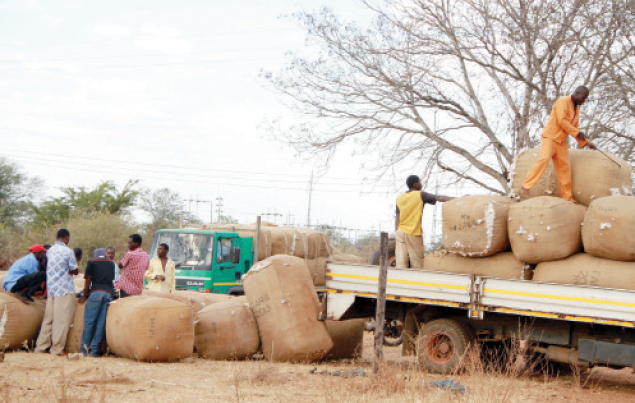
 COTTON farmers in Chiredzi have bemoaned poor producer prices for the crop which used to be referred to as the district’s white gold.
The farmers, largely contract farmers, said the amount of time and inputs invested in the cash crop did not match the outputs as the profits continued to dwindle and in some cases they made losses.
Contract farming is meant to link smallholder farmers with larger business operations in order to provide a ready market for the farm produce. This relationship has the backing of the World Bank which sees it as a perfect “win-win” situation.
The great cotton boom from the 1990s when smallholders entered cotton production in a big way was driven by contract arrangements, initially with the parastatal, Cottco, and then with many other companies following the liberalisation of cotton buying.
Through the arrangement, smallholder farmers are expected to get access to inputs and markets while agri-businesses are guaranteed products at good prices.
The system has however failed these cotton growers who devote much of the year to growing the cash crop and receive peanuts at the end of the farming season.
“The amount of rainfall in a specific farming season determines the harvest but the grace period for growing cotton to its maturity is six months. It is hand-picked but this also depends on whether or not it is raining otherwise dry weather is generally the best when picking cotton.
“This area doesn’t receive much rainfall that’s why cotton is the best crop to plant but the low producer prices are what stress us the most. At the moment it is being bought for 60c per kg but if you sell for less, they don’t back pay, unenge watonyura (it would be your loss),” said James Mazodze, a cotton farmer from the area.
Mazodze said farmers in Chiredzi were finding it difficult to trust agribusinesses but had no option but to continue planting the cash crop.
“Farmers are in this business at their own risk. Another problem we face is the chemicals that we’re being supplied with; they’re too weak compared to those we used in the past.
“Of importance though is that farmers need to consider occupational safety and health when using these chemicals. They need to wear protective clothing but there are no people to advise us about these things. They say we can’t use stronger chemicals because we’re not protected,” said Mazodze.
Due to lack of protective clothing, Mazodze said cotton farmers were discouraged from growing cotton after five successive farming seasons.
Another cotton farmer, Tamirirashe Chimbada who was spotting a blue worksuit and was busy jotting down figures in a counter book when a Chronicle news crew met him at a cotton buying point recently, said contract farming was oppressing many farmers who had no option but to abide by the provisions of their contractors.
“Hatikwanisi kuzvimiririra tega sevarimi vedonje (Cotton farmers are not independent under this arrangement). I proposed that each district create a register in which farmers record the kind of inputs they prefer so that they are ready in time for the next farming season.
“But after planting, picking and baling the cotton, it ceases to be yours. Ownership now belongs to the contractor. Haungomuke uchiti wakurima donje nekuti cotton haidyiwe (You don’t just wake up and start growing cotton because it’s not a food crop). You’re given a contract to grow the cotton by a particular company.
“They don’t force people, they just offer the contract and farmers are at liberty to accept or decline the offer. When you accept, it becomes a binding contract.
“But the problem is when we’re offered contracts, we don’t read all the contents of the contract. We just rush to sign them. Some just sign without understanding the conditions of the contract and end up losing out,” said Chimbada.
Chimbada said there was an urgent need to review cotton prices upwards if cotton farming was to remain viable.
“The viable price should be about $1 per kg. Even if that were to be a constant price, we’d benefit more than we are doing now,” he said.
One bale of cotton weighs about 200kg with a kg costing 60c.
One bale therefore amounts to $120. After a good harvest, a farmer can realise between seven to 40 bales of cotton. The problem however, is that cotton is not planted all year round so the dividends are only for a short period of time.
“The problem is that cotton is not properly marketed in Zimbabwe and its selling prices are too low. At the end of the day, we don’t benefit much. This year I’ve done reasonably well though. After sharing dividends with my contractor, I had 17 bales of cotton left but four have been used to pay for labour. I have 13 bales now, which amount to $1,560 at $120 per bale.
“But that money is seasonal so it’s not much at the end of the day. I earn a decent living but the inputs just don’t match the total gains,” said another cotton farmer, Tongai Chipfume.
Chipfume said big companies were benefiting from cotton farming at the expense of the ordinary farmer.
“I spend almost a year on the project and only have $1,560 to show for it.
In essence, that’s about $130 per month which is not enough to adequately sustain a family. Unfortunately, there is no other market except this one,” he said.
Farmers in Chiredzi have contracts with a number of cotton companies including Cottco, China Africa and Alliance Ginneries Limited.
Cotton Ginners Association former president Godfrey Buka said cotton prices were based on individual companies.
“It’s no use talking to associations because at the end of the day, it’s a matter involving an individual company because companies are the ones that peg the prices,” he said.
Almost all parts of the cotton plant are used in some way including the lint, cottonseed, linters, stalks and seed hulls.
The fibre from one 227kg cotton bale can produce 215 pairs of jeans, 250 single bed sheets, 1,200 t-shirts, 2,100 pairs of boxer shorts, 3,000 nappies, 4,300 pairs of socks or 680,000 cotton balls.
Cotton lint is spun then woven or knitted into fabrics such as velvet, jersey and flannel. About 60 percent of the world’s total cotton harvest is used to make clothing, with the rest used in home furnishings and industrial products.
Over half the weight of unprocessed cotton (seed cotton) is made up of seed.
The most common uses of cottonseed are oil for cooking and feed for livestock. Cotton seed is pressed to make cottonseed oil.
Cottonseed can be made into a meal and is a popular feed for cattle and livestock as it is a good source of energy.
Cottonseed oil can also be used in a range of industrial products such as soap, margarine, emulsifiers, cosmetics, pharmaceuticals, rubber, paint, water proofing and candles.
Cottonseed oil is cholesterol free, high in poly-unsaturated fats and contains high levels of anti-oxidants (vitamin E) that contribute to its long shelf life.
Cotton linters are fine, very short fibres that remain on the cottonseed after ginning. They are curly fibres typically less than 3mm long.
Linters are used in the manufacture of paper (such as archival paper and bank notes) and as a raw material in the manufacture of cellulose plastics.
Linters are commonly used for medical supplies such as bandages, cotton buds and cotton balls.



 Online Reporter