Online Reporter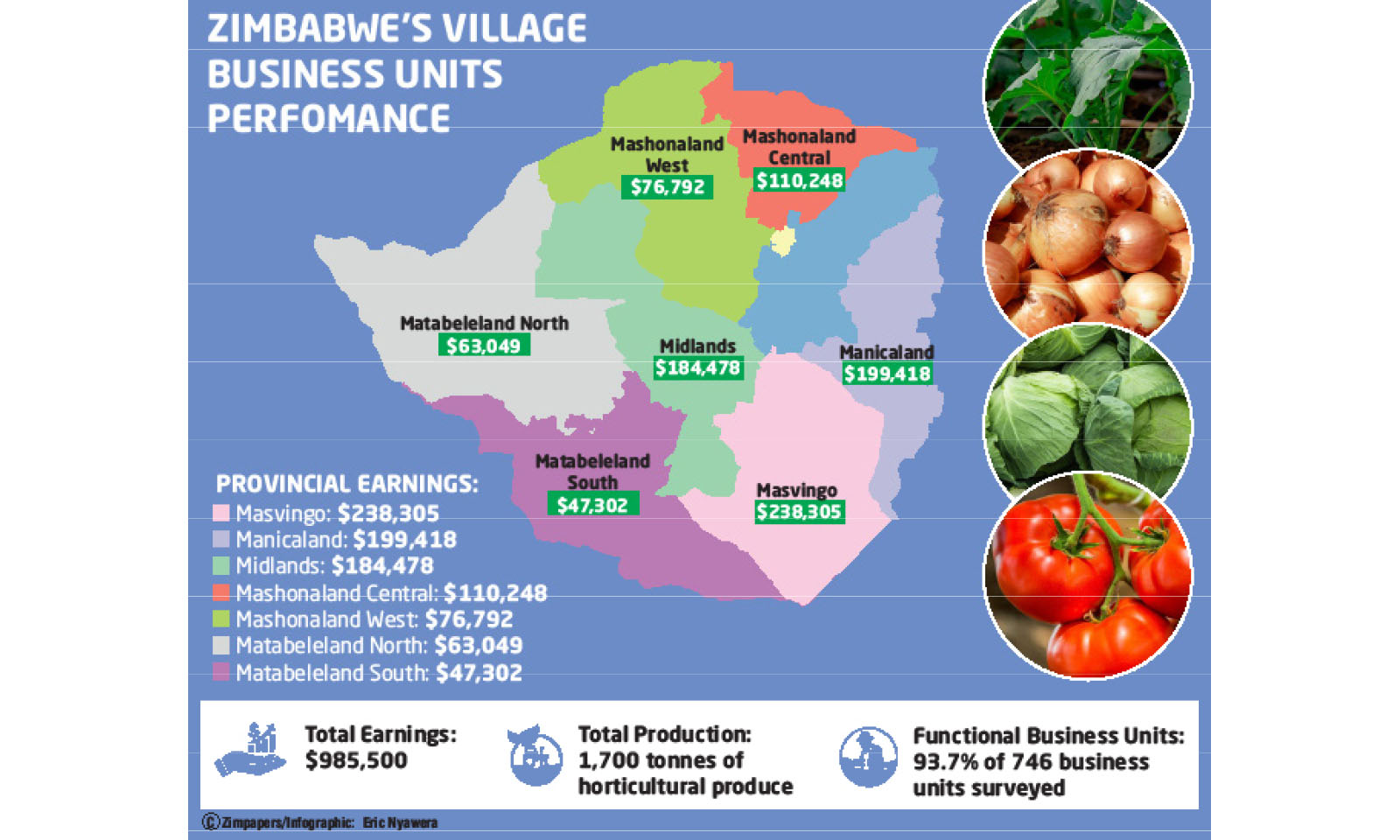
Precious Manomano
FARMERS from more than 700 business units established by the Government have earned close to US$1 million in the January to August period this year, a development that is boosting rural incomes and transforming livelihoods.
According to the 2024/2025 Post-Harvest Survey Report released by the Zimbabwe National Statistics Agency (ZimStat) last week, farmers working under 746 business units produced over 1 700 tonnes of assorted horticultural produce, mainly tomatoes, cabbages, onions, leafy vegetables, Irish potatoes and butternuts.
The report shows that total production included 504 tonnes of tomatoes, 376 tonnes of cabbages, 98 tonnes of Irish potatoes, 136 tonnes of onions, 510 tonnes of leafy vegetables and 82 tonnes of butternuts.
Altogether, these sales generated an estimated US$985 500 during the first eight months of the year.
Farmers in Manicaland province earned around US$199 418, while those in Mashonaland Central realised US$110 248.
In Mashonaland East, earnings reached US$65 863 and Mashonaland West farmers pocketed US$76 792.
Farmers in Matabeleland North earned US$63 049, those in Matabeleland South generated US$47 302, Midlands farmers recorded US$184 478, while Masvingo topped the list with US$238 305.
ZimStat indicated that out of the 746 business units surveyed, 93,7 percent were fully functional, while 6,3 percent were non-functional, mainly due to low-yielding boreholes, pump breakdowns or manually operated water systems.
Permanent Secretary in the Ministry of Lands, Agriculture, Fisheries, Water and Rural Development Professor Obert Jiri said success of business units depends on active community participation.
“We anticipate that the entire village will rally behind the business unit to ensure its operational success,” said Prof Jiri.
“This initiative goes beyond just farming; it is about creating a sustainable economic model that empowers families and fosters community spirit. By working together, villagers can ensure food security, which is critical.”
A business unit is a community-based agribusiness model designed to promote income generation, food security and self-reliance at the village level. It brings together local farmers to produce, process and market agricultural products collectively, thereby creating viable income streams and improving household nutrition.
So far, the Government has established 50 business units in Manicaland, 151 in Mashonaland Central, 63 in Mashonaland East, 72 in Mashonaland West, 46 in Matabeleland North, 60 in Matabeleland South, 132 in Midlands and 172 in Masvingo.
The report also recommends improving rural infrastructure, particularly roads and transport services, to enhance post-harvest management.
Upgrading roads, it says, will facilitate faster delivery of produce to markets such as the Grain Marketing Board, reducing spoilage and transport costs.
ZimStat further encouraged the formation of farmer cooperatives and better access to market information to strengthen farmers’ bargaining power and enable informed production and pricing decisions.
Access to affordable financing was also highlighted as essential for farmers to invest in post-harvest technologies, such as storage facilities and processing equipment.
The post-harvest survey sought to collect accurate data on actual crop production, current stocks, storage methods, seed use and livestock conditions, thereby providing critical insights to guide agricultural policy formulation.
Experts say the success of the village business unit model underscores the Government’s broader efforts to industrialise rural economies, empower smallholder farmers and ensure that every village becomes a hub of productivity and prosperity.
What is a village business unit?
A village business unit (VBU) is a community-based agricultural enterprise model introduced by the Government under the Rural Development 8.0 programme.
It is designed to transform rural communities from subsistence farming to commercial, income-generating agribusinesses.
Each unit is typically established at village level and is centred around a solar-powered irrigation system, enabling farmers to produce crops throughout the year regardless of rainfall patterns.
The VBUs usually include a fenced nutrition garden, a borehole equipped with a solar pump and drip or sprinkler irrigation infrastructure to ensure efficient water use.
Objectives
The main goal of a VBU is to promote food security, nutrition and income generation among rural households.
It aims to empower villagers, especially women and the youth, to participate in structured, profitable agricultural production.
VBUs are part of the Government’s broader rural industrialisation thrust, which seeks to ensure that every village becomes a centre of production, value addition and trade.
By encouraging collective production and shared management, the model fosters community ownership, cooperation and self-reliance.
Typical enterprises within a VBU include:
- Horticulture: Production of vegetables such as tomatoes, cabbages, onions, leafy greens and butternuts.
- Poultry or fish farming: Depending on water availability, some VBUs incorporate aquaculture or poultry to diversify income.
- Value addition: Some units process produce into dried vegetables, sauces or juices, extending shelf life and improving returns.
Structure
A VBU is generally managed by a village committee under the supervision of local agricultural extension officers.
Members contribute labour, share proceeds and reinvest profits into expanding production or improving infrastructure.