Lovemore Kadzura
Post Reporter
A PROLONGED dry spell across parts of Manicaland Province has raised fears of widespread crop failure, threatening what had initially been a promising start to the farming season.
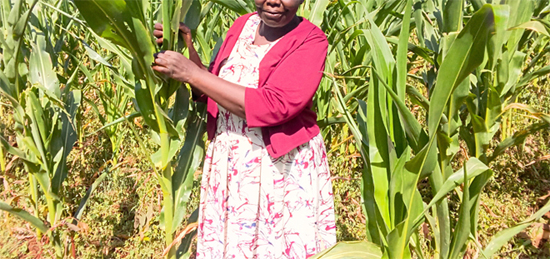
The relentless heat has severely stressed crops: maize is wilting, while tobacco is showing signs of false ripening due to excessive temperatures.
In some areas, farmers have endured an entire month without rainfall, leaving them deeply anxious about their livelihoods and food security.
The timing of the drought has been particularly devastating.
Many crops were in the vegetative stage, while others had begun tasselling—critical growth phases that depend heavily on consistent rainfall. Smallholder farmers, who rely almost entirely on rain-fed agriculture, are among the hardest hit.
Yet, amid the challenges, traditional grains such as finger millet, groundnuts, round nuts, and rapoko have demonstrated remarkable resilience.
Their drought-tolerant nature has allowed them to remain in good condition, offering a glimmer of hope in an otherwise bleak situation.
Farmers now wait anxiously for the weekend’s forecast, which could determine the fate of the province’s agricultural sector.
If rains fail to arrive, the consequences could be severe, compounding the already dire conditions and leaving crops increasingly vulnerable.
Middle Sabi Farmers Association chairman, Mr Skumbuzo Todhlana, confirmed that rainfall was last received three weeks ago.
He noted that maize and rapoko are beginning to wilt, while irrigation efforts have stalled due to power disconnections linked to outstanding debts with the electricity supplier, ZESA.
“The dry spell here has prolonged and our crops are under severe threat. Farmers had planted mainly maize and rapoko. This region is generally very hot and the temperatures of the past three weeks are taking a toll on the crops. The maize is at the flowering stage, which requires a lot of water for it to produce a healthy cob.
“In the past, we used to supplement rainfall with irrigation, but the irrigation schemes were switched off by the Zimbabwe Electricity Supply Authority due to farmers’ debts. We have been left exposed. The water is abundant in Save River, but we cannot use it to irrigate our crops without power. A solution must be availed so that we keep on producing grain in large quantities for the nation to benefit,” he said.
A tour of Buhera District last week revealed that maize was still in good condition, especially for farmers who applied fertilisers – for those who did not, their crop was already wilting.
Tobacco Farmers union Trust (TFUT) president, Mr Edward Dune said due to lack of water and excessive heat, dry land tobacco is experiencing false ripening, which ultimately affects the leaf quality.
He urged farmers to invest in irrigation, which is reliable and produces reliable results.
“If there is excessive heat, there will be an imbalance of metabolic processes, which results in premature ripening. It is a disaster because farmers are forced to reap the poor-quality leaf.
“For dryland crops, the yield is compromised. If we receive the rains in the next four or five days, some crops can still recover.
“The advice to farmers is to invest in irrigation infrastructure, even starting small with solar-powered boreholes. The small centre pivots that irrigate three to five hectares are still beyond the reach of small-scale farmers. With climate change, relying on rainfall only is no longer advisable because the rain is not reliable,” he said.
However, the Meteorological Services Department (MSD) has since made assurances that the rains are returning.
The forecast aligns with projections from the 32nd Southern African Regional Climate Outlook Forum (SARCOF-32), which indicated that countries in the Southern African Development Community, including Zimbabwe, should expect normal to above-normal rainfall between February and June. The MSD says a return to normal rainfall patterns began on Friday, offering renewed hope for crops that had begun to show stress under dry conditions.
The MSD forecasted mixed weather conditions from yesterday to Wednesday, with scattered showers mainly in central and northern Zimbabwe, and drier conditions in the south.
Farmers fear losses as heatwave hits province