Online Reporter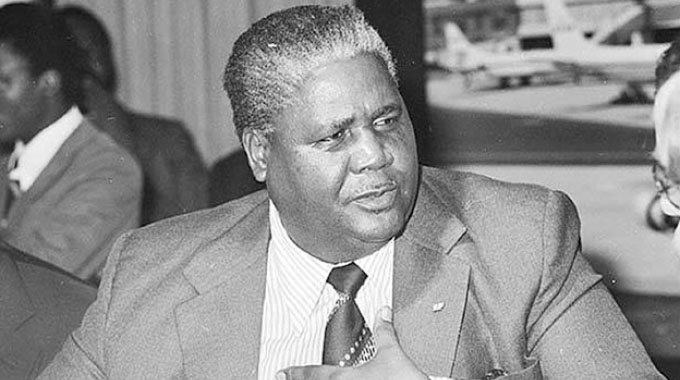
Elliot Ziwira
It is 27 years since the passing of Vice President Dr Joshua Mqabuko Nkomo, affectionately known as Father Zimbabwe, Chibwechitedza and Umdala Wethu, who died on July 1, 1999, aged 82.
Yet, as human beings, revolutionaries may die, but their ideas and legacies endure. As the Burkinabe revolutionary Thomas Sankara once observed, while revolutionaries perish, their ideas live on.
So, it is with Father Zimbabwe. Dr Nkomo’s immense contribution to the liberation of the Motherland remains enduring testimony to his selfless love for his country, his unwavering commitment to unity and his lifelong dedication to the upliftment of the oppressed.
Today, we remember the iconic son of the soil through his own words — reflections made over more than three decades of confronting colonial injustice and pursuing his enduring dream of one people, one nation.
A life devoted to the land and freedom
The land, the African’s heritage, identity and lifeline, lay at the centre of his political philosophy. His dream was to see his people living freely on the land of their ancestors, united in dignity and purpose.
Addressing a nationalist gathering of about 5 000 people in Mufakose, Salisbury (now Harare), on October 12, 1963, Dr Nkomo declared: “We have come here today because of the call of our land.
“You are part of a great struggle to free a great continent, and now you have a duty to free Zimbabwe. We are coming to an end of that struggle. With only two or three months left, we must prepare and see to it there is unity everywhere,” (The Sunday Mail, October 13, 1963).
His actions consistently matched his convictions.
Conviction in the face of persecution
In August 1963, he pledged his car, valued at £250, towards the £350 bail granted by the High Court in Bulawayo for his friend and former senior official of the banned party, Jason Ziyaphapha Moyo. Mr L. Kunaka contributed the remaining £100.
Months earlier, in October 1962, Umdala Wethu had been placed under restriction at his birthplace in Kezi, then in the Semokwe Reserve, Plumtree District, near St Joseph’s Mission, where he shared a thatched hut with three relatives.
Journalists from across the world descended on the remote village. As the Evening Standard reported on October 24, 1962, NBC and BBC television crews erected cameras on tripods while reporters milled around the homestead, turning it into “something like a film lot”.
To the assembled journalists, Dr Nkomo remarked: “This is the last interview I will give in English. The English language represents what has put me here today.”
Earlier that month, supporters from across Southern Rhodesia presented him with a brand-new Vauxhall while he remained under restriction.
When a journalist asked what use such a vehicle would be to a restricted man, he replied with characteristic humour: “Perhaps I’ll take a daily ride round my three-mile restriction limit.
“Now my people are making my stay here as comfortable as possible. Visitors from all over have brought me everything I need in the way of food, live goats and two dozen chickens,” (Evening Standard, October 11, 1962).
Even amid war, Dr Nkomo consistently preached reconciliation over revenge.
Reconciliation over revenge
On September 15, 1979, he assured Zimbabwe-Rhodesia’s white community that the Patriotic Front had no intention of persecuting them because there was no “charter of fear” in its constitutional vision.
He said: “We can assure our white fellow citizens that we accept them as we accept ourselves. They have nothing to fear.”
Borrowing from Jim Reeves’ song “A Stranger’s Just a Friend”, he added: “A stranger is just a friend you do not know. It is possible that’s their problem. We are friends they do not know,” (The Sunday Mail, September 16, 1979).
Unity above ethnicity, race and colour
At the Geneva Conference in October 1976, Dr Nkomo told journalist Denis Sargent that the Patriotic Front, bringing together ZAPU and Robert Mugabe’s ZANU, was established to endure because both liberation movements were “fighting to build a nation of people, not of tribes or nations, or colours.”
He explained: “In the few weeks of its existence, it appears we are getting closer and closer. Much more understanding is developing between us.
“We are working for harmony. It is very important for the two liberation movements with some sort of armies to harmonise to avoid the possibility of a clash.
“If these young people can be turned into a regular force to defend the independence of their country that they had been fighting to achieve, it could save the country from the horrors of civil war.”
Speaking of Zimbabwe’s future, he rejected racial politics altogether.
“No one is fighting white people as white people. I have struggled almost 30 years to remove an evil, the separation of people by races.
“I could not at the end of it find myself applying what I was fighting against. We regard people as people, and white people as people like ourselves, with the emphasis on the people, not on the white. Those of our white friends in that country, who decided to make that country their home, are just as much citizens as anyone else. The future we are fighting for is a future of respect for human rights.
“I could never be party, nor could my colleagues, to a regime which relegated the rights of other people to a position of inferiority because they were a minority in the country.”
Beginning of a new Zimbabwe
Still in Geneva, on October 24, 1976, Dr Nkomo addressed the people back home: “We have come here to do a job that will sort out the injustices we have been fighting for years. We are in Geneva today to work out a constitution that will give the people of Zimbabwe the right to choose their own Government.
“I hope that those who are in control of the country and the people realise the responsibilities on their shoulders. The struggle nor the dangers are yet over. But we are at the beginning of the end of the problem,” (Rhodesia Herald, October 25, 1976).
Unity remained the thread running through his political life.
Enduring pursuit of national unity
During negotiations between PF-ZAPU and ZANU-PF on March 14, 1987, he said: “We are doing everything in our power to achieve unity and we believe we shall achieve it. If unity fails, we must give an account of why it failed. But when you bring groups of people together, they must be prepared to forgo some of their rights.
“This happens if our unity is to be meaningful. This must apply to both sides.”
By 1988, his focus had shifted from liberation to nation-building.
“The first struggle, that of liberation, is over and now we are faced with the struggle to create a nation and for development to eliminate the problems that have faced us for almost a hundred years,” he said.
Freedom belongs to the people
Addressing about 5 000 people at Mandava Stadium in Zvishavane on February 16, 1980, Umdala Wethu reminded Zimbabweans that victory belonged to everyone, not only those who carried guns.
“This country wasn’t freed just by men with guns, as some will tell you.
“It was a combination of all of you. You must now combine to give a reasonable government that will see to it that this country is peaceful.
“There are stories going around that this country is going to be divided. It must not be divided, and all leaders must warn their followers against this sort of thing. Our primary task is to create one nation. All those fighters in unmarked graves died to liberate all of Zimbabwe as a single nation.
“Although we are independent, we are not fully free. We cannot be free if people are afraid to go from one place to another. It would be terrible — and what would the world say — if we used the weapons we got to free our country against each other.”
His message remained unchanged years later.
“We must unite and be an example,” he told The Herald on September 27, 1988.
Leadership as service
Opening Nkayi District Council in 1981, Umdala Wethu reminded councillors that leadership was about service.
“Councillors are there for the benefit of the people and must work for the development of the area. No country is without problems, and there will always be problems. As some problems are solved, new ones will arise. We must all work to solve the problems as they come,” (The Herald, March 30, 1981).
On land resettlement, he urged patience and responsibility.
“When you eventually get your land, make sure you know how to use it. We do not want to see this country turned into a desert,” (The Herald, March 30, 1981).
One people, one Zimbabwe
No statement captures Dr Nkomo’s vision for Zimbabwe more profoundly than the one he made at a rally in Victoria Falls on October 16, 1982.
“People of Zimbabwe are one and there is no Shona or Ndebele, but there is one Zimbabwe,” (The Sunday Mail, October 17, 1982).
Nearly three decades after Father Zimbabwe’s passing, those words continue to find resonance in the country’s national discourse.
Paying tribute to Dr Nkomo, President Mnangagwa has repeatedly urged Zimbabweans to honour the late nationalist not merely by remembering his name, but by living the values he championed.
“Our Father Zimbabwe . . . the message which he left us, which we would also wish to leave the nation of Zimbabwe, is unity, unity, love, love and harmony,” the President said on the sidelines of a Zimbabwe Prisons and Correctional Services pass out parade at Ntabazinduna, Umguza, Matabeleland North in 2021.
He added that Dr Nkomo always reminded Zimbabweans that the liberation struggle was fundamentally about the land and the people.
Recalling one of Dr Nkomo’s final messages, President Mnangagwa said: “I remember when he was feeling very ill, making this statement to the late President (Robert) Mugabe that, ‘If I go Cde, I want unity, keep our land, give it to our people.’”
That message remains as relevant today as it was during the struggle for liberation. Indeed, President Mnangagwa has consistently stressed that Zimbabwe is “a unitary State” in which no ethnic group, language or culture is superior to another, and that differences should always be resolved through dialogue, peace and reconciliation; ideals that Dr Nkomo dedicated his life to advancing.
Twenty-seven years after his passing, Father Zimbabwe’s voice continues to echo across generations. His words timelessly remind Zimbabweans that the struggle for freedom was never merely about ending colonial rule, but about building a united nation founded on justice, equality, peace and shared destiny.