Chronicle Editor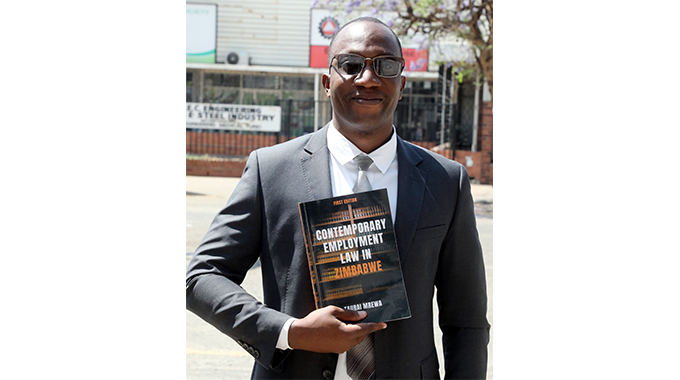
Peter Matika, [email protected]
SOME 20 years ago, Mr Taurai Murewa, experienced a traumatic incident that changed his life forever. It was an experience that brought disharmony and humiliation to his family.
Mr Murewa, witnessed his father being mistreated at his place of employment where he was dismissed from work without pay on allegations that could not be proven.
Seeing his distressed father failing to provide for their family hurt him so much that he was inspired to study law and be able to disseminate information to companies, workers, and employers on the intricacies of labour laws.
Mr Murewa recently published a book titled Contemporary Employment Law in Zimbabwe, which focuses on the employment relationship between employer and employee.
“When I was young my father was suspended from work without pay for a very long time. It brought so much hardship to my family to the extent that we failed to pay school fees or even enjoy proper meals,” he said in an interview.

“It’s an emotional experience, it’s something that happened 20 years ago. So, because of that, my mission has been to ensure that employees and employers are protected from issues that may arise in the workplace. “So, I grew up knowing very well that if a person is not aware of their rights, they can experience difficulties at work and with their families.”
A qualified lawyer and human resources professional, Mr Murewa said he decided to pursue this career to be able to better assist society. Earlier, he had pursued a degree in psychology but still felt he wanted something much more robust and empowering.
“Having spent over 10 years working in the field of human resources, I decided to pursue a legal career specialising in employment law. As a result, I have written this book as a contribution to both the human resources and labour law communities,” said Mr Murewa.
He said he hopes that the book will be taken up by companies to study and understand the finer concepts of the country’s labour laws.
“As you know the labour laws were amended recently and all that is contained in this book is in line with all current laws,” said Mr Murewa.
“It is, therefore, my sincere hope that this book will make a valuable and meaningful contribution to the ongoing conversation around employment law in Zimbabwe.”
He said his father assisted him in compiling some of the contents of the journal, as well as editing it before publishing.
“On completion of my law degree, I started writing and compiling notes on labour law, and the person who helped me and inspired me greatly was my father, Jack Murewa. From 2019 I have been writing and eventually managed to publish it,” said Mr Murewa.
The publication covers a wide range of important labour principles that employers and employees, trade unionists, workers committees, human resources, and lawyers must be conversant in.
The book contains 300 judgements that are used to illustrate points that are made in the book.
“In the first chapter, this book looks at 30 cornerstones of employment law in Zimbabwe. These are the building blocks of employment law. These cornerstones cover a wide range of topics that are relevant to any employment setup,” said Mr Murewa.
“The second chapter of the book contains a commentary on the Labour Amendment Act of 2023. The third chapter is dedicated to demystifying the Labour Court rules as amended in 2023.”
He said the fourth and final chapter of the book assesses more than 50 employment law court decisions that have a bearing on the employer-employee relationships.
“Case law is an integral component of our law as it provides consistency in judicial making. This chapter is important because many rules that affect the employment landscape are scattered in several court judgments that explain the Labour Act,” said Mr Murewa.
In compiling the book, he said he made a series of engagements with other legal practitioners in Bulawayo, where he was able to cite cases as examples of what labour law says when cases are being heard in court.
“Writing judicial works is not an easy task. It takes a lot of effort and time. There needs to be a system of friends, family, bosses, and co-workers who are a firm support and encouragement mechanism,” said Mr Murewa.



 Online Reporter