Chronicle Editor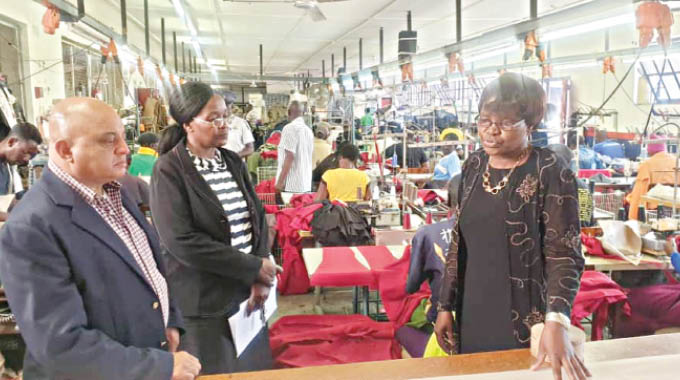
Pride Mahlangu, Business Reporter
ONE of the few companies in Bulawayo operating at full throttle, Justin Clothing Private Limited has appealed to Government to allocate foreign currency to all performing companies in the manufacturing sector.
The Government introduced the interbank foreign currency market in February last year on a willing-buyer-willing seller arrangement to address the challenges previously faced by companies in sourcing forex to acquire raw materials and spares.
However, of late concerns have been raised by the private sector that forex was still not easily accessible on the interbank market.
In an interview on Wednesday, Justin Clothing merchandising director Mrs Christine Dube-Huni said as access to foreign currency still remains a challenge, she urged the Government to consider forex allocation to firms that were operating at full capacity to enhance their participation to the national vision through job creation.
“As a manufacturing company, we order raw materials from outside the country using forex. At the present moment we are having challenges of getting foreign currency on the interbank market and this sometimes delays our orders,” said Mrs Dube-Huni.
“We want the Government to stand with us in forex allocation. As manufacturers we take care of citizens by creating employment and we pay our taxes out of everything that we could have sold and this leads to the development of the nation.
“We want the Government to have an upper hand in apportioning surviving companies with foreign currency so that conducting business becomes easy and we move forward through production.”
During a tour of Justin Clothing by Industry and Commerce Deputy Minister Raji Modi in August last year, the firm announced that it was producing at 100 percent capacity despite the prevailing macro-economic challenges.
Mrs Dube-Huni said the lack of access to forex was one of the major challenges frustrating their ability to operate more efficiently and contribute to economic development through payment of taxes in line with the Government’s vision of making Zimbabwe an upper middle-income economy by 2030.
She said power supply constraints were also hindering productivity in the manufacturing sector, adding that it was imperative for the Government to quickly find a lasting solution to the challenge.
The country was experiencing power challenges due to lack of investment in power generation projects in recent years.
As a result, the equipment at Zimbabwe’s power stations were antiquated, resulting in constant breakdowns. Low dam water levels at Zimbabwe’s major power plant, Kariba Hydro-electric plant is also contributing to the electricity shortage.
To address the power challenges as a long-term solution, the Government, among others, has embarked on expansion of the existing power plants through the addition of generation units , for example at Kariba and Hwange. – @pridesinstinctz.



 Online Reporter