Chronicle Editor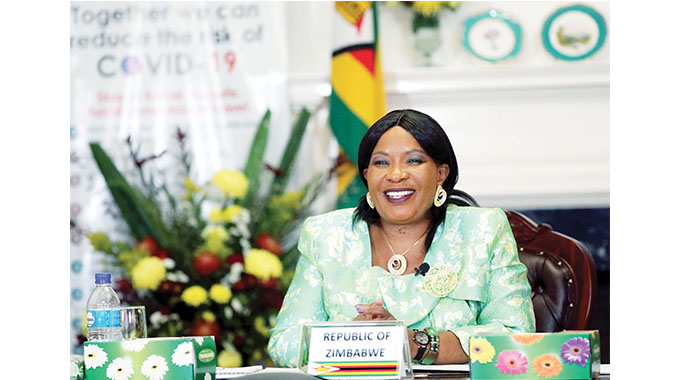
Harare Bureau
NATIONS can build a future that is free of gender discrimination if young men and boys are reached out with programmes that redefine manhood, increase their perception of themselves as responsible, caring, and non-violent partners and promote gender-equitable attitudes.
This was said by the Organization of African First Ladies for Development (OAFLAD) during a presentation made by its vice-president and Zimbabwe’s First Lady Auxillia Mnangagwa at a virtual meeting held on the sidelines of the United Nations General Assembly (UNGA) on “engaging men and boys to advance gender equality”.
OAFLAD outlined its efforts to achieving gender equality to various empowerment programmes which it is prioritising for this year.
The organisation stated that it continued to resolutely advocate for gender equality and empowerment of women across the continent.
Speaking on behalf of OAFLAD, Amai Mnangagwa said gender equality and women empowerment were important agendas of ensuring sustainable socio-economic development globally and in the African region as envisioned in SDG goal 5.
To achieve this, it requires buy-in from men and boys.
“It is key to reach young men and boys with programmes that redefine manhood, increase their perception of themselves as responsible, caring, and non-violent partners and promote gender-equitable attitudes if we intend to ensure a future that is free of gender-based discrimination,” she said.
Some gender equality movements and initiatives, she said, failed to bring the anticipated results because they did not involve men.
“Most gender equality initiatives are led by women and girls and rarely are open for men and boys to take part. It is important to frame gender equality as an issue that men and boys have a stake in and actually benefit from. This could be an effective way to motivate men to get more involved and some women to be open for discussion.”
The African First Ladies expressed their appreciation to spouses of Caricom leaders action network (SCLAN) for affording them a chance to share their position with the international community.
On the local front, Amai Mnangagwa has been pivotal in strengthening women empowerment and gender equality through programmes hence her travels across the length and breadth of the country attending to issues that affect the citizens.
She said since the inception of OAFLAD in 2002, African first ladies had resolutely advocated gender equality and the empowerment of women across the continent.
“Achieve gender equality and empower all women and girls and Agenda 2063 goal 17: full gender equality in all spheres of life.”
The African Union (AU), she said, had developed various frameworks to support gender equality and women’s empowerment at the regional level.
“These frameworks are used as a guide for the development of national policies and programmes. Some of the popular frameworks in this regard include The Protocol On The Rights Of Women In Africa, the Maputo plan of action on sexual and reproductive health and rights; and the Framework For Action And Recommendations On Harmful Traditional Practices in 2011. African governments have also passed the declaration of 2010-2020 as the African Women’s decade, which is an indication to the importance accorded to gender equality. These efforts indicate that over the years, African governments have committed to adopt global agreements on gender equality and women empowerment at regional and national levels,” she said.
African first ladies through their organisation, Oaflad had collaborated with various stakeholders to hold governments accountable for the commitments they signed over the years, in various ways involving a multi-stakeholder campaign called “Right by her”, which strives to make gender equality to move from paper to reality.
“Despite the efforts mentioned above, there are still gender-related inequities that need to be addressed such as: harmful practices, early child and forced marriages and female genital mutilation; discrimination and unequal participation and opportunities for leadership at all levels of decision-making in political, economic and public life; domestic violence; lack of universal access to sexual and reproductive health and reproductive rights; unequal education opportunities, even though the gender gap on education is rapidly closing due to intensive promotion of girl child education.
“An emerging challenge is that there are limited programmes and initiatives to ensure inclusivity of the male in education and in sexual and reproductive health and reproductive rights. These are gaps that can be addressed through advocacy, community mobilisation, resource mobilisation and ensuring strategic partnerships.
“We, at Oaflad believe that this is an opportune moment to discuss gender equality and women empowerment particularly where gender inequality and violence have been exacerbated during this time where Covid-19 has had a huge, economic, psychological and social impact in our communities, leaving women as victims. Expressing our concern, we issued a joint statement with plan international to draw attention to the risk of an increase in the incidence of violence, in particular against women and girls, which could be triggered in a state of panic and mandatory confinement initiatives,” she said.
The involvement of men, Amai Mnangagwa said, was crucial to ensuring that women’s rights were respected and their potential tapped for the betterment of their communities.
“It is important to not only make men part of the discussion of the women equality agenda, but also encourage them to become solutions and take visible action to ensure women’s advancement in life,’’ she said.


 Online Reporter