

 Online Reporter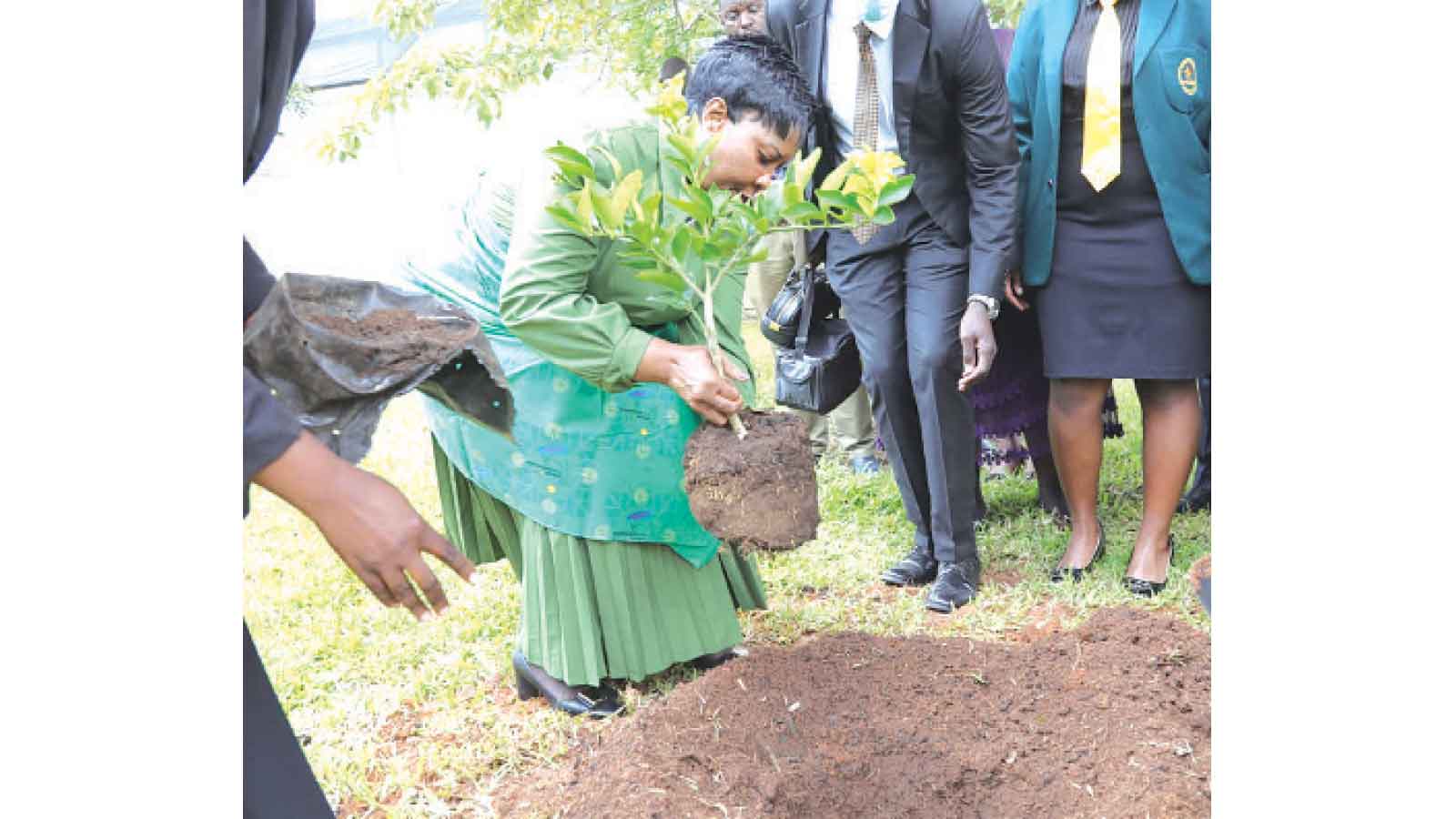
Environment Patron, First Lady Dr Auxillia Mnangagwa, recently rallied communities to embrace tree planting as a lifelong responsibility, saying every citizen has a role to play in building a greener and healthier Zimbabwe.
Dr Mnangagwa made the call while leading a tree planting programme at the magnificent Trabablas Interchange, a modern landmark whose sweeping flyovers and seamless traffic flow now stand as a symbol of national progress and collective effort.
Set against this impressive infrastructure, the First Lady planted an indigenous muunga tree (acacia fever), which has been the Tree of the Year since 2023.
The exercise forms part of a national campaign launched by President Mnangagwa in Mutare, aimed at restoring forest cover while enhancing the country’s towns and cities.
Tree planting is fast becoming a unifying national movement, with communities across Zimbabwe answering the call to green their surroundings and safeguard the future.
This spirit of collective action was on display at Trabablas Interchange as the Patron of Environment, Dr Mnangagwa, brought together Government officials, private sector players, and local residents who took a leaf from the First Lady and also planted their trees.
Among them were Environment, Climate and Wildlife Minister, Dr Evelyn Ndlovu, Deputy Minister of Transport and Infrastructural Development and Zanu PF’s Deputy Secretary for Environment, Joshua Sacco, Permanent Secretary in the Office of the Minister of State for Provincial Affairs and Harare mayor Councillor Jacob Mafume, among others.
In her address, Dr Mnangagwa said cities and towns across Zimbabwe are set to become greener and healthier as the national tree planting programme continues to gain momentum, with communities encouraged to embrace tree growing as a shared responsibility for environmental sustainability.
“As we gather at this venue, it is not only about planting trees but to plant a vision of beautification of cities and towns in this country. See tree planting not as an occasional event, but as a lifelong commitment.
“The importance of tree planting as one of the means to restore our lost trees and forests cannot be overemphasised.
“It is, however, the survival of such planted trees that determines whether or not we are making the desired progress in our endeavours as a nation,” she said.
Dr Mnangagwa said tree planting was more than a ceremonial activity, describing it as a practical investment in cleaner air, climate resilience, and healthier living spaces.
The Patron of Environment said the tree planting initiative is already yielding positive results, with the Forestry Commission reporting that 27,2 million trees had been planted nationwide against a target of 30 million by the end of the season.
“This is testament to the collaborative effort from various stakeholders and I strongly believe that, as a nation, we can surpass the set target. It is my clarion call that everyone should consider planting trees before the end of the tree planting season.
“The act of planting a tree may seem simple, but its significance is profound. A tree is more than a living organism rooted in the soil; it is a guardian of our environment, a silent worker that labours day and night to purify the air, to store carbon, and to provide shade and shelter.”
Dr Mnangagwa added: “In our urban centres, where concrete and steel dominate the landscape, trees become the lungs of the city. They absorb harmful pollutants, filter dust, and release oxygen, reminding us that our health is inseparably linked to the health of our environment.”
The First Lady said Trabablas must be remembered as the place of renewing the pledge to live in harmony with nature, with the planted trees growing tall and strong, standing as living monuments to a vision of a Zimbabwe that is beautiful, healthy, and sustainable.
“As the Patron of Environment and Tourism, I am deeply committed to advancing initiatives that improve the health and wellbeing of our people. Tree planting is one such initiative, and it requires the participation of all sectors; Government, private institutions, schools, churches, and communities.
“Each of us has a role to play. Let us not see this as the responsibility of a few, but as the duty of all. Imagine if every household planted a tree, if every school nurtured a small orchard, if every business contributed to greening its surroundings. Together, these



