admin
admin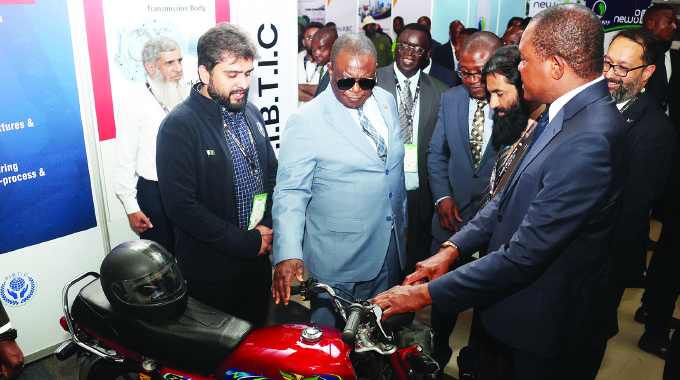
Mukudzei Chingwere
Herald Reporter
THE country’s research ecosystem must actively come on-board and play a critical role in Government’s quest to enhance value addition and beneficiation in the entire agricultural value chain to boost export earnings and create jobs, Acting President Dr Constantino Chiwenga said yesterday.
In his address to the inaugural Research for Agricultural Excellence Indaba at the Zimbabwe Agricultural Show (ZAS) in Harare, the Acting President said the Research Council of Zimbabwe and ZAS should endeavour to promote use of research results in informing sustainable agriculture practices by linking researchers to industry, farmers and other stakeholders.
The indaba sought to highlight the centrality of research in underpinning the Government’s quest for enhanced agriculture production in Zimbabwe’s agro-based economy.
The Acting President challenged participants to quickly come up with tangible solutions for research-based agriculture that could be showcased next year and move away from just celebrating blueprints without results.
“The plan is broadly anchored on improving animal health, genetics and nutrition among others,” he said.
“The role of research in this matrix is to proffer innovative, scientific and actionable solutions to support this strategy.
“I therefore, urge you to think boldly out of the box and come up with research programmes which the country can leverage on to improve agricultural and industrial production and productivity”.
He said there are critical issues in the agriculture sector, which need to be led and driven by scientific research.
The Government, he said, was geared to climate proof agriculture in a bid to ensure food and nutrition security.
“Beyond that, the Second Republic remains committed to enhancing value addition and beneficiation in the entire agricultural value chain to boost our export earnings and create jobs”.
He said it was pertinent to redirect research efforts to solve contemporary and emerging challenges in the agriculture sector.
“Let this indaba be a catalyst for a new era of research-driven agricultural policymaking in Zimbabwe, one that improves food security, strengthens livelihoods, and secures a sustainable future for generations to come,” he said.
He said it was incumbent on all to ensure the realisation of President Mnangagwa’s strategic direction of transforming the agriculture sector through the Agriculture Food Systems and Rural Transformation Strategy and Agriculture Recovery Plan.
He said the research ecosystem should come up with findings that transform the country’s agricultural landscape through harnessing research that delves deep into the complexities of farming systems.
The indaba is running under the theme: “Research and innovative solutions for sustainable agri-business development.” This dovetails with the Government’s aspirations for a prosperous and food-secure Zimbabwe.
He reaffirmed his conviction that all that was needed is pragmatic research that informed policies and programmes that shaped the future of the agriculture sector.
“I challenge you to listen, to learn, and to act. Embrace the power of research, create the conditions for innovation to thrive, and ensure that your decisions are grounded in evidence and guided by the needs of our farmers and our communities.
“By doing so, we can realise the transformative potential of Zimbabwean agriculture, not just for today, but for generations that will follow,” he said.
The Acting President hailed some universities and colleges for coming up with innovative research solutions which were being used in the country’s agricultural value chain.
He said the few examples illustrated the immense potential that lay at the intersection of research and policymaking.
The Acting President said there was a need to forge a path towards a Zimbabwe where agricultural prosperity was not just a dream, but a reality where farmers were empowered and communities thrived with natural resources being sustainably managed.
Lands, Agriculture, Fisheries, Water and Rural Development Minister Dr Anxious Masuka said he and Higher and Tertiary Education, Innovation, Science and Technology Development Minister Professor Amon Murwira were pushed to action by the disconnect between ideas and practice.
“First we sought to bridge that gap and we said how do we create a research ecosystem that allows the manifestation of ideas, ideas that solve society issues so that there is progress in agriculture.”
Industry and Commerce Minister Mangaliso Ndlovu said his ministry was in the process of developing the Zimbabwe Industrial Reconstruction and Growth Plan.
This plan would detail strategies to be taken to address the manufacturing cost drivers, strengthening of value chains, promoting industry and research through innovation hubs.
“This indaba provides a unique platform for Government, the private sector, farmers, academia and development partners to come together and identify key national research priorities in the agricultural sector and discuss innovative strategies and the commensurate interventions,” said Minister Ndlovu.
“Sixty percent of the manufacturing sector’s raw materials come from the agricultural sector, while the agricultural sector equally relies a lot on the manufacturing sector for its inputs.
“It is therefore critical that this interdependence is well understood, nurtured, protected and promoted for the mutual growth of both sectors and our economy,” said Minister Ndlovu.



 Online Reporter