admin
admin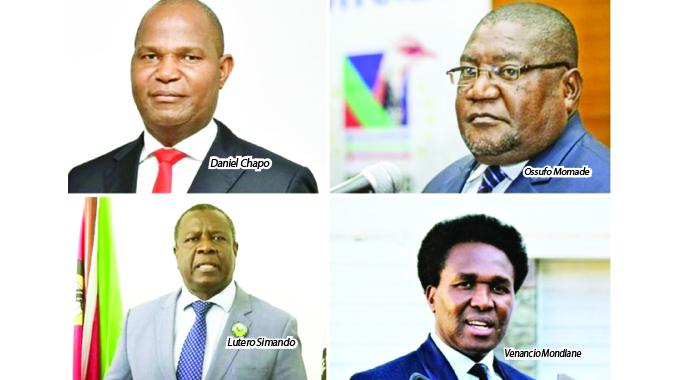
Ranga Mataire
Zimpapers Politics Hub
In less than a month, Mozambicans go to the polls on October 9, 2024 to decide on who will govern them for the next five years.
Frelimo settled on Daniel Chapo, an outsider from the usual candidates born before the country’s independence as its presidential candidate.
The ruling party’s candidate has excited the electorate by presenting himself as an ordinary man who understands ordinary peoples’ aspirations and needs.
But will it be an easy ride for Frelimo, the party that has ruled Mozambique since the country attained independence on 25 June, 1975?
Although Chapo is the odds-on favourite, the elections are not going to be a walk in the park.
At least 37 political parties and associative movements are contesting for seats but only four candidates have come forth to contest the presidency.
More than 17 million voters are registered to vote in the October 9 general election, including more than 300,000 people registered outside Mozambique.
These will be Mozambique’s seventh general elections since the advent of multiparty democracy in 1994, two years after the government signed a peace deal with Renamo to end a 16-year civil war that killed an estimated 1 million people.
The country has held elections on time over the last 20 years, a departure from the turbulent years of civil and more recently, an insurgency in the north. But now appears stable and as what outgoing President Filipe Nyusi said, it is the first time in three decades that Mozambicans are voting in an election without an armed party.
President Nyusi last week described the prevailing environment as “the fruit of the peace and reconciliation” built together by Mozambicans citizens who go to the polls with good conscience for the candidate and party of their choice.
So, who are the presidential frontrunners? Frelimo’s Chapo is facing competition from three other candidates – Ossufo Momade of Renamo, Lutero Simango of the Movement Democratic of Mozambique (MDM) party and Venancio Mondlane- an independent.
Analysts put the real tussle to be between Frelimo’s Chapo and independent candidate Mondlane. Both are relatively young candidates who have excited their respective bases.
Mondlane has been a member of Renamo until the party’s congress disqualified him for not meeting the profile requirements defined in the party’s constitution. Despite appealing to the courts to force the inclusion of his candidacy, his party congress did not alter the list of candidates put to the vote or allow him to enter the main meeting. It was after his disqualification that Mondlane decided to stand as an independent.
Running under the slogan “Save Mozambique! This country is ours!”, Mondlane stated his campaign in a Maputo suburb, where he promised to create an honest and transparent government and remove Mozambique from the list of the poorest countries in the world.
“We want to put an end to a partisan state once and for all. We want a clean state, a state that works for the people and by the people. We want the resources exploited in the provinces to be used in projects in the provinces to develop those regions,” Mondlane told hundreds of supporters in Maputo as he began his campaign last week.
Unlike Mondlane, Chapo has lots of advantages up his sleeves. He is a candidate of a ruling party that has been in power since the country got independence in 1975 from Portugal. He is essentially supported by a whole government machinery. But besides being a candidate for the biggest political party in his country, Chapo’s own resume makes him an amenable candidate to a large section of voters.
Frelimo’s presidential candidate entered politics in 2009 when he was appointed administrator of the Nacala-a-Velha district. Six years later he became administrator of Palma District and the next year he became the governor of Inhambane Province. He was the most popular candidate when Frelimo went to the polls on 5 May 2024 when he garnered 225 votes (94 percent of the votes) against other aspiring party cadres.
Chapo is fluent in his native mother-tongue, Portuguese and English and is a former radio announcer. Connecting with the public appears to be his forte- as he is seen dancing and laughing with voters in an easy go kind of way.
Analysts view Chapo as a leader who may be able to restore security in the troubled oil- and gas-rich province of Cabo Delgado, where Islamic State-linked insurgents have been terrorizing civilians and destroying public infrastructure since 2017, forcing the interruption of multibillion-dollar projects. Many voters view him as incorruptible and are pinning their hopes on his vision of a united and peaceful Mozambique.
Speaking last Saturday during a campaign rally in the central city of Beira, the Frelimo presidential candidate emphasized the need to combat bureaucracy
“We want to combat bureaucracy, combat corruption and create laws that facilitate a good business environment, so that investors, whatever national or foreign, can come and invest in Mozambique,” said Chapo, an indication of his belief in a market free economy, different from the Marxist dictates of the early independence era.
He hopes that massive investments into his country would be able to create jobs, more stable salaries and companies will pay more taxes. His candidature represents a continuation of Frelimo’s liberation ethos but in a more robust way that is conscious of the global market trends.
The other contender, Lutero Simango of MDM, took over the leadership from his brother Diaz Simango when he died in 2021, who two years earlier also ran for president.
Simango is the son of the late Uria Simango, founder and vice president of Frelimo during the armed struggle against the Portuguese colonial regime.
Among other pledges, Simango is promising to create a pharmaceutical industry and implement tax cuts if elected.
“We will create and build a national pharmaceutical industry, we will produce all basic medicines here in Mozambique, to ensure that our hospitals have medicines,” said Simango at a rally marking the start for the general elections in the city of Beira, Sofala province, central Mozambique.
On the economic front, Simango is pledging to reduce Value Added Tax (VAT) from 16 percent to 14 percent, to reduce the cost of fuel and prices of basic commodities. He is also advocating for the establishment of industries to process raw materials to allow the country to retain surplus value through processing.
“Our goal is to win political power through a democratic procedure, and this is going to happen now, on 9 October,” Simango declared.
The downside of Simango’s bid is that his party is viewed as the perpetuation of dynastic succession after replacing his own brother, Diaz, after his death in 2021.
On the other end of the political spectrum is Ossufo Momade from Renamo.
He is no newcomer to the presidential contest. He has been the president of Renamo, the main opposition party of Mozambique since January 17, 2019 following the death of Afonso Dhlakama in May 2018.
On August 1, 2019, Momade agreed to renounce violence and signed a peace pact with President Nyusi.
A second peace agreement was signed in Mapotu’s Peace Square, where Momade declared he and Renamo members would now focus on “maintaining peace and national reconciliation.”
He was one of the losing candidates in last general elections in 2019, coming second with just under 22 percent of the vote, with Frelimo’s Filipe Nyusi of the governing party, being re-elected as head of State, with 73 percent of the votes.
Many Renamo supporters were of the view that he should have passed the leadership baton to Mondlane and feel that the whole process that elected Momade was fraught with chicanery. When Mondlane announced his intention of running for the Renamo presidency, Momade supporters devised ways to stop him by adopting a profile which all candidates were supposed to fit. The rules seemed to exclude Mondlane, especially one that said that one should have been a member of the party for at least 15 years. Mondlane joined the party in 2018.
One thing for sure, by October 9, Mozambicans will have a new leader. A lot is indeed at stake as the European Union has announced that its group of 130 observers is the largest they have ever deployed anywhere in the world.
Ahead of voting next month, the head of the National Electoral Commission, Carlos Matsinhe, last Friday called for peaceful elections and urged everyone to abide by the rules to avoid possible post-electoral conflicts.
“Let us not use the electoral campaign to promote disorder, incitement to hatred, moral violence that has led to insults and defamation. We must also avoid physical violence and/or other forms of injustice, as all competitors are compatriots and only occasional adversaries, said Matsinhe.



 Online Reporter