admin
adminwith complementary policies that would yield positive results in this respect,
Although Zimbabwe pursued the trade liberalisation agenda by signing a number of trade protocols, the economy had not responded favourably.
The immediate experience, according to Mr Mugano, resulted in a decline in productivity and employment, a consumption boom, influx of imports and a rising trade deficit.
Mr Mugano, a PhD student for International Economics at Nelson Mandela University in South Africa, noted that the timing of the reform in 1992 was unfortunate, as it coincided with a serious drought.
“Empirical literature shows that the economy expanded during trade liberalisation as expected and contracted with the cost benefit analysis reviewing that, overally, Zimbabwe is losing out,” he said.
“Merchandise imports continue to rise on an annual basis while real exports fell. Zimbabwe’s export growth is too slow to compensate for the loss of domestic market shares.
“As a result, the trade deficit continues to widen. Although there are a number of fundamentals, which explains the trade deficit, trade liberalisation is the main driver.
“The foreign debt accumulated fast during the liberalisation process in a country that had previously shown prudent control and independence from international financial markets. The structural change observed so far must be described as de-industrialisation.
“Imports crowded out domestic production. The negative effect on industrial production was influenced by several droughts, which hit the economy, with reduced agricultural income and demand and reduced access of inputs from agriculture to industrial processing.”
Economist Dr Eric Bloch concurred with Mr Mugano, pointing out that some supporting policies were vital if the economy was to benefit from trade reforms.
He said there was need to recapitalise the industry to avert company closures.
The other component he mentioned was boosting liquidity in the financial markets to improve affordable lines of credit as well as boosting investment inflows.
Development of sustainable infrastructure was critical if Zimbabwe was to address structural rigidities to produce competitive products.
The intention of the trade liberalisation was to reverse regulation of foreign trade, which had been a key feature of the economy during the UDI period between 1965 and 1980.
During this era, international sanctions, and domestic policies to cope with them, induced import-substituting industrialisation. A sophisticated import control system was built up, which the new government continued to use after independence.
The post-independence boom of 1980-82 was unsustainable on foreign exchange grounds, and the Government resorted to administered foreign exchange allocation to control the current account deficit.
This policy led to macroeconomic stability, but restricted growth.
The Government then chose to go for full trade liberalisation — in fact, more radical than most developing countries.
Then, Zimbabwe was under increased pressure to join the international trend of liberal economic reform.
Outside Zimbabwe, both donors and the Bretton Woods institutions the International Monetary Fund and World Bank argued for trade liberalisation and would increase funding.
The Economic Structural Adjustment Programme was then announced in July 1990.
The programme contains all the elements of the orthodox Washington package, and trade liberalisation has been the main area of action.
Reforms under ESAP included the liberation of exchange rates, liberalisation of imports and exports.
The trade policy component of the programme was carried out in full.
“The interest rate shock associated with financial liberalisation raised the costs of working capital, and real wages dropped substantially,” said Mr Mugano.
Zimbabwe is a member of the World Trade Organisation, the Africa Caribbean and Pacific–European Union Cotonou Agreement, regional trade arrangements Comesa and Sadc Free Trade Protocols.
It also has bilateral trade agreements with Botswana, Namibia, Malawi, Zambia and South Africa.
All the arrangements provide frameworks for further liberalisation of trade. Zimbabwe has been participating in these protocols to benefit from the gains of trade liberalisation.
Trade reforms result in an increase in import competition, thereby encouraging local producers to pursue productivity gains, either through the use of better technology and business practices, or through innovation.
Improved domestic efficiency and liberalisation of other countries’ trade barriers will improve the competitive position of exporters, and greater exports may also be associated with productivity gains.
Mr Mugano, a former economist with the Ministry of Industry and Commerce said the trade and welfare benefits nexus was not automatic but was dependent on several factors, such as sequencing and phasing of liberalisation as well as built-in mechanism to distribute benefits.
He said although it was clear that the country did not benefit much from the trade policy, it still needed to remain part of the global village to avoid the risk of being marginalised from the rest of the world.
“Hence, complementary policies are required to address structural and institutional constraints if the country is to benefit from trade liberalisation.
“Policies, which support the eradication of structural rigidities, education, infrastructure, financial and macroeconomic policies are needed.
“Zimbabwe must address its supply side constraints. A number of policies in this regard are needed. These include the industrial policy, agricultural policy, a dynamic fiscal policy and monetary policy.”
Efforts should be directed towards achieving a 6 percent average annual agricultural sector growth rate at the national level while 10 percent of the national budget should be allocated to the agricultural sector.
Zimbabwe also needs a vibrant industrial policy to help the industry to retool and raise its production capacity to optimal levels.
Due to the poor performance of the agricultural sector, coupled with dilapidating infrastructure, the cost profile of manufactured products has been very high, compared with regional benchmarks.
As a result, Zimbabwe is failing to fully exploit market access created by the trade liberalisation. Worse still, the country cannot compete with regional products, especially from South Africa, in its domestic market. Zimbabwe has become “the tenth province of South Africa”.
Companies need distressed fund facility, which will help them to recapitalise.
“The restoration of the Reserve Bank lender of last resort status is a plus. One of the immediate impacts of this move is the increase in lending by banks to the productive sector with reasonable tenure.
“However, the funds being allocated to the RBZ are still low. The ball goes back into the Ministry of Finance backyard,” said Mr Mugano.


Online Reporter
- Herald
- September 23, 2026
- 7 views
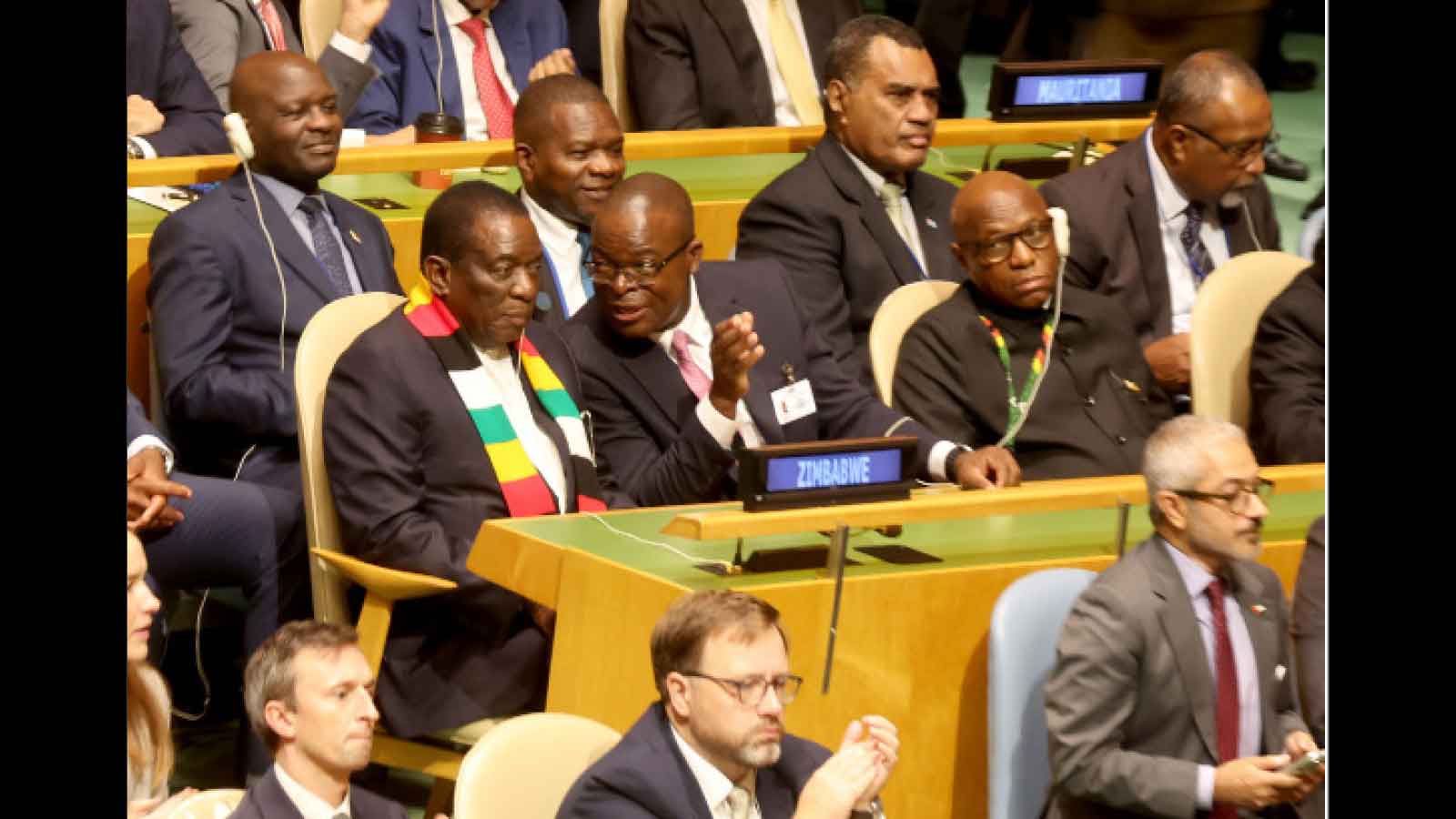
Africa stamps authority . . . We must be heard, understood, treated as equals: President
Wallace Ruzvidzo in New York, USA AFRICA will take a message to the 81st session of the United Nations General Assembly (UNGA81) that it must be heard, understood and treated…