

 Chronicle Editor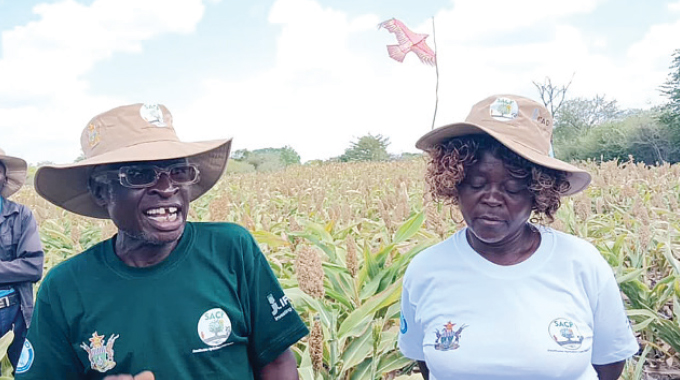
Leonard Ncube, [email protected]
DRAWING inspiration from the Intwasa/Pfumvudza regenerative agriculture model, Mr Robert Dube and his wife, Mariya from Jambezi in Hwange District, Matabeleland North, have become model farmers by fusing this concept with hydrogel technology. Their innovative approach to farming has not only transformed their own livelihood but also sparked hope for sustainable agriculture in the district, one of Zimbabwe’s driest regions.
Hydrogel technology, known for its ability to absorb and retain moisture around crops for more than a month, played a crucial role. Hydrogel is a synthetic material applied around crops in planting holes. It absorbs and stores water, releasing it slowly during dry periods to moisturise crops.
The Dubes experimented with incorporating hydrogel crystals into their farming practices, and the results were astounding. Despite adverse effects of climate change, they are expecting a bumper harvest from their three plots.

On one plot, they planted the sorghum variety Macia using both the Intwasa/Pfumvudza model and hydrogel, expecting about 0,4 tonnes of yield — a huge success considering most farmers’ crops were a write-off.
The other two plots were planted using just the Intwasa concept.
Intwasa/Pfumvudza conservation farming, introduced by the Government, has helped Zimbabwe attain food security in the last three seasons while boosting household incomes for small-scale farmers. This climate-proofed farming model enables farmers to salvage better yields despite low rainfall.
The Dubes’ success story demonstrates the power of innovation and sustainable practices in addressing food shortages caused by climate change. A field day celebrated the pilot project’s success, encouraging other farmers to embrace climate-smart methods.
“For now, the Government has been assessing the concept to have an appreciation so that we take a bold decision that it works. The aim is that where farmers are supplied with inputs, they also get the hydrogel,” he said.
Dr Godfrey Nehanda, the SACP national co-ordinator, said that hydrogel materials, currently imported from South Africa, are available in limited quantities.
“We don’t have large-scale suppliers of the hydrogel. However, once there are takers for the technology we will see more of suppliers. We are doing similar things in five provinces and organising field days in the same way we have organised a field day here in Hwange, Matabeleland North. We are following a value chain development approach and what we are trying to do is link farmers to the market,” he said.

Dr Godfrey Nehanda, the Smallholder Agriculture Cluster Project (SACP) national co-ordinator, said that they are organising farmers into clusters. These clusters produce specific products that are then aggregated. The SACP concept aims to promote market-led and climate-smart value chains, along with a small component of irrigation schemes.
“We entice buyers to come in and pick products in large volumes. The idea is to cushion farmers against the effects of climate change through climate-smart initiatives as well as assisting the value chains to participate in the market,” he said.
At its peak, the project will see 1 780 hectares of land being developed under irrigation, while also promoting agricultural value chains in the five provinces. The project co-financed by the government of Zimbabwe, International Fund for Agricultural Development (Ifad) and the Opec Fund for International Development (Ofid), to the tune of US$67million, aims to promote value chains for different agricultural activities including the traditional grains. It covers 428 wards in 28 districts countrywide.



 Online Reporter