Online Reporter
Tapiwanashe Mangwiro, Senior Business Reporter
ZIMBABWE’S fuel market continues to demonstrate resilience, with diesel prices holding firm at US$1.55 per litre for the third consecutive month, according to the latest update from the Zimbabwe Energy Regulatory Authority (Zera).
This stability in domestic fuel prices stands in contrast to fluctuations in international markets.
Global fuel prices are expected to remain volatile, with significant drops in crude oil prices projected by late 2025 and into 2026 due to rising oil inventories from Opec+ members.
However, geopolitical tensions, supply chain disruptions, and increased global demand are likely to trigger price spikes, contributing to ongoing volatility.
Earlier this year, global fuel prices saw a notable decline, driven by oversupply, weakened demand and geopolitical factors — reaching four-year lows before experiencing slight upward pressure in recent months.
In Zimbabwe, the unchanged September price has been widely welcomed by businesses and consumers alike, marking a period of sustained stability in one of the economy’s most sensitive sectors.
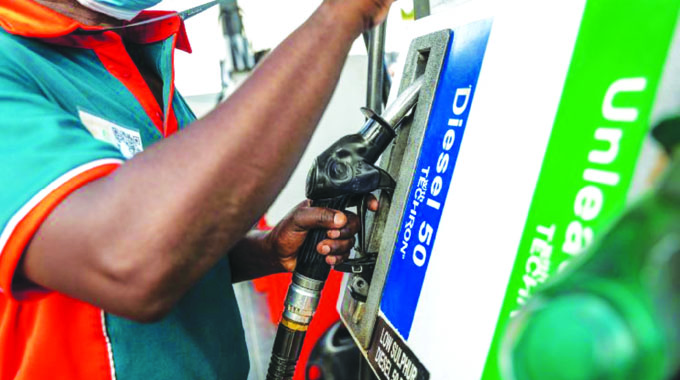
Petrol has also maintained a stable trajectory, easing slightly from US$1,56 per litre in August to US$1,55 per litre this month.
This durable price stability reflects deliberate policy measures aimed at shielding the economy from global oil market turbulence while supporting domestic growth.
For entrepreneurs and fleet operators who rely heavily on diesel, the benefits of such consistency are clear.
Kelvin Mombe, a Harare-based entrepreneur in logistics and delivery services, said the predictability of prices was proving more valuable than temporary reductions.
“Stability is everything,” Mr Mombe explained. “Knowing diesel is US$1,55 today, next week, and next month allows me to budget, take on new contracts, and serve my clients without the fear of sudden spikes.
It’s not just about saving a few cents; it’s about being able to plan and expand.”
Similar sentiments were echoed across the small business sector, where fuel remains one of the largest operating costs.
Economist Gladys Shumbambiri-Mutsopotsi, noted that the significance of steady fuel prices extends far beyond transport operators.
“When fuel prices are predictable, transport costs stabilise, production costs can be forecast accurately, and consumer confidence improves. It strengthens planning for businesses, especially SMEs, which form the backbone of our economy and employ the majority of Zimbabweans.
The broader effect is that the whole economy becomes more predictable, and that is what drives sustainable growth,” she said.
She emphasised that controlled fuel costs are a key lever for durable economic stability, aligning with Government policy objectives to ensure macroeconomic stability, accelerated growth, resilience and the realisation of Vision 2030.
This stability in fuel pump prices contrasts with shifting patterns in global oil markets. Brent crude oil, the international benchmark, has fluctuated between US$81 and US$87 per barrel over the past four months.
May averaged US$82, June rose to US$85, dipped to US$81 in July and firmed again to US$87 in August. Early September has continued in the US$86–US$88 range.
Despite these global shifts, Zimbabwe has maintained steady pump prices — a reflection of disciplined import cost management, a consistent exchange rate policy, and the successful ethanol blending programme, which continues to cushion petrol prices.
Diesel, unchanged since July, remains a symbol of this consistency.
Such stability enhances competitiveness for local producers and exporters, ensuring transport and logistics costs remain predictable compared to regional peers.
Zera data also highlights fuel’s contribution to national fiscal revenue mobilisation. Of the US$1.,55 diesel price per litre, US$0,57 is allocated to taxes and levies, which fund infrastructure, road rehabilitation and energy projects.
Administrative and distribution costs are tightly managed, at a combined US$0,056 per litre, while wholesale and dealer margins are capped to ensure fairness across the supply chain.
Officials argue that this balance ensures not only stability at the pump but also reliable funding for national priorities — turning every litre purchased into a contribution towards Vision 2030 targets.
With September marking the third successive month of unchanged diesel prices, analysts believe this consistency will give businesses the confidence to expand and help lock in economic recovery.
Entrepreneurs like Mr Mombe have already affirmed this development, while economists like Ms Shumbambiri-Mutsopotsi see broader benefits for inflation expectations, consumer confidence and overall planning.
At a time when global oil markets remain volatile, Zimbabwe’s ability to hold its line on fuel costs underscores how careful policy and sound management can deliver stability.