admin
admin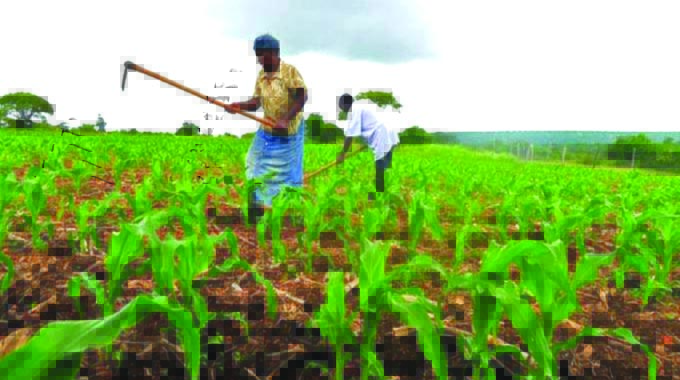
Obert Chifamba Agri-Insight
Their exploits on and off the field have over the years earned them the proverbial “Jack of all trades” title, thanks to some solid performance in the production of staple crops such as maize and a host of other market sought crops like cotton and tobacco.
In fact, smallholder farmers are fast emerging as a class of capitalists that see opportunities in almost every farming discipline that comes onto the scene.
They have done and are doing everything for which they have the capacity, for instance, the current joint venture and out-grower arrangements that are sweeping across the country.
This farmer category has in recent years easily metamorphosed into producers and traders of a little bit of every crop.
It is sad to observe that they cannot readily tap into the litany of opportunities they stumble upon almost on a daily basis due to resource constraints.
But it is encouraging to note that Government, development partners and a host of other key stakeholders have also made the realisation that this group of farmers represents a sleeping giant that just needs to be aided to get onto its feet and that will be it.
Once capacitated, smallholder farmers have the ability to hold their own and produce in excess of their requirements and even saturate markets.
It is important to note that in the history of the country, smallholder farmers have contributed more to food security than their large-scale counterparts since their focus was mostly on staple crops and not the commercial side of things.
Large-scale producers would train their energies on commercial crops the bulk of which were exported or sold locally for processing.
Most of such crops would even be non-edible, for example, flowers and tobacco. It was the smallholder farmers that would year-in, year-out fill the Grain Marketing Board’s (GMB) silos.
Smallholder farmers have demonstrated that given an opportunity, they can always turn the tables in their favour, for instance, those that diversified into tobacco farming at the turn of the millennium managed to record notable socio-economic improvements in their lives.
There are also some who are entering partnerships or contract farming arrangements that later provide markets and are doing very well.
Out-grower schemes have also proved to be quite economically empowering to this group of farmers, whose biggest undoing is the inability to self-fund and also find lucrative markets after harvesting produce.
It is not a secret that every time smallholder farmers have been sponsored or have produced crops under contract, they have done very well.
The Pfumvudza/Intwasa programme can easily confirm this, as the farmers scored very good yields in the 2020/21 cropping season earning the country a bumper harvest.
Give them inputs at the right time and a reliable water source or evenly distributed rains and they are good to produce.
Smallholder farmers usually include food crops in their planning and do not depend on producing a cash crop first, then sell it and buy food like their large-scale counterparts.
They always make sure they produce their own food crops and whatever comes from cash crops is meant to boost their income and not for buying food.
They are a strong force to reckon with in terms of supporting both household and national food security.
Generally, it is difficult for any country to reach its vast production potential if its developing farming systems do not take on board smallholder farmers.
Zimbabwe is seized with modernising its agricultural production strategies in response to changes taking place technologically, climatically and in the farming methods and marketing strategies in line with global consumer preferences.
Developments on the ground, however, make it look like most of the changes are favouring the commercial category of farmers who happen to have the means to implement them without disrupting their operations or compromising their targets.
Of course, it is a painful actuality that most smallholder farmers have no capacity to adopt the current modernisation processes happening in the sector because of resource constraints, which requires them to be hand-held by those capacitated to do so.
Many smallholder farmers are having their first romance with global value chains when they explore export markets through various arrangements that include contract farming, out-grower schemes and many other situations. And just like their name suggests, smallholder farmers form that group of producers who ply their trade on small pieces of land that they own or control.
In some cases, they do not even own the pieces of land they will be using.
On the one hand, the term ‘outgrower’ is a derivative from the idea of the farmer growing a particular crop for delivery to someone else somewhere.
The farmer, who is engaged to the outgrowing arrangement, is in most cases classified as a smallholder who is in a dependent or managed relationship with the exporter who would have engaged him.
These smallholders usually produce crops in relatively small volumes on relatively small plots of land and this will serve as a top-up to what the contractor would have produced too.
In most cases, they produce the crops for export or even domestic markets that will take the burden of scouting for buyers off their shoulders.
They will be in the arrangement to make a livelihood, something that they would have not managed to do on their own given that they are not resourced to do so.
In strict business terms, the out-grower farmers are seen as belonging to the informal economy because they may not be registered, tend to be excluded from aspects of labour legislation, lack social protection and have limited records..
They usually depend on family labour and may sometimes hire extra hands when there are funds to do so. The sad reality is that they are often the most vulnerable in the supply chains and when there are challenges they will be the worst hit.
Their production levels in most developing countries have often see-sawed between subsistence and small-scale commercial for those that would have managed to get a good foundation usually after working with development partners or even government.
One of the biggest challenges they face is that they do not have easy access to credit due to their lack of tenancy with financial institutions frowning on them as high-risk customers.
Smallholders normally lack access to credit, receive little technical support and often have low productivity due to an inability to invest in things such as improved seeds and soil replenishment.
They are dependent on labour-intensive production methods and family labour, although they often have to hire labour.



 Online Reporter