

 admin
admin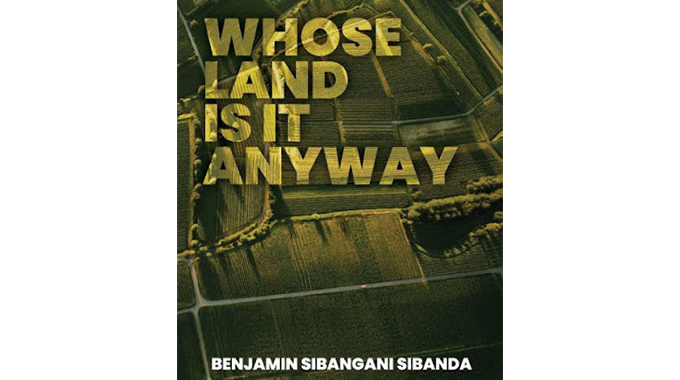
Elliot Ziwira, At the Bookstore
In “Whose Land is it Anyway?” Benjamin Sibangani Sibanda, compellingly explores the contentious issue of the Church in the colonisation of Africans.
Over and above interrogating the multiple claims to heritage premised on history, which, in a way, is the major character in the novel, Sibanda examines the role Christianity played in propagating hegemony—eventually leading to the subjugation of indigenous peoples.
One is reminded of Mohamed Gibril Sesay in “This Side of Nothingness” (2009), who, through the Preacher, insists: “The word, the word, the different meanings of the word, that’s the source of unfaith. Those who have faith follow the established meaning of words; those without follow the metaphorical implications.”
“(Satan)”, continues the Preacher, “makes you imagine the thousands of metaphorical implications of every word; you now have variety, as the situation predisposes, you jump from one meaning to another, you become untrustworthy, sceptical, without faith in anything, you become a heckler, a munafiq, and unbeliever.”
Hence, the word has been read in many different ways, with some following its literal meaning (the believers), and others resorting to its “metaphorical implications”.
However, in matters of heritage, the issue of faith or lack thereof remains prickly when read in terms of tangibles (material gains) and intangibles (spirituality).
Through Pastor Patrick Jones, who is caught up between the European nation and the African nation—a demarcation in existence since 1890, Sibanda highlights the Church’s role in the contestation of heritage enshrined in the land.
The setting of the story is Zimbabwe, 20 years after independence in 1980.
It is just before the post-2000 Fast Track Land Reform Programme. Through multiple voices of the black and white citizens of the country, the story follows up on the land reforms.
The different individual episodes that make up the tale of contestation play out through liberation war veterans, traditional leaders, Christians, white commercial farmers, farm workers and politicians; who all lay claim to the land. Interestingly, the novel opens with Pastor Jones sitting in the veranda of the Venters’ farmhouse with Jacques Venter, admiring the beautiful country before them. It is Jacques’ opening line to their conversation that is even more curious.
He says, “God’s own country, heh”. The clergyman responds: “It is, isn’t it. . . I have just been sitting here thinking how blessed we are to be living in such a beautiful part of such a beautiful country”.
Here, both Pastor Jones and Jacques are using the beautiful scenery before them to claim the Christian God’s presence in the European nation begotten of “Christian civilisation”.
It is a legacy they wish to safeguard, especially Venter, who makes no attempt to veil his contempt for blacks—the “munts”.
With Jacques making it clear that it is “God’s own country”, the cleric’s own attempt at disguise lacks conviction at this stage as the reader is informed that the chapel was “built on land donated by Jacques Venter’s grandfather”.
The clergyman may be concerned about the poverty that stalks the African side of his congregation, but he appears to have no solution except to perpetuate their misery through faith. He sits for coffee with whites, and buys beer for the protagonist, Themba, a war veteran, as a way of offering Africans an elixir out of their dilemma.
However, since he is linked to the history of colonialism, he falls into the trap of supremacism, where blacks are considered incapable of minding their heritage and changing outcomes for themselves without the interference of whites.
Pastor Jones fails to realise that what the African nation requires is more than alms.
They need land to sustain their livelihoods. His belief that land could neither be claimed nor owned, appears to be Afrocentric when read in the light of the views posited by Lan (1985), Armah (1973), Bakare (2012), and Vambe (1972).
But when scrutinised against the Afrocentric view of ownership, whatever he stands for goes against the ritualistic import of the land to Africans. Attempting to placate both sides of his congregation, he says in one of his sermons: “We cannot, we should not claim ownership of the land; it belongs to God, the creator as we have just read from the bible”.
The same Christian bible that divested Africans of their heritage is used to tell them that they should not claim ownership of the land, because it belongs to God. His argument here follows the same thread that Jacques unwinds when he quips: “God’s own country, heh”. One wonders on whose side God is, when colonialists can claim land on behalf of God, and when blacks want to do the same, it becomes God’s.
In “Christianity, Islam and the Negro Race” (1887), Edward Wilmot Blyden, argues that Christianity was introduced by Europeans chiefly to colonise Africans and other races. In concurrence with Blyden (1887), Fanon (1967:163) maintains: “The Church in the colonies is the white people’s Church, the foreigner’s Church. She does not call the native to God’s ways but to the ways of the white man, of the master, of the oppressor”.
Africans lost their spiritual connectedness to the land as a result of Christianity, fronted by missionaries, like Pastor Jones, who called them pagans and painted their culture as a “quintessence of evil” (Fanon, 1967). Spiritually alienated, Africans lost more than their spirituality; they lost their livelihoods through displacement and dispossession.
Yet, Pastor Jones asserts that they should not claim ownership of the land, for it belongs to God.
In the Afrocentric view, land, as an ancestral land, does not belong to individuals but to the community. As the abode of the ancestors, it is neither bought nor sold (Lan, 1985).
De Waal (1990), observes that although missionaries and priests helped African liberation movements during their struggles for independence, they could not deny their whiteness. Thus, their connection to colonial governments remained a blood link.
There may be hope though, as blacks read between the word, and the futility of relying on handouts, through the ZIPA district youth chairman, George Magaya, who informs the clergyman: “We have come to take over this church . . . It belongs to us now. It is no longer for whites”.
Though it may be frowned at in some quarters, taking over the church connotes reclamation of Africans’ spirituality, which will then help them in reclaiming their lost heritage. The land, the means of production key to their livelihood trajectories, cannot remain in the custody of colonialists and their surrogates.
Nevertheless, in the absence of ideological vision on what to do with the chapel, and what constitutes spirituality in the African worldview, taking over the church, the pastor’s house, and the surrounding land, will not achieve desired results.
Notwithstanding the moral backlash, there is no guarantee that George and his fellows will not be forced off what they consider to be a safe bet—capturing the church that no one else could be interested in.
When Pastor Jones informs him that in “exactly one month, the church and the cottage will be empty and you take over”, the young man’s desperate plea for food spells doom for the African nation.
Ultimately, in this instance, the Church provides alms and offers possible vents of escape through food, the word and opium, while the issue of empowerment, through reclamation of the ancestral heritage enshrined in the land, is sidestepped and demonised.


 Online Reporter