admin
admin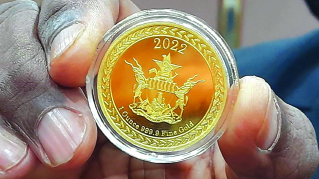
Herald Reporter
The issuing the first of gold coins at the end of July last year and then the new gold tokens from May this year was an extremely innovative move to give holders of large sums of local currency a legal and rock-solid way of preserving value of their liquid assets without having to mess around with the black market.
Early this year President Mnangagwa noted that the issue of the gold coins was a “masterstroke” that had removed a lot of surplus local currency that would otherwise have gone to fuel the black market as businesses were seeking ways of insuring the value of the their cash.
The large sums that were invested first in gold coins and then in gold tokens show that there were a lot of businesses and a lot of Zimbabweans who wanted a legal way of doing this.
As the two measures withdrew a lot of surplus Zimbabwe dollars out of bank accounts, they helped make possible the recent reforms and stabilisation of the exchange rate, whereby new local currency is no longer being added to the pool and that pool, thanks in part to the gold coins and tokens, became sufficiently small that the exchange rate could become stable, at a much lower figure than had originally been expected by many in business.
Which is why those messing around in the black market and pushing prices up so far beyond the rational limits have come short, while those with gold holdings and a clear costing structure based on official exchange rates are the ones who have won through.
The minting, first of smaller gold coins and now with the gold tokens being issued in units of one milligramme, a 30 000th of an ounce, means that any Zimbabwean who wants to legally own gold can own it, with a minimum of fuss and bother.
The new tokens, a digital currency backed by physical gold in the vaults of the Reserve Bank of Zimbabwe, can be used as a digital currency so long as the seller and buyer of goods and services agree. That is the buyer of something can transfer tokens from their account to the seller’s account.
What the two measures ensure is that there are better and legal alternatives to the sort of panic buying in the black market that have caused so many problems and allowed those who manipulate that market an opening.
Reserve Bank Governor Dr John Mangudya made it clear from the beginning that coins, and now tokens, were a legitimate way of giving Zimbabwean businesses and individuals an alternative to storing wealth. They did not need to rush to some dealer in the black market and buy foreign currency.
One reason for the recent slackening of demand for tokens is that they were highly successful in pulling out the surplus cash, and now there is very little floating around, hence the falling prices of a US dollar.
With the recent crashes in the value of foreign currency, along with the gold price remaining relatively stable and unlike to soar or crash in value in any case, those who invested their spare cash in gold coins or tokens are in far better shape that those who bought overpriced US dollars on the black market and now have to accept significant losses when they want to use that money.
The gold coins and tokens are not seen as a single solution to the sort of volatile exchange rates that have been seen in Zimbabwe, but they are considered an important part of the package of measures that have been taken, mostly in the second quarter of this year, that address the fundamentals.
They certainly speeded up the process of price reduction and the crash in the price of a US dollar on official markets by around a third, and a far larger crash on the black market, and have also helped make the black market increasingly irrelevant to Zimbabwean businesses and the economy, as it grows smaller and smaller.
The coins and tokens were largely designed to do just that, help along with other measures to mop up liquidity, and helped create the new way of looking at money supply, with the Ministry of Finance and Economic Development taking over the job of buying the 25 percent of export earnings that exporters must sell.
With the removal of a critical quantity of local currency liquidity by the gold coins and tokens, and then the other reforms that stopped any meaningful increase in liquidity, the exchange rates driven by speculation and businesses fears started first falling and then stabilising, and in the midst of all of that the holders of the legal gold, rather than the holders of black market currency, were the ones whose assets remained stable.



 Online Reporter