admin
admin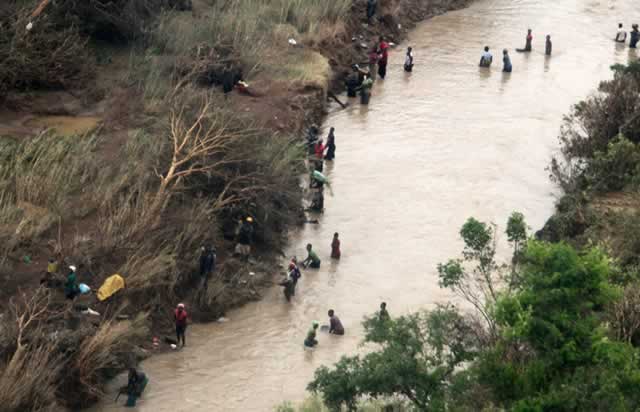
. . . as rising water brings relief to villagers near Sanyati River Bridge
Sydney Kawadza and Noah Pito Features Writers
The rains pounding the northern parts of the country are a blessing, not only to thousands of farmers but also for villagers near Sanyati River Bridge in Magunje.
Between April and October each year, hundreds of gold panners invade the river in search of gold in areas believed to be rich in gold deposits.
As they invade the river, they bring with them all manner vices, diseases and other social ills to the surrounding communities.
Villagers are happy when rains come. At least the gold panners are driven off the river banks.
Gold panners are a menace but for the people near Sanyati River Bridge the rising water is a relief.
According to a villager, Mr Elliot Urayayi, the gold panners attract prostitutes, illegal gold buyers, criminal activities and other social ills.
“It is quiet during the rainy season because the panners are afraid of the rising water levels when it rains up stream.
“By April the river banks would be teeming with hundreds of gold panners, traders and prostitutes,” he said.
Near Sanyati River Bridge is a notorious spot that demarcates Hurungwe and Nyaminyami districts in Mashonaland West province.
Here, the end of the rainy season marks the start of serious work, bliss, money-making, poaching, and all forms of vice including prostitution, drug-taking and gambling.
This is when the makorokozas officially return to work as semi-business entities are established with bottle stores, shops, butcheries and brothels operating from disused shafts and tunnels.
Close to Sanyati River at Chiroti, popularly known as paBridge or Pamadiro paChiroti is an extremely small piece of land.
It accommodates several “businesspeople” during the peak of activities.
However, towering over the woods from the eastern side of the river is Sanyati Safari Camp.
Just four years ago the camp was a must see place for every tourist travelling to Bumi Hills or Victoria Falls by road.
While there, tourists would spend a night viewing game that was in abundance then.
Today, the glamour and splendour of Sanyati have been overshadowed by the rising numbers attracted to the river by gold panning activities.
The Safari Camp is no longer operating, choking the financially troubled Hurungwe Rural District Council’s (HRDC) once a vibrant Community Areas Management for Indigenous Resources (Campfire) project.
HRDC chief executive Mr Joram Moyo said the downturn began in 2010 with the massive poaching of elephant and buffalo.
Most of the poachers would come to the area under the pretext of gold panning.
“Before 2010 at least, all was well until the gold panning activities took a surge that was matched with a sharp increase in elephant poaching activities.
“This is the time when the situation went out of hand. Remember at the island gold panners operate for 24 hours,” said Mr Moyo.
He said noise from the buzzing generators, the lights and music blaring all night into the surrounding hills and mountains had driven wild animals from the area.
The gold panners also use machinery that has driven animals from their watering holes.
“In reality no client wants to hunt in an area that is infested with snares and where they come across barking dogs chasing game, where veld fires are also the order of the day,” Mr Moyo said.
He added that illegal settlements had sprouted along the Sanyati River for easy poaching and gold panning.
“Each time we evict them they still come back and the process ends up requiring considerable amount of resources. The same applies for the gold panners at the bridge,” he said.
Norman Manyembere, a gold panner at the bridge, said some of his colleagues come from as far as Beitbridge, Mutare, Masvingo and Nyamapanda.
He however, added that the practice is risky and three people died in 2013 after tunnels known as ngwavava collapsed.
“The fatalities could have been higher but we were assisted by some Chinese who were also mining along the river.
“A miner faces imminent death because when you are digging you will be lying on your stomach and when the tunnel collapses one can easily be buried by the collapsing walls,” he said.
Manyembere added that some of the people taking advantage of the large numbers at the camps were fugitives running away from the police.
However, while most panners are based at the Sanyati River Bridge, there are other points that attract them. These are Maridzangoma, Gunduza, paConcrete, Mano, Mashuma, Gwararenzou, Manyeredzi and Mahwindo.
Urayayi, who supplements his meagre income from the fields through gold panning, said a lot had been happening along the river.
“We know there were gold mining activities for a long time but the numbers started increasing in 2007. From then on the numbers have continued to grow especially during the dry season between April and October,” he said.
Mrs Fauna Chirongoma, another villager, said gold panning activities were fuelled by poverty but people from the area did not benefit much from the resources.
“People believe they can overcome their problems when they can get a few grammes of gold but it is not easy. The buyers give us very little for the gold. We get as little as $25 a gramme,” she said.
The gold panners have also been engaged in running battles with the police.
“We have, however, devised our own ways of dealing with the police especially from the Border Control and Minerals Unit who make regular and spontaneous raids in the area. It’s like a cat and mouse game,” she said.
Another villager, Honest Kwaramba believes there is need for controlled mining along the river.
“Controlled mining ensures that villagers benefit and the illegal activities along the river can be controlled. When the gold panning activities start, everything turns into chaos. The river, natural ecosystem and even our ways of life are affected,” he said.
He said people are always risking their lives hence they disappear during the rainy season.
“Last year, some of the illegal miners were marooned for days. Their friends made a makeshift boat known as chikwarapuro and rescued them before helicopters arrived. They feared exposing their activities,” he said.
A Chinese company reportedly started operating in the area amid rumours that they misrepresented to the community that they were trying to clear the river of silt.
“They were involved in mining gold but we were never told until the local political leadership intervened because the communities were not benefiting from the minerals,” Kwaramba said.
Government has, however, banned alluvial gold panning within 200 metres of river banks under Statutory Instrument 82 of 2014.
The legislation is expected to address concerns of siltation of rivers and contamination of water bodies.
Alluvial gold mining is common in Ghana, Australia and Canada where there is special attention to rehabilitation of water bodies near mining areas.
Feedback: [email protected]


 Online Reporter