admin
adminand evening, which we grew used to as young scholars.
For the generation in their prime, zero to 30 years group, it was good morning life, 30 to 50 years group it was a case of good afternoon life and for those above 50 years it was good evening life.
The three categories could also be viewed as learning years, earning years and yearning years respectively. Can the same be applied to the economy of Zimbabwe after 31 years of independence both politically and economically?
As we celebrate our 31st independence I wish to reflect on the past and also look at our successes and failures as a country.
On the eve of April 18 1980 around midnight, the Union Jack was lowered at Rufaro Stadium marking the beginning of a new era for black Zimbabweans. Then, it was so unfathomable to see a black man presiding over the august House as a Speaker of Parliament let alone being the Head of State.
What followed was a period of reconciliation, the economy was in sound shape in spite of the fact that the bigger GDP variable was shared by the elite only.
This could be a testimony that Zimbabweans were generous considering that Government adopted reconciliatory approach in the midst of rampant unemployment especially in relation to cadres who were coming from the bush.
The Zimbabwe Stock Exchange was in the hands of the whites. For a black man to attend an Annual General Meeting was truly synonymous with owning a piece of land in Borrowdale Brooke.
The few successful black people were clerks, police officers and the highest they could achieve was to own a two- bedroomed house in Marimba near Mufakose with a Peugeot 404 completing the property portfolio.
Then about 80 percent of the populace was from the communal areas where they practised subsistence farming.
To be a columnist like we are today was like asking for a seat in the Parliament no matter how popular you thought you were in your community. To have a black and white television set in our small dining-rooms was sufficient to bring smiles to our faces. One could actually count the number of households with television sets as indicated by the presence of an aerial on top of roofs.
That was the Zimbabwe we had coming out of the Rhodesian government and into a new nation.
Zimbabwe has had its own fair share of problems as an African nation since 1980. It is a fact that the economy could not deliver as everyone would have wanted to witness.
The value of the Zimbabwe dollar in 1980 was stronger than the greenback, using unemployment as an economic measure was not a sufficient yardstick since it was mostly structural unemployment associated with the absence of relevant educational qualifications not the non-performance of the economy.
Local but multinational banks were highly rated internationally notwithstanding their bias in loaning out funds.
Inflation as measured by the Consumer Price Index was at 4,1 percent when Zimbabwe attained independence and it became unsustainable following the adoption of the Economic Structural Adjustment Programme and then the quasi-fiscal activities by the central bank not to mention the debilitating effects of economic sanctions.
Ours is a country with a population size of roughly 11,4 million people, a total land area of 390 580 square kilometres which makes it a relatively small nation.
Our neighbour to the south, South Africa’s land area covers 1 219 912 square kilometres, Zambia to the north 752 614 square kilometres and Botswana to the west occupying
585 370 square kilometres.
This implies geographically we are quite a small nation not only in Sadc but Africa as a whole save for Lesotho and Swaziland, which are much smaller than us.
Zimbabwe had achieved one of the best literacy rates in the world at large and surpassing all the African states not withstanding the last decade that was lost economically. What a sign of resilience and uniqueness!
With a current literacy rate of 91,2 percent, this is sweet news compared with Zambia at 68 percent, Egypt at 72 percent in spite of it being the cradle of civilisation. South Africa is at 88 percent with all its international schools and Nigeria at 72 percent despite its numerous university graduates.
With an inflation rate of 2,7 percent per annum, Zimbabwe has the lowest inflation rate currently on the mother continent even though we are one of the biggest net importers.
Last year South Africa had an average inflation rate of 7,1 percent, Ghana 10,7 percent, Egypt 9,3 percent and Botswana 7,1 percent.
However, our life expectancy at 45,1 years for males and 43,5 years for females is quite low and compares unfavourably with fellow African states. For Egypt, it is 69,3 years for males and 74,5 years for females, Botswana has 51,3 for males and 49 for females with Swaziland the only country in Sadc below Zimbabwe’s life expectancy at 31,7 and 32,3 years for males and females respectively.
Zimbabwe also experienced improved communications, which could be the reason for its better infrastructural state as compared to most African states. There are an average of 1,4 million internet users in the country versus a population of 11,4 million and 10 million internet users in Nigeria against a population size of 146 million people
There are four million users in South Africa against a population of 48,7 million and 500 000 users in Zambia against a population size of 11,6 million people.
In terms of TV sets, there are 35 sets for every 1 000 people in Zimbabwe, 69 sets for 1 000 people in Nigeria, 138 sets for every 1 000 people in South Africa and 21 sets for every
1 000 people in Botswana. For an urban resident, such statistics might sound weird and understated but surely speaking the greater percentage of our populace is devoid of such gadgets which the leadership has to take heed of if we are to say good afternoon Zimbabwean economy.
In the 31 years of our independence, Zimbabwe’s relationship with the Western world reached a boiling point after it pulled out of the Commonwealth.
This saw our foreign direct investment plummeting to all -time low levels. For Zimbabwe to regain its status, it has to choose its priorities, work closely with allies and agree on international rules of interaction.
Going forward, the West also needs to be warned that sanctions are a coward’s war. They do not work but are a way in which the rich elites feel they are committed to some distant struggle.
South Africa was transformed not by sanctions but by the collapse of the moral coherence of Afrikanerdom, leading to everlasting peace which Nelson Mandela is today credited for.
As a sovereign state, it is hard for the Zimbabwean Government to be shaken by a piece of paper which was inappropriately termed the Zimbabwe Democracy and Economic Recovery Act (Zidera).
Business cannot be executed as usual when most of the economic indicators had been facing southwards.
The population of black-owned banks had gone up significantly compared to 1980 when there was not even a single black man owning even a single share in a bank.
Now the number of both public and private schools is still on the rise even with the illiquid conditions crippling the Treasury functions.
Arise and shine Zimbabwe, the economy cannot afford to remain in the morning phase, we need development and a big no to corruption as we venture into a new era.
l Christopher Takunda Mugaga
Head of Research
Econometer Global Capital
[email protected]
+263 772 340 353, +263 776 266 062


Online Reporter
- Herald
- July 31, 2026
- 3 views
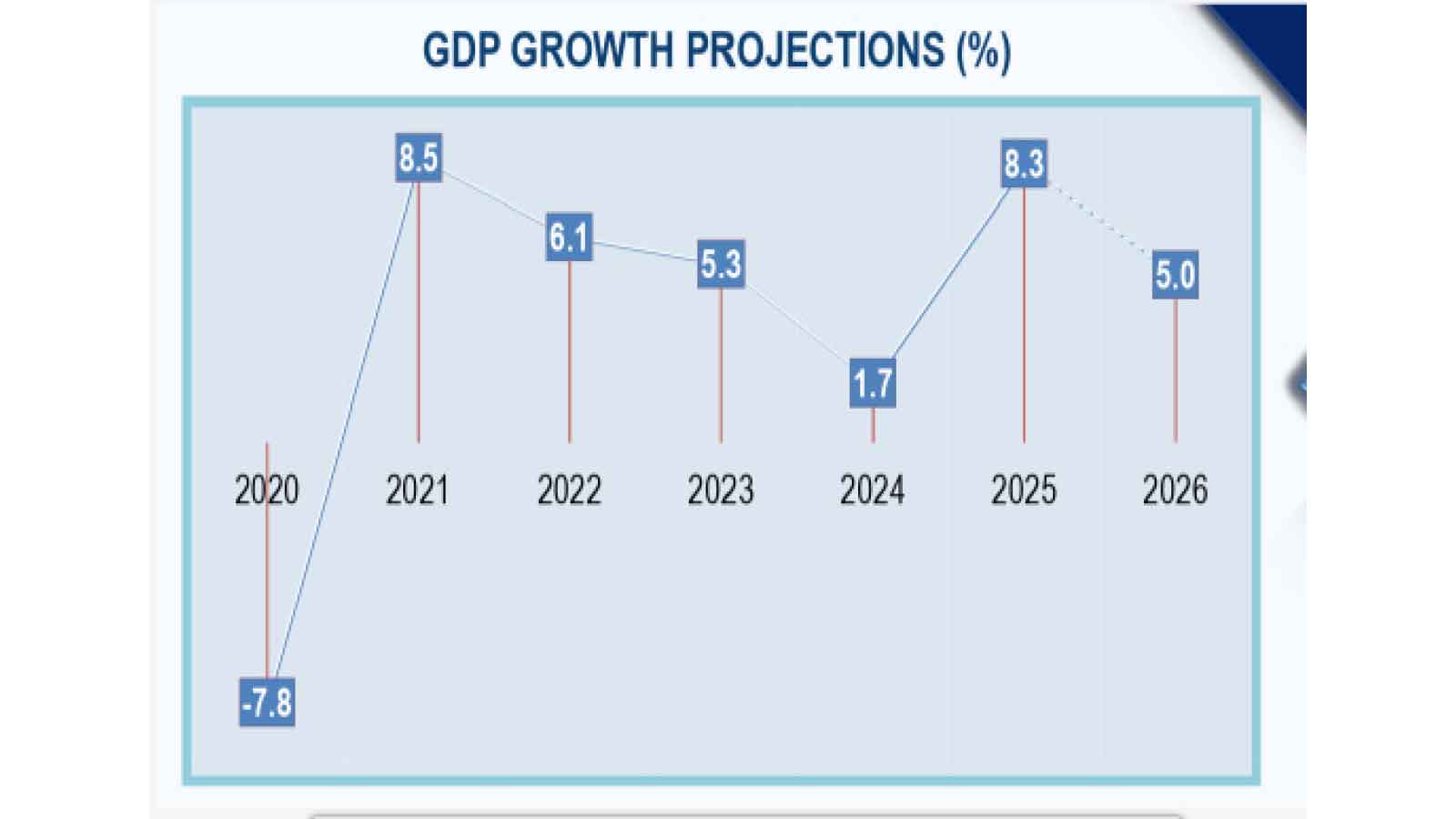
Stable inflation fuels 6.8pc Q1 growth as Zim outruns projection
Nelson Gahadza Senior Business Reporter Zimbabwe’s stable inflation environment has created the conditions for stronger-than-expected growth, with the economy expanding by 6,8 percent in the first quarter of 2026, putting…