Online Reporter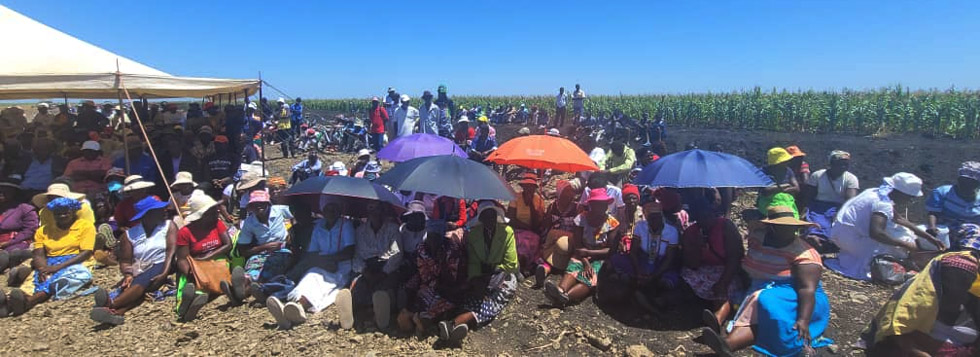
Ray Bande
Senior Reporter
GOVERNMENT will commence the household food aid programme this month, targeting child-headed families, the elderly, and disabled in all provinces across the country.
Lands, Agriculture, Fisheries, Water and Rural Development Minister Dr Anxious Masuka said during the handover of 220 smallholder irrigation plots to households in Machona and Vheneka villages in Chipinge South Constituency, by GreenFuel.
Minister Masuka said the able-bodied households will only receive food assistance after preparing a specified number of Pfumvudza plots for summer cropping.
“Those in need of food aid will, starting this month, receive food distributions. Households led by the elderly, children, and those with disabilities will receive 7.5kg of grain every month, commencing this month. For those also requiring food aid but are physically fit, we will instruct them to first dig Pfumvudza plots and then receive aid. This approach was previously referred to as ‘food for work’. However, this condition only applies to those who are physically fit. Vulnerable individuals, such as those in child-headed families, families headed by the elderly, and the disabled, will receive food aid free of charge,” said Minister Masuka.
Minister Masuka’s comments came at a time when the country is moving from the 2023/2024 El-Nino-induced drought that affected the Southern African region and was declared a state of national disaster in the country.
He said the Government is making strides in ensuring resilience mechanisms are in place in case of future droughts.
“We are constructing silos in three locations in Manicaland – Mutare, Rusape, and Timber Mills. Our objective is to store agricultural produce locally, rather than relying on silos in Harare and Mashonaland Central and Mashonaland West. We are also building additional silos in Lupane and Gokwe, areas that typically experience low rainfall. This will enable us to transport surplus grain from areas with favourable rainfall to these silos, facilitating easier distribution in times of scarcity. Against this backdrop, we will officially commission the Mutare silos on October 29, as construction is now complete,” said Dr Masuka.
He further noted that grain reserves amassed by the Grain Marketing Board (GMB) have exceeded 4 000 metric tonnes.
“Following last year’s drought, we expressed our gratitude to President Mnangagwa for his support during that challenging period. We encouraged those who had harvested surplus grain to contribute to the national reserve.
As a result, we have collected 4 081 metric tonnes of grain, which are being stored in local silos. We aim to make this an annual practice, ensuring we have reserves to draw upon during times of drought,” he said.
Minister Masuka also spoke about the target of 15 million Pfumvudza plots by 2030.
“We are all aware of the devastating effects of climate change. One way we can contribute to the fight against climate change is through Pfumvudza.
I am pleased to note that Manicaland has responded positively to the call for land preparation. We have exceeded five million plots nationwide. Our national target is 15 million plots by 2030, ensuring that even in times of limited rainfall, these plots will retain sufficient nutrients to sustain crops
“The second approach to combating climate change involves the careful selection of crops by farmers. It is essential to remember that the choice of crop is not solely based on personal preference, but rather on the suitability of the crop to the local climate and soil conditions.
For instance, bananas thrive in Honde Valley, tea in Chipinge, macadamia nuts in Chipinge, and sorghum in areas with limited rainfall. It is crucial to avoid persisting with crops that are ill-suited to the local weather patterns. If you reside in a dry area and wish to cultivate maize, consider planting sorghum instead, which can be exchanged for maize at the Grain Marketing Board (GMB).
“However, the widespread adoption of Pfumvudza plots is not feasible nationwide. Therefore, climate-proofing at the household level involves the implementation of Pfumvudza and the careful selection of crops tailored to the local agro-ecological conditions.
“At the national level, climate-proofing entails the accelerated construction of dams and the massive expansion of irrigation development. The President has set a target of 496 000 hectares under irrigation by 2030. Currently, we have achieved 223 000 hectares. Nevertheless, we are aware that it is possible to irrigate up to 350 000 hectares, yielding 1.8 million metric tonnes of food at a rate of five tonnes per hectare. As a nation, our population of 15.1 million people requires 1.4 million tonnes of food, leaving us with a surplus of 400 000 tonnes for livestock feed. This is what we refer to as climate-proofing at the national level,” said Minister Masuka.