

 admin
admin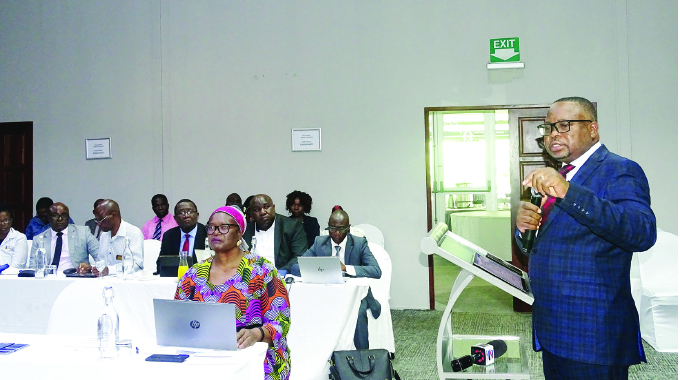
Remember Deketeke and Gloria Muruva
As the realisation of an upper middle income society is fast becoming a reality, the Government is committed to addressing a mismatch between what the training institutions produce and the requirements of the industrial sectors.
Skills Audit and Development Minister Professor Paul Mavima yesterday said Zimbabwe training ministries, institutions and parastatals need to adopt policies that promote a skills revolution in order to keep up with the fast-paced technical world.
Speaking at the consultative conference yesterday, Minister Mavima said the ministry’s primary goal is to ascertain what skills the nation possessed and where there were deficiencies in order to realise the goals that are explicitly outlined in Vision 2030, NDS1, and ultimately NDS2.
The consultative workshop was inspired by the realisation that the industrial sector was severely lacking in skilled labour, and that the only way to address this issue was by investing in training institutions and ministries.
Minister Mavima said problems in the industrial sector stemmed from a mismatch between what is produced by training institutions and what was needed in industry.
“This also reflects redundancy of some of the available skills and the need to develop the required skills and modernise them for both the present and the future.
An exodus of skilled workers in recent years had to be addressed in order to transition from a low-income to a high-income society.
“Furthermore, the mass exodus of skilled personnel from Zimbabwe during the last two decades created a vacuum which needs to be addressed through a skills revolution that includes reversing the brain drain and focusing on contemporary skills needs.
“All nations that have evolved from low-income to high-income status in the past have done so premised on their deliberate efforts on skills development,” he said.
Skills Audit and Development Permanent Secretary Ambassador Rudo Chitiga said the catalyst for social and economic change was human capital.
“Human Capital Development is the engine of economic and social transformation.
“It is the human resources of any nation, rather than its physical capital and material resources, which ultimately determine the character and pace of its economic and social development,” she said.
Ambassador Chitiga said the ministry is working towards moving the country from a certificate based to a skills oriented society through investing in vocational training centres.
“At the moment there is vocational training being offered by the ministry, church organisations, private sector among others. We are also examining the standard of the equipment being used at these training facilities; are they suitably equipped?
“The main thrust is to move from what was before a certificate-based society where one was required to produce a certificate to get a job to a skills oriented society where skill is the major qualification for employment,” she said.



 Peter Tanyanyiwa
 Online Reporter