Chronicle Editor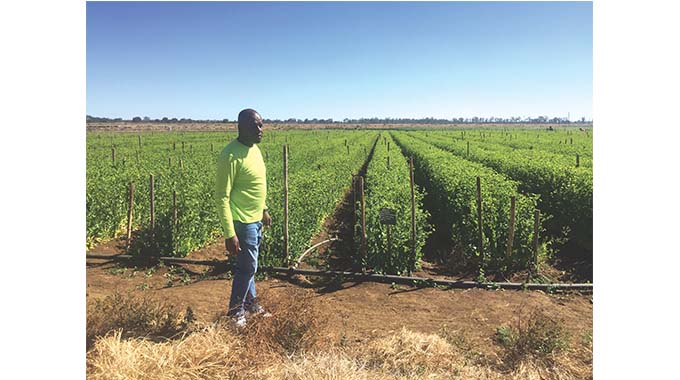
Munyaradzi Musiiwa, Farming Reporter
SINCE the turn of the millennium Zimbabwe has experienced intermittent droughts due to climatic change resulting in the Government being forced to import food to feed the nation.
The dire situation has been exacerbated by the economic sanctions imposed on the country by some Western powers that have continued to affect the economy. Nonetheless, agriculture which used to be the backbone of the country is slowly recuperating but is being greatly affected by under-utilisation of land.
However, an old English adage says, “Where there is a will there is a way and where the determination is, the way can be found.” This rings true for a Gweru farmer Mr Tatenda Karimazondo who has found a silver lining in the prevailing economic situation and the country’s international relations to reopen the floriculture export window to Europe. Mr Karimazondo is one of the most successful farmers in Midlands.
He is farming eight flower varieties at his farm in Gweru all meant for the export market. In addition to floriculture, he is also into peas farming also for the export market, maize, tomatoes, potatoes, beans, dairy farming and cattle ranching. He also runs a family business Midlands Metals which are manufacturers of foundry products. In Gweru, Midlands Metals has been nicknamed “the last man standing” as it is one of the few companies that did not shut down due to economic challenges.
At his farm he employs more than 500 people. Mr Karimazondo says he is slowly reincarnating the export market, particularly in Europe where he is selling his farm produce. He is now exporting to Germany, Britain and Netherlands.
“We are trying to resuscitate floriculture in the country and we also face stiff competition from countries such as Kenya. We know it’s difficult but slowly we are moving up. We are doing summer flowers and all of them are done in the open without greenhouse. We have eight varieties including proteas. Per week we export a maximum of 150 000 stems. Right now, the flower season is coming to an end. It starts from September and we usually start planting in July. The selling season stretches from September to June.
“We have summer flowers that are bupleurum, ammi visnaga, carthamus flower, liatris flower, helichrysum flower, among others. We plant the flowers according to the market specifications in Europe and Netherlands in particular so we agree maybe three months before time. These are also planted in batches particularly bupleurum because they can’t be harvested all at once.
We also calculate the number of stems needed by our clients. We send 100 000 stems of bupleurum per shipment and we do shipments weekly. So our weekly target is 300 000 stems. The target for ammi visnaga is 3 000 stems per shipment same as the three other flower varieties,” he said.
Mr Karimazondo said operations at the farm were affected by coronavirus but that has not stopped exports.
“We were badly affected by the novel coronavirus and, we had to throw away flowers for a period of about six weeks. When the outbreak was first announced our markets in Europe closed. Due to the coronavirus-induced lockdown, people were not buying flowers and this affected our business. So we lost a lot of potential revenue but that did not and will not deter us,” he said.
Mr Karimazondo said he also grows peas for the export market supplying mainly Germany, Britain and Netherlands.
“We also have peas. In the first phase when the planting season started, we planted 12 hectares and after three weeks we then added another eight hectares to make them 20. This is because we need to supply the market weekly. We started exporting from April and the selling season extends up to September. We have five hectares under pivot. We also have another eight hectares under peas. So we have a total of 33 hectares. We have two varieties of peas. Now we are harvesting and it is done every day. When we are at peak, we harvest almost eight to 10 tonnes every day and then we grade the produce. We then export 90 percent of the produce. We export to Britain, Germany and Netherlands,” he said.
Mr Karimazondo also has an orchard of avocados mainly for the export market. He has put close to 25 ha under maize production and grows tomatoes and potatoes seasonally. He also has 300 dairy cows and 500 cattle for beef.
Mr Karimazondo challenged young farmers and other beneficiaries of agricultural programmes to ensure full utilisation of land and restore the country’s status of being the breadbasket of Southern Africa.
“Farming must be run as a business. It is unfortunate that we allow outsiders to come and exploit resources in our own country and make money because we are not able to utilise the land ourselves. It is not only about exports but sustaining food security for our country and Africa,” he said.



 Online Reporter