Chronicle Editor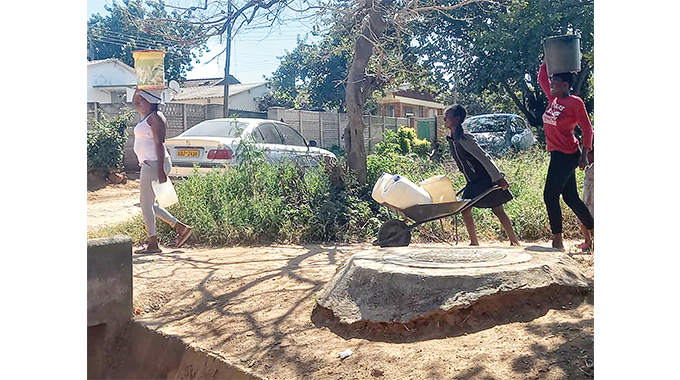
Patrick Chitumba
It is 5AM on a Monday and residents of Mkoba 1 suburb in Gweru have begun their desperate search for water.
Of these residents, the majority are school-going girls and women who are having to bear the brunt of the crisis.
Accessing water has become a daily struggle in the City of Progress, as Gweru is affectionately known.
A water rationing programme was initiated by the local authority allowing some suburbs to receive running water for up to two hours every three or four days, which is barely enough to cover daily basic needs.
Some taps in high-lying areas such as Ridgemont, Mkoba 1, 2, 14, 15, and 21 among others dried up some three months ago.
Obsolete water infrastructure, power cuts, and a ballooning population among other factors have been cited as reasons behind the city’s water problems.
The local authority currently pumps 45 000 megalitres of water per day, which is just below half of the city’s daily requirement.
Without running water at home, the girl child is forced to walk to alternative water sources to fetch water.
Chronicle witnessed young children pushing wheelbarrows while some were carrying containers on their heads after fetching water from a water collection point set up by the council.
“The burden of collecting water falls on us girls mostly. I am forced to wake up early in the morning to queue for water at a local distribution point before it runs dry,” said Marian Shoko (13) from Mkoba 1 suburb.
The Form One pupil at a local school said walking long distances under the weight of heavy water containers has become a daily routine for her and many other girls.
Marian is forced to fill two 20-litre containers which she takes home in a wheelbarrow.
“It’s a Monday morning and I am in a queue to collect water for household chores before I prepare for school. There are four people in our family and it is my mom and myself who are always looking for water,” said Marian.
She said she is tired when she reaches school, which affects her school work.
“You know, the time that I should be spending playing with my peers, studying, or resting is replaced by hours of collecting water,” said Marian.
In the streets of Mkoba 1, Mtapa, Mambo and other high-density suburbs in Gweru, desperate young girls and women are always seen clutching empty buckets as they search for water or those filled with the precious commodity going back home.
At a solar-powered water kiosk in Mkoba 15 suburb, mostly young women were queuing for water.
“We buy the water for 50 bond per 20-litre bucket which is affordable to some residents. For residents who live within the vicinity, it’s a matter of walking to this kiosk and buying water,” said another girl, Shanty Khumalo (18).
The Form Five pupil said culture has made it mandatory for the girl child to partake in water collection jobs.
“I bring a container at the water kiosk, wait for my turn to get to the taps after which I clean it out first and then fill it with water and carry it home. When there are a few people at the kiosk, I can make two trips and use it for water storage at home,” she said.
Khumalo said she has been experiencing neck and back problems from carrying heavy containers filled with water.
Health experts say carrying heavy loads on one’s head is associated with a particular pain pattern, with discomfort in the upper back and hands and an increased risk of headaches.
“If I complain, I am told that I am lazy. At one time I was actually beaten with a leather belt by my father after delaying as I was walking very slowly because of the back problem. He thought or assumed that I was hanging out with boys,” she said.
Gweru Mayor Councillor Hamutendi Kombayi said the water reticulation system in use was meant for about 300 000 people and now there are about 1,2 million people in the city.
“The water reticulation system is now obsolete. It was designed around the 1950s to cater for a population of about 300 000 people. However, the city now has about 1,2 million people and therefore the need for a new system to be installed,” he said.
According to the UN’s 2002 Committee on Economic, Social and Cultural Rights in the General comment 15: “The human right to water is indispensable for leading a life with human dignity. It is a prerequisite for the realisation of other human rights.”
For that reason, water is not an optional consumer item. Rather, it is essential for human life and its availability presents a key resource for all economic activities.
According to environmental health specialist Mr Jay Graham from the Milken Institute School of Public Health at the George Washington University – a new study in PLOS ONE looking at data from 24 sub-Saharan African countries – they found that in households where a family member had to spend more than 30 minutes to collect water, the primary collectors were women.
PLOS One is a peer-reviewed open access mega journal published by the Public Library of Science since 2006.
“When the chore is a kid’s job, there’s still a major gender gap, 62 percent for girls versus 38 percent for boys. It’s a physically demanding, time-consuming responsibility and one that almost always falls to females,” wrote Mr Graham.
That so many people, particularly children, shoulder this burden is what distresses Mr Graham.
“The scale of the problem really sinks in,” he said.
In his acceptance speech after the Freedom of the City conferment by the City of Gweru at the Town House in March, President Mnangagwa urged local authorities to plan ahead of population growth by coming up with proper service delivery projections that will ensure that service delivery is not affected as is now the common sorry state of affairs in councils across the country.
Giving an example of Gweru, which is using infrastructure that was put in place around the 1950s, President Mnangagwa said if there was proper development planning – the council would not be failing to provide basic social amenities such as water. -@pchitumba1



 Online Reporter