admin
admin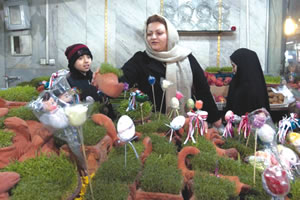
winter to spring on the vernal equinox, which usually happens on March 20 or 21 each year.
Nowruz (pronounced no-rooz) is a combination of two Persian words. The first word “now” means new and the second word “ruz” means day; together they mean “New Day”.
Today over 300 million people from all over the world celebrate Nowruz, whose origins can be traced back to the geographical area called Persia in the Middle East and Central Asia.
The distinct culture based on the language, food, music and leisure activities that developed among the many people and ethnic groups who lived in this area is known as Persian.
Nowruz became a popular celebration among the communities that grew from these Persian influenced cultural areas.
While the physical region called Persia no longer exists, the traditions of Nowruz are strong among people in Afghanistan, Iran, Iraq, Tajikistan, Uzbekistan, Azerbaijan, India, Pakistan, Turkey, Canada and the United States.
Hence Nowruz is a holiday that is celebrated by people from diverse ethnic communities and religious backgrounds.
For the Parsi community, however, Nowruz is very special and is known as their spiritual New Year.
Nowruz starts at the exact moment of the vernal equinox, commencing the start of the spring.
It is the first day of the New Year in the Iranian calendar which is March 21 when day and night have equal hours. The festival’s celebrants believe that on Nowruz light overcomes darkness.
Iranian old traditional beliefs view the emergence of light as the dismay of the darkness.
In realisation of the prominence and the importance of Nowruz in the life of Persians and the world, the United Nations Educational, Scientific and Cultural Organisation on September 30, 2009 recognised this day as the International Day of Nowruz.
The world body described it as a spring festival of Persian origin which has been celebrated for over 3 000 years.
In his message, the Secretary-General Ban Ki-moon, on the International Day of Nowruz, 2011, says, “ . . . l hope people everywhere will join in observing this Day (Nowruz).
“At a time of crisis, upheaval and change, including in the very regions where the holiday is rooted, let the spirit of Nowruz prevail.”
These sentiments by Ban Ki-moon are clear testimony that all the people across the world have a great responsibility to understand the universal message of Nowruz, since this noble tradition has been passed from generation to generation, with its deep philosophical heritage heralding universal humanitarian values.
Among its many attributes is that it promotes values of peace and solidarity between generations and within families as well as reconciliation and neighbourliness, thus contributing to cultural diversity and friendship among peoples and different communities.
Nowruz is, in essence, the Celebration of Life.
From an Islamic point of view, any day in which one is not disobeying God or not committing sin is a festival or Eid.
Since Nowruz was practised before Islam, when the religion of Islam came into existence all the customs and beliefs which were not against the will of God and the teaching of the Holy Koran were approved by Islam. Amongst such festivals was Nowruz because its concept goes along with the Islamic teachings and it does not contradict the Islamic faith.
The following are some of the concepts of Nowruz which are synonymous to the teachings of Holy Quran:
l respecting of Elders
l forgiveness of sins
l resolving of conflicts and disputes among the believers
l giving of gifts to children
l cleanliness as the prescribed by the Holy Prophet who says cleanliness is from faith which in Nowruz is achieved through cleaning houses and wearing new clothes
l helping the poor and underprivileged
l the respect of nature and the creation of new life and being thankful to the blessing and mercy of God.
Nowruz and Customary Rituals Nowruz begins with “Saal-Tahvil”, and a prayer which can be translated as year delivery. It is the very first instant in the New Year — the exact moment of the spring equinox.
Everybody in the family, dressed up in his or her new clothes, gathers around the Haft Sin spread looking forward to “Saal-Tahvil”.
As the countdown ushers in the New Year, the members of the family start praying, rejoicing, cheer up, hug and kiss each other, and exchange Nowruz greetings, “Eid-e Shoma mobarak!” or “Sal-e No Mobarak” (Happy New Year). Now everyone, especially the children and the youth, moves on to make the rounds of the elders of the family first, then the rest of their family and finally their friends and the neighbourhood.
Adults, too, have a set schedule of visits and receiving visitors.
This custom, that first the young call on the elder demonstrates the respect that Iranians pay to the aged people.
Visits are short, so that a typical trip takes about 30 minutes.
“Eidi”, new-year gift, is another characteristic feature of Nowruz. Within the family, it is the duty of the head of the household to grant the Eidi to the members of the family, the same can be true of the visitors as well.
Of course, in the case of visitors only those who are considered younger, or lower in rank, would receive “Eidi”.
It is to be mentioned that the young visitors do not bring any gifs with them, and may only receive a gift.
The rounds of visitations might last as long as twelve days, up to the day of “Sizdah-Be-dar”.
Just like other cultural celebrations, many special foods are prepared during Nowruz, depending on the country of origin.
One of these dishes, ash-e resteh or noodle soup, is typically served on the first day of Nowruz.
This soup is special because the knots of noodles symbolise the many possibilities in one’s life, and it is thought that untangling the noodles will bring good fortune. Another Nowruz dish is called sabzi pollo mahi (fish served with a special rice mixed with green herbs).
The rice is made with many green herbs and spices, which represent the greenness of nature at spring.
Special sweets are also served during Nowruz.
Traditional items include naan berengi (cookies made from rice flour); baqlava (flaky pastry sweetened with rosewater); samanu (sprouted wheat pudding); and noghl (sugar-coated almonds).
Among all Persian ancient ceremonies, Nowruz with its different aspects in every region of the country has got no more real, fresher and deeper peer.
Nowruz repeats and renews everything, generates and revives the nature and influences Iranian creative soul, emotion and thought.
Meanwhile, although the Iranians, who were converted to Islam, observed and are observing the Muslim lunar calendar for religious purposes, the Iranian calendar was soon restored within a century for administrative and economic reasons and that it continues to be their daily time reckoning.
l Mohammad Asadi is the Head of Cultural Centre of the Islamic Republic of Iran.


 Online Reporter