
Remember Deketeke-Municipal Correspondent
ZIMBABWE’S local authorities registered a decline in overall performance during 2025, with the country’s largest urban councils failing to improve service delivery despite their central role in the economy, a new Government performance evaluation has revealed.
The Ministry of Local Government and Public Works’ Annual Performance Feedback Report for the Fiscal Year 2025 shows that the average performance score for the country’s 92 local authorities fell from 3,67 in 2024 to 3,61 in 2025 on a six-point performance scale.
This indicates that while councils generally remained operational and within acceptable performance variance, most continued to fall short of their service delivery targets.
The findings have heightened concern within the Government as Zimbabwe transitions to the second phase of local governance reforms under the National Development Strategy 2 (NDS2), where measurable improvements in service delivery are expected to drive the attainment of Vision 2030.
The report, prepared by independent performance management consultancy firm Best Practices (Private) Limited on behalf of the ministry, assessed all the 92 local authorities, comprising 60 rural district councils (RDCs) and 32 urban local authorities against agreed annual performance indicators.
One of the most striking findings was the sharp decline in councils meeting all their performance targets.
Nationally, the proportion of councils that achieved all their targets dropped from 31 percent in 2024 to just 20 percent in 2025, meaning four out of every five local authorities failed to fully deliver on their annual commitments.
The report identifies local authorities as the weakest-performing institutions within the ministry’s broader performance management framework and warns that without urgent reforms, service delivery could stagnate further and undermine national development objectives.
How councils were assessed
The assessment used a six-point rating system to evaluate performance across agreed service delivery indicators. A score of six represented very good performance, while one reflected the poorest performance.
Scores of four and above indicated councils had exceeded acceptable performance levels, while a score of three represented acceptable performance within variance.
Scores below three signified underperformance requiring corrective intervention.
Although the national average of 3,61 remains above the minimum acceptable threshold, evaluators noted that it reflects modest rather than exceptional performance and points to a sector that is largely maintaining services instead of significantly improving them. The evaluation found that RDCs continued to outperform local urban authorities.
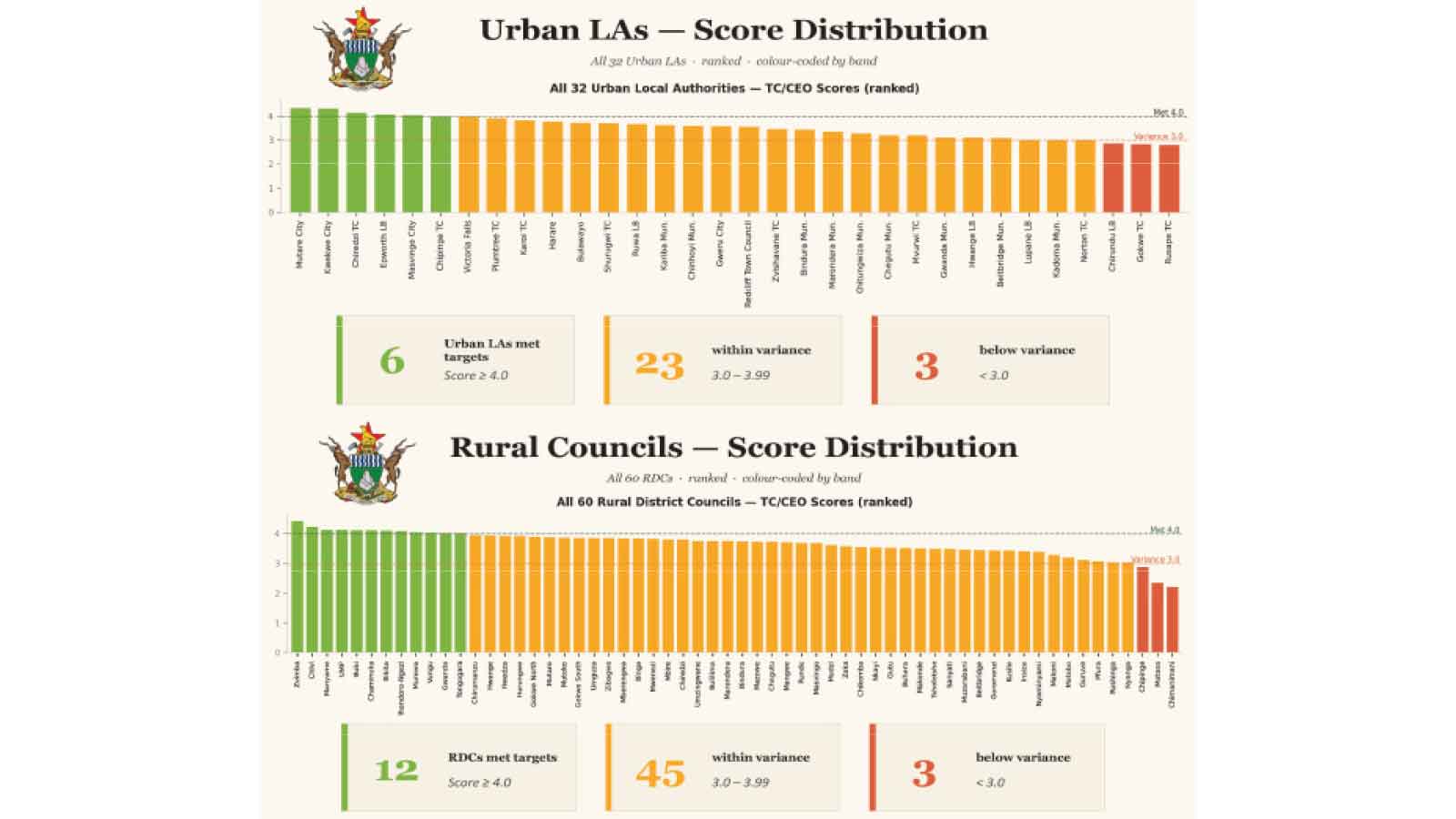
Rural councils recorded an average score of 3,66, compared to 3,52 for urban councils.
Among rural authorities, 12 exceeded their performance targets, 45 performed within acceptable variance and only three fell below acceptable levels.
Conversely, only six urban councils met all their targets, while 23 remained within variance and three performed below acceptable standards. The report attributes the stronger performance of rural councils to comparatively less complex infrastructure systems, improved utilisation of devolution resources in previous years, stronger collaboration with development partners and more focused service delivery programmes.
Overall, 74 percent of all local authorities were classified as performing below target, although still within acceptable variance, creating what evaluators described as a “mediocre-performance equilibrium”.
Zvimba Rural District Council emerged as Zimbabwe’s best-performing local authority with a score of 4,42.Mutare City was the highest-ranked urban authority and second overall after scoring 4,33, followed by Kwekwe City on 4,31. The report attributes the success of leading councils to strong revenue collection systems, sound corporate governance, efficient utilisation of equipment and productive partnerships with the Government, development agencies and the private sector.
The dominance of rural councils among the country’s top performers suggests that smaller local authorities are increasingly outperforming larger municipalities in governance, financial management and implementation of development projects.
Major cities under scrutiny
Despite their importance to Zimbabwe’s economy, Harare, Bulawayo and Chitungwiza all failed to distinguish themselves.
Harare scored 3,77, ranking 10th among the country’s 32 urban local authorities and 50th nationally. Bulawayo followed closely with 3,72, ranking 11th among urban councils and 51st nationally.
Chitungwiza performed significantly worse, scoring 3,29 to rank 21st among urban authorities and 61st nationally. The report warns that the weak performance of the country’s largest municipalities presents both an economic and governance risk because they are expected to drive industrial growth, commerce, investment and urban development. The findings reinforce recent remarks by Local Government Minister Daniel Garwe, who described Harare, Bulawayo and Chitungwiza as councils in the “intensive care unit” because of persistent failures in water supply, refuse collection, road maintenance and sewer management.
Minister Garwe has since directed the three councils to submit turnaround strategies detailing how they intend to improve service delivery.
Service delivery gains
Despite the overall decline, councils recorded notable achievements in 2025.
Collectively, local authorities completed 1 867 ward development initiatives against a target of 1 462, drilled 1 690 boreholes, constructed 429 classroom blocks and 135 clinics, maintained more than 18 285 kilometres of roads, achieved over 95 percent refuse collection coverage in central business districts, implemented 85 percent e-governance systems and ensured full online availability of public services.
According to the report, these achievements were largely made possible through partnerships involving the Central Government, communities, development partners, the Rural Infrastructure Development Agency (RIDA), non-governmental organisations and the private sector.
Worst-performing councils
Six local authorities were classified as performing below acceptable variance and requiring urgent intervention.
Chimanimani Rural District Council ranked last nationally with a score of 2,21, followed by Mutasa RDC on 2,35.
The report attributes their poor performance to weak governance systems, poor revenue collection, deteriorating infrastructure and persistent failures in delivering basic municipal services. Most collected less than 30 percent of their projected revenues, severely limiting their operational capacity.
The evaluation identifies several structural constraints affecting local authority performance. These include low revenue collection, which averaged only 59 percent nationally, non-revenue water losses estimated at 45 percent, ageing water and sewer infrastructure, inadequate equipment, delayed devolution funding, reduced allocations from the Zimbabwe National Road Administration (ZINARA), illegal settlements and the rapid growth of informal vending.
More than 80 percent of councils reportedly received no devolution funding in 2025, resulting in stalled infrastructure projects and delays in acquiring essential machinery.
The report also notes that poor payment compliance by residents and outstanding debts owed by Government institutions continue to weaken municipal finances.
Calls for reform
To accelerate improvements, the report recommends establishing a Presidential Local Government Performance Delivery Unit to strengthen monitoring and accountability across councils. It also proposes improved revenue collection systems, implementation of minimum service delivery standards, accelerated rehabilitation of water and sewer infrastructure, increased investment in equipment and machinery, stronger governance systems and wider use of public-private partnerships.
Speaking during the launch of the Citizens Engagement and Scoring Platform a fortnight ago, Permanent Secretary in the Ministry of Local Government and Public Works Dr John Basera said the Government was shifting from the first phase of local governance reforms — “Call to Action 1: No Compromise to Service Delivery” — to a more demanding second phase, “Call to Action 2: Scale Up for Impact — Creating Vision 2030 Service Delivery”.
“We are transitioning from setting up administrative structures to enforcing aggressive high-impact service outcomes,” he said.
Commenting on the findings, Combined Harare Residents Association director Mr Ruben Akili urged councils to refocus on their constitutional mandate.
“Local authorities must return to the fundamentals of local governance,” he said.
“Their primary responsibility is to provide essential services such as clean water, efficient sewer management, refuse collection, road maintenance and public health.
“These are the core functions that directly affect the daily lives of residents and should always take precedence. “Over the years, some councils have become preoccupied with activities that are peripheral to their constitutional mandate, often at the expense of service delivery.
“Local authorities should refocus their resources and attention on delivering reliable water supplies, maintaining sewer infrastructure, effective waste management and other basic municipal services that residents expect and deserve.”