admin
admin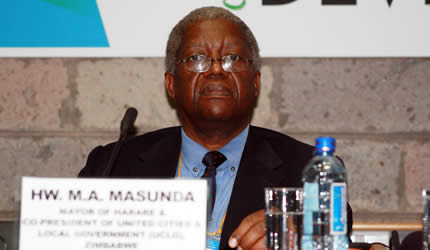
funded from revenue collections.
The city intends to collect US$291 million from residents, industry and commerce.
About US$74 million would be spent on capital projects.
The proposed charges for all services have remained the same as they were in 2012.
Refuse collection for a once a week service has remained at US$6,50 for high-density suburbs and US$9,50 for low-density areas while commercial enterprises would continue to pay US$16.
Ambulance fees remain at US$20 while inter-hospital transfers will be charged at US$30.
Burial fees (cremation) remain at US$200, while burial in the ‘B’ area is US$75, ‘A’ area US$100, and ‘A+’ US$175.
Fixed water charges remain at US$5 for high-density areas and US$11 for low-density areas and US$80 for industry and commerce.
The first 20 cubic metres would be charged at US$0,25, US$0,50 for the next 21 to 30 cubic metres, US$0,75 for the 31 to 50 cubic metres.
Consumption of between 51 and 100 cubic metres would be charged at US$1 per cubic metre while consumption above 100 cubic metres would be charged at US$2.
These charges apply to high density areas.
For low density suburbs the charges are much higher.
Health fees have remained static. Adults pay US$5 at clinics while children pay US$3 and US$10 at hospitals while children pay half the amount.
Maternity fees have also remained at US$25.
The rate card for high density suburbs remains at US$12,50, Mabelreign US$25.50, Folyjon Crescent US$41,50.
Chairman of the finance and development committee Clr Friday Muleya presented the budget to the special council.
The city expects to spend US$287 million and to have a surplus of US$4 million.
The funds are expected to be generated from a number of activities which include property tax (US$107 million), refuse collection US$23 million, welfare US$0,7 million, Zinara, billboards US$5 million, and city architect US$3,8 million.
Clamping and towing are expected to bring in US$5 million, health fees US$10 million, housing; rentals, leases and markets US$11,3 million.
Harare Water would rake in US$117 million, while parks and cemeteries US$0,8 million, metropolitan police US$2 million, education US$1,3 million, and estates US42 million.
Up to 40 percent of the expenditure would be on salaries and allowances for city employees.
“It is council’s intention to raise the projected amount of US$289 million required to finance the envisaged 2013 annual expenditure totaling US$288 million without increasing tariffs, charges and fees for the third year running,” said Clr Muleya.
He said a number of properties that are not currently being billed would be included on the valuation roll.
Funds from these properties would boost revenue collection.
Some of the areas soon to be incorporated into greater Harare are Sally Mugabe Heights, Southlea Park, Whitecliffe, Ushewokunze, Stoneridge Park, Zambezi Flats and Willowvale Flats.
He said council would intensify water and sewer pipe replacement.
“Pressure reducing valves are currently being installed to minimise incidences of burst pipes as a result of unregulated pressure,” he said.
The budget is results based and is geared to achieve the 2025 World Class City vision.
The proposals were adopted by the full council, which means the city would proceed to advertise the budget and invite for objections from ratepayers.
Mayor Muchadeyi Masunda appealed for constructive input from ratepayers for incorporation.
“We need to redouble our efforts to collect our revenue,” he said.
The city is owed over US$250 million by residents in unpaid rates and supplementary charges.


 Online Reporter