Online Reporter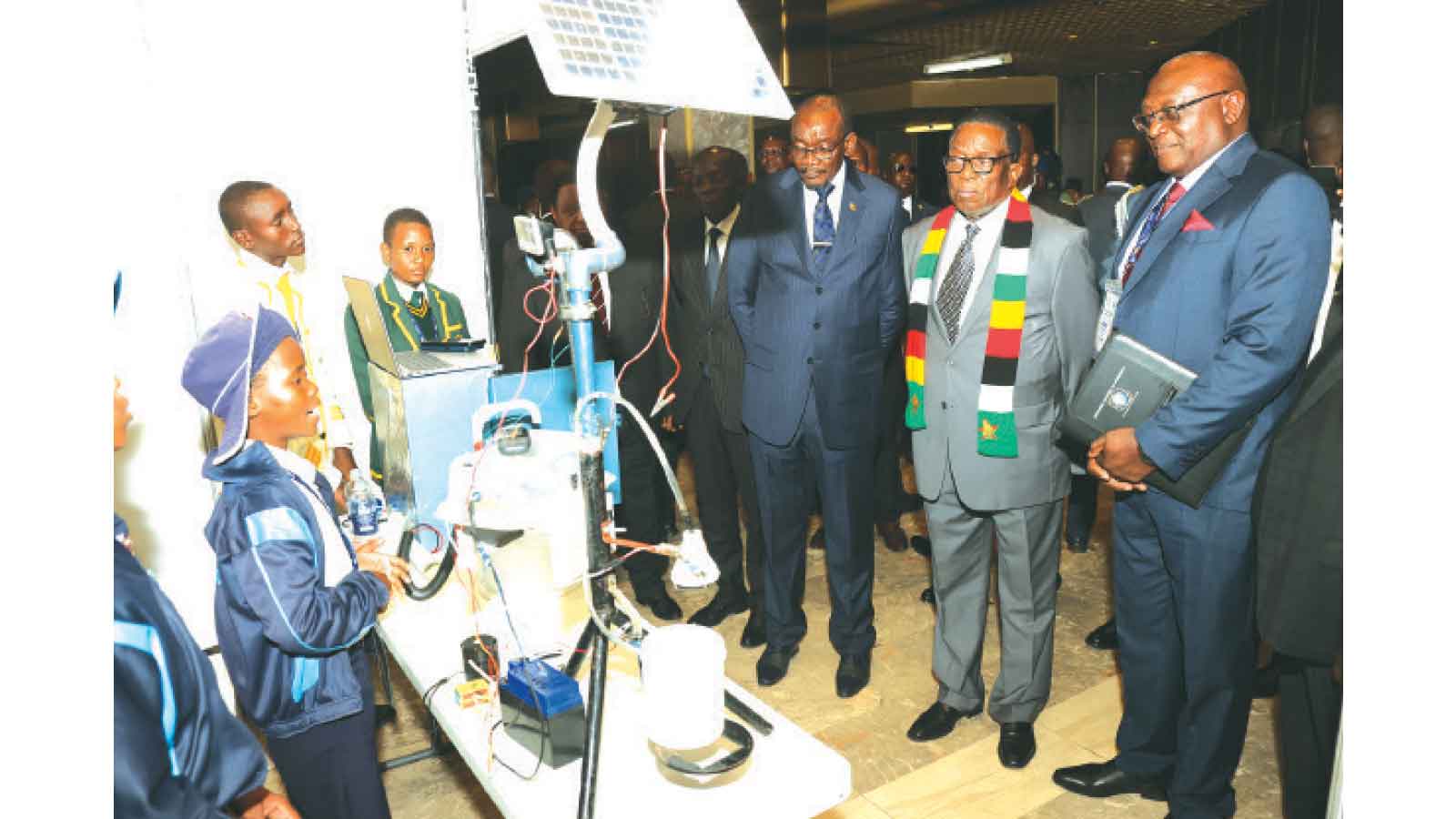
Debra Matabvu
Herald Reporter
ZIMBABWE should harness artificial intelligence, research and innovation to enhance efficiency across all economic sectors and develop practical, home-grown solutions to national challenges while accelerating industrialisation, modernisation and strengthening the country’s sovereignty, the President has said.
Speaking at the 14th Zimbabwe International Research Symposium at the Harare International Conference Centre yesterday, President Mnangagwa said research and innovation must be leveraged to create employment opportunities, particularly for young people, and improve the quality of life of citizens across the country.
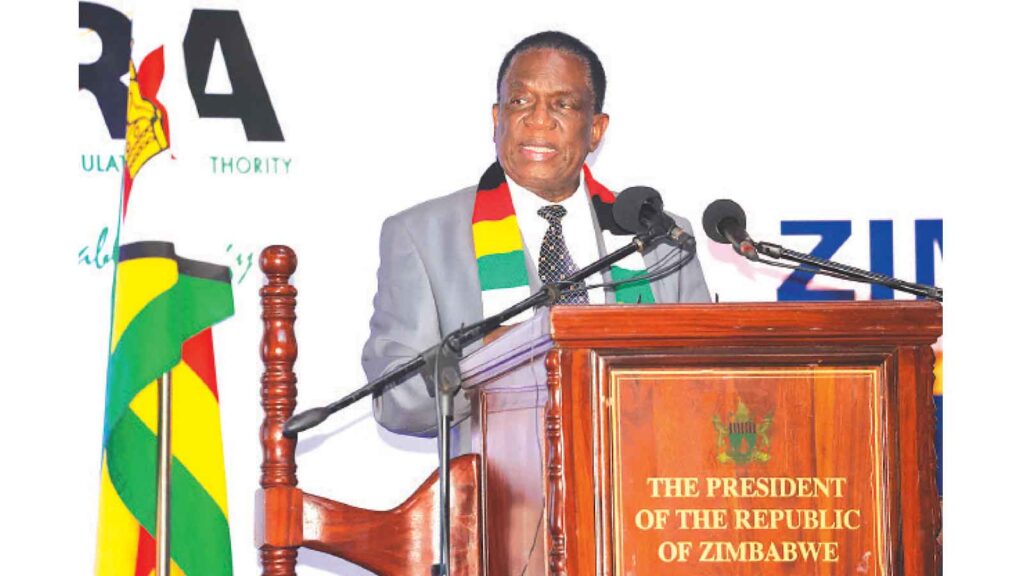
President Mnangagwa delivers his keynote address while officially opening the 14th Zimbabwe International Research Symposium at Harare International Conference Centre yesterday. – Pictures: Believe Nyakudjara.
The symposium brought together participants from primary and secondary schools, universities, polytechnic colleges, teachers’ colleges and Government departments, who showcased a wide-range of research projects, innovations and technological solutions aimed at supporting national development.
“Harnessing Artificial Intelligence should enable our economies to improve efficiency and safety in fields such as mining,” President Mnangagwa said.
“As Zimbabwe, we are not going back on scaling up the value addition and beneficiation of our vast minerals and natural resources which must now be transformed into high value products that create jobs, build industries and strengthen national sovereignty.
“With regards to agricultural sector, research must lead to precision agriculture that increases yields, while protecting the environment and fostering development of agro-processing industries, for both domestic and export markets.
“Our pharmaceutical research must produce medicines that reduce import dependency and strengthen our health systems, while also inculcating predictive healthcare systems that save lives.
“Furthermore, modern manufacturing platforms should enable us to produce goods competitively and stronger public systems that deliver services efficiently. Above all, artificial intelligence should create new opportunities for our young people.
“The ICT sector should progressively begin to see our robust platforms for digital trade, e-government and fintech solutions that expand financial inclusion.”
President Mnangagwa also called on the country’s institutions of higher learning to intensify research, innovation and knowledge generation in support of national development priorities.
The President urged the institutions to continue translating research findings into tangible products and services that contribute to economic growth.
“Research must move beyond the classroom and into practical solutions,” President Mnangagwa said.
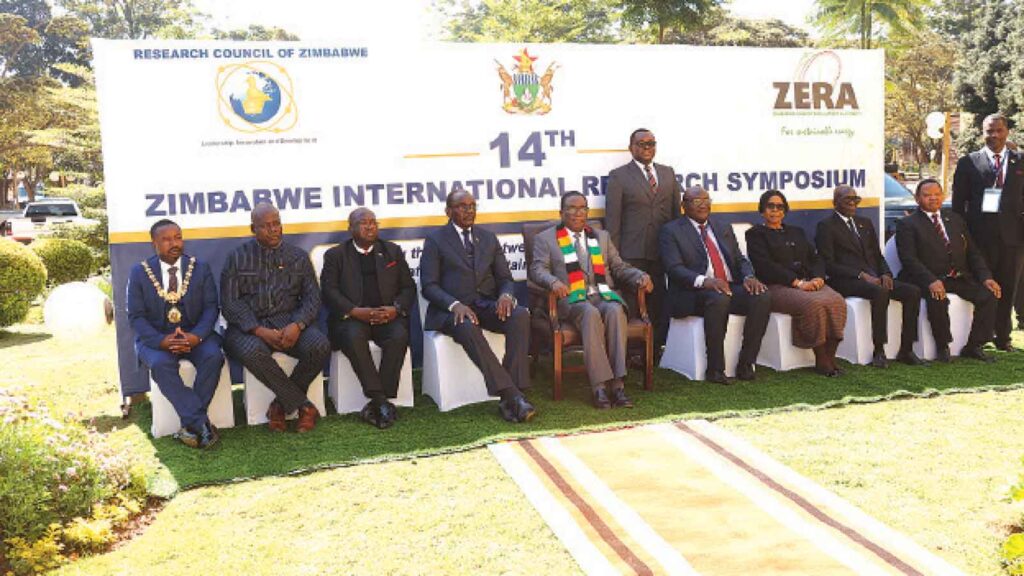
The President and Vice President Dr Kembo Mohadi (fourth from left) are joined by ministers and other senior officials for a family photo at the symposium.
“It is with this recognition that my administration adopted Heritage- Based Education 5.0 policy.
“This has seen our institutions of higher learning being transformed from centres of theory into engines of industrialisation.”
“Through innovation hubs and industrial parks, research has translated into tangible products, start- ups, patents and industrial solutions that contribute directly economic growth.
“We now have students who think, question, experiment and innovate with boldness as inventors, entrepreneurs and nation builders.
“Their creativity is being harnessed to produce solutions that are home-grown, practical and uniquely Zimbabwe.”
President Mnangagwa said research should be translated into solutions that change the ordinary people’s lives towards the realization of the country’s goal of becoming an upper middle economy by 2030.
“I once again challenge you to strengthen collaboration, inspire bold ideas and accelerate the translation of research into life transforming solutions that improve the quality of life of our people,” President Mnangagwa added.
“Collectively, lets us harness artificial intelligence, research and innovation towards the realisation of an empowered and prosperous upper middle -income society by 2030.”
He said the research is a key catalyst in developing, modernizing and industrializing any economy that the Second Republic has established policies and an enabling ecosystem aimed at promoting research-driven innovation across all sectors of the economy.
The President said the policies seeks to accelerate industrialisation, value addition and beneficiation, ensuring that research contributes directly to sustainable economic growth and national development.
He said: “To date, my cabinet has approved the research amendment bill, which will soon be tabled before Parliament.
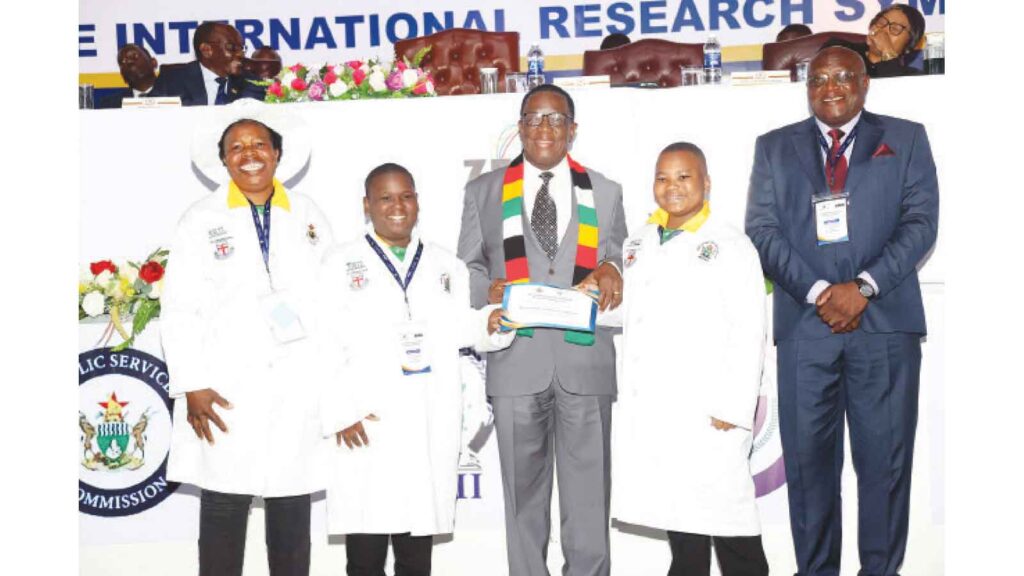
The President hands over a certificate of distinction to Cecil John Rhodes School learners Moses Msipa and Alicious Tamisayi at the symposium.
“This bill seeks to transform the research authority of Zimbabwe and sets a national target of our Gross Domestic Product for allocation to research and development.
“It is opportune that my Government adopted the National Artificial Intelligence Strategy (2026-2030) earlier this year.
“Hence I am confident that the deployment of new technologies will be appropriately guided by ethical, inclusive and responsible Artificial Intelligence adoption.”
President Mnangagwa also called for stronger collaboration among all stakeholders, particularly the private sector, to support the adoption and commercialisation of research and innovation outputs across all sectors of the economy.
He further urged African countries to strengthen partnerships in the development of artificial intelligence, saying collaborative efforts were critical to harnessing emerging technologies to drive industrialisation, boost productivity and accelerate sustainable development across the continent.
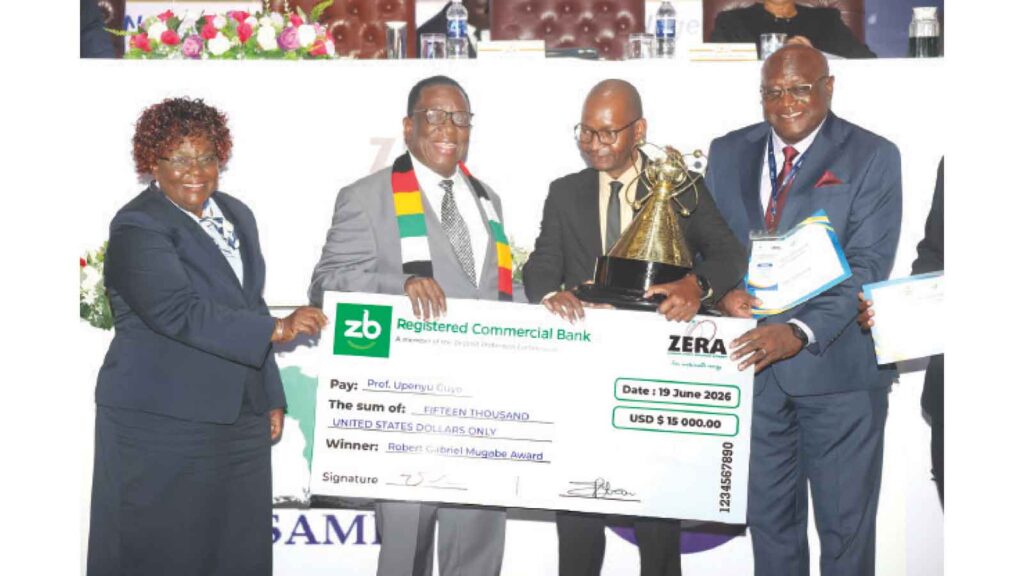
The President hands over a symbolic cheque of US$15 000 to the overall winner, Professor Upenyu Guyo (second from right), who won the Robert Gabriel Mugabe Award at the colourful event.
“Let us imagine a Zimbabwe, SADC and Africa where mining companies partner with Universities to develop Artificial Intelligence-driven exploration and exploitation tools as well as new technologies for increased production and productivity,” he added.
“Agro-industries should also collaborate with researches to build climate-smart processing plants, ICT firms strengthen synergies with innovators to create platforms for e-commerce improved service delivery and new technologies.”
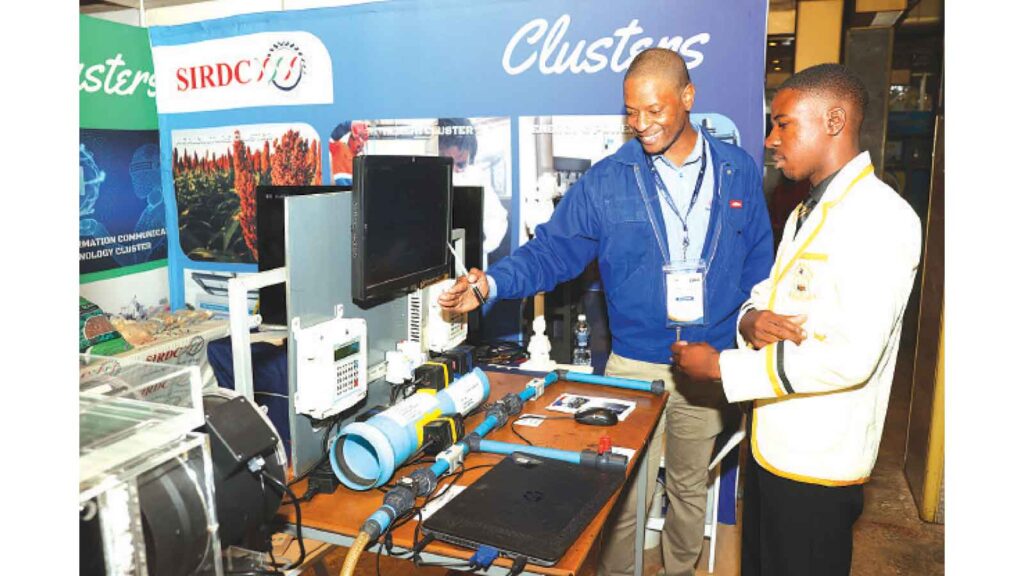
A learner listens as a SIRDC staffer takes him through some of the innovations being exhibited at the symposium.
President Mnanagwa said Zimbabwe remained committed to mutually beneficial research partnerships that advanced shared prosperity and collective progress.
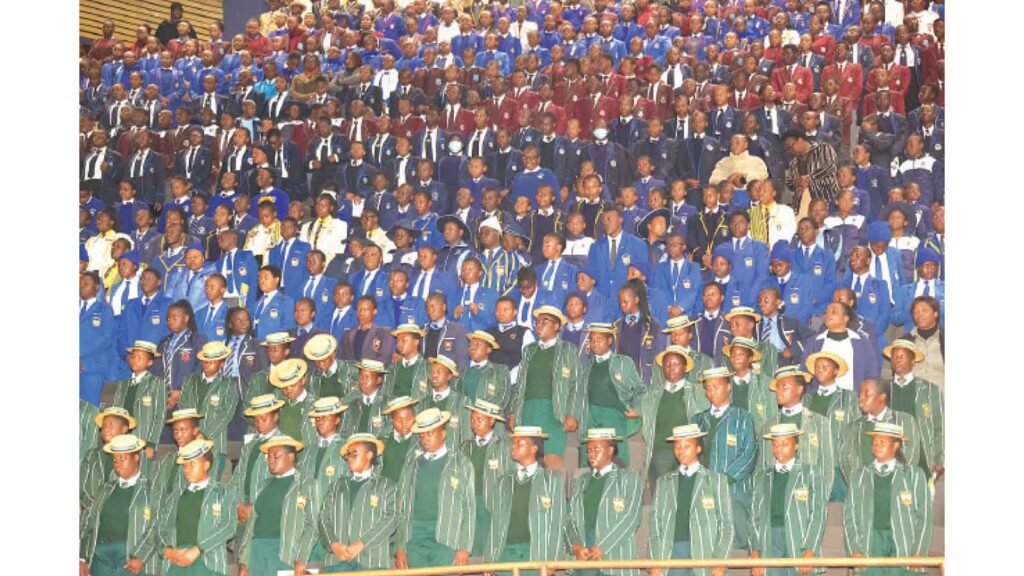
Learners from various schools across the country sing the National Anthem at the colourful annual event.
The symposium was attended by Vice President Dr Kembo Mohadi, Chief Secretary to the President and Cabinet Dr Martin Rushwaya, Defence Minister Oppah Muchinguri-Kashiri, Higher, director general of East and Southern Africa Management Institute (ESAMI) Professor Peter Kiuluku and various Government officials.
President Mnangagwa also presented awards to schools, universities and Government departments that showcased outstanding innovations at the symposium