Chronicle Editor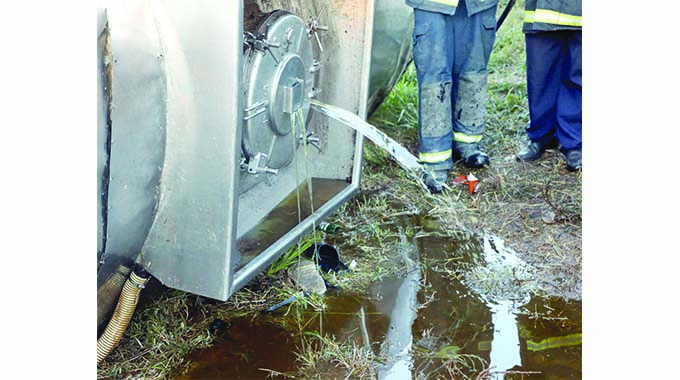
Mkhululi Ncube, [email protected]
A piercing smell of petrol engulfed the atmosphere following spillage of the hazardous liquid along Harare Road recently.
Although I tried to stand at a safe distance as I had to cover the accident, fear of an explosion kept creeping into my mind.
This was the second accident of this nature along the same road within two months.
The first accident was in March when a truck transporting cooking oil to Zambia overturned near Mahatshula suburb in Bulawayo.
By the time I got to the petrol tanker accident scene, residents had already started looting the petrol as police and fire officers tried in vain to stop them.
This was against the backdrop that in June 2011, eleven Sunningdale residents in the capital died as they were siphoning fuel from an overturned tanker.
In December last year, four Zimbabweans lost their lives in South Africa following the explosion of a tanker which was carrying Liquefied Petroleum Gas in an incident which killed 18 people.
Recently, two Sizinda boys suffered horrific burns following an explosion while trying to “sort” a container they wanted to sell as scrap metal.
The sight of the two boys at Mpilo Central Hospital was a sorry one as one had his face almost entirely burnt in what will be a lifelong reminder of the incident.
These accidents lingered at the back of my mind as I tried to get the story even though in this field we say, “No story is worth dying for”.
The accident which happened adjacent to Mzilikazi Barracks was attended to swiftly with the road leading to the scene blocked from both ends.
But despite this, some ignorant motorists still wanted to go through despite police telling them it was not safe to do so.
After gaining entrance to the blocked zone, Environmental Management Agency (EMA) Environmental Quality Officer Mr Fredrick Maponga was watching with me from “afar” as the fire fighters battled to contain the situation.
“Bro, if there’s an explosion, the fire will wipe us out because its windy. Even though we are a bit “far”, we will not be able to escape,” he said.
Although I already knew it was a dangerous assignment, that statement raised my adrenalin and I kept making silent prayers as I gathered the news.
EMA Bulawayo Provincial Manager Mrs Sithembisiwe Ndlovu says there are a number of dangerous substances which are transported on the country’s roads regularly.
There is a law in place to regulate their handling and transportation.
“According to SI 268 of 2018, a Hazardous Substance means any substance whether solid, liquid, or gaseous which is injurious to human health or the environment.
These substances can either be explosive, gases ( LPG, acetylene), flammable and combustible liquids (petrol and diesel), flammable solids (Nitrocellulose products), oxidising (fluorine), toxic (cyanide), radioactive, corrosive (caustic soda).
“In Zimbabwe, these substances are regulated by the Environmental Management Act. This means if anyone wishes to import, store, use, sell, dispose or transport, they have to do so under a licence issued by EMA. This ensures proper handling of these hazardous substances is done in compliance with environmental laws,” said Mrs Ndlovu.
Because Zimbabwe is a conduit connecting a number of countries within the Sadc region, a number of dangerous substances are transported on our roads daily thus exposing the nation to danger should accidents happen.
Concern remains the lackadaisical approach shown by members of the public in the face of such potential disasters.
“Zimbabwe is strategically located on the North South Corridor and East to West Corridor. Some chemicals enter Zimbabwe as their last destination while others transit through Zimbabwe to other countries in the region.
The use of road transport presents an increased risk of environmental damage and public health calamity owing to accidental chemical spills.
The challenge faced during these accidental chemical spillages is the danger posed by the substances to human health and the environment.
“In many cases, members of the public have gone to the extent of approaching and even acquiring some of the spilled substances with some catastrophic consequences like the 2011 Sunningdale disaster, when some members of the public lost their lives while trying to decant fuel from a tanker that overturned. In the process the tanker caught fire,” said Mrs Ndlovu.
In 2021, Bulawayo had one accidental spillage against a national total of 50 accidental spillages while this year three cases of spillages and explosion of dangerous substances have been recorded in the city.
“In cases of spillages, we advise members of the public to call emergency services and stay away from the scene.
The transporter is also advised to notify the agency within 24hrs of such accidental spillages,” said Mrs Ndlovu.
Bulawayo City Council Acting Chief Fire Officer Mr Linos Phiri is worried about the danger such accidents pose to his fire men and members of the public.
He said motorists must follow direction that will be given by police when such accidents occur.
“When the petrol tanker overturned, we closed all roads but there was one drunken driver who was driving a car with one wheel on a rim which was producing sparks and it could have been a serious disaster had he not been stopped,” he said. — @themkhust



 Online Reporter