admin
admin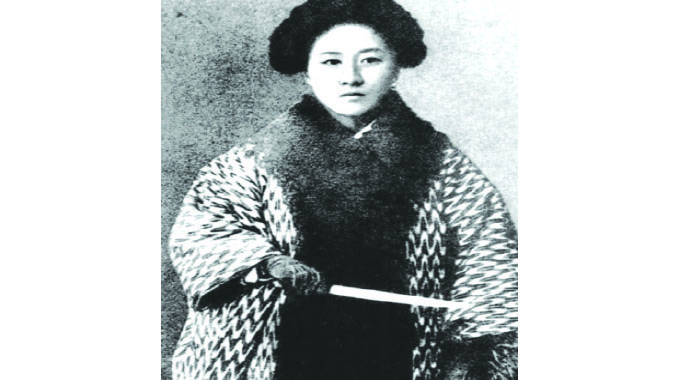
Ms G
This passing week one can hardly open a newspaper without reading about the heroism of Mbuya Nehanda. But to me, the best point made about her is by the first lady, who tweeted that the beautiful monument was not only a symbol of Zimbabwe’s struggle for liberation, but also a celebration of the enormous role Zimbabwean women played to guarantee the freedom.
When we think of wars and martyrs, the male image is usually the first to come up. But in the revolutionary history of Zimbabwe, and China as well, women were never absent. Some of them became household names and inspirational figures like Mbuya Nehanda herself.
This week’s story is about Qiu Jin, the leading female revolutionary in China. She was born in 1875, when China was still under the rule of the Qing Dynasty, into a respected, albeit declining, gentry family. Her father was a government official. Her mother also came from a distinguished literati-official family.
By all accounts, she had a comfortable childhood. But like all the girls at that time, she was forced to live like a secondary citizen, owned and objectified. But she did not enjoy needlework and all the girlish stuff at all. Instead, she became very good at martial arts, sword, and horse riding and took a particular interest in political affairs.
After marrying the man her parents chose for her and moved to Beijing with her new family, Qiu Jin struck up friendships with like-minded women and began to be involved in politics.
Her husband, she felt, was uncultivated and had no ambition. In the summer of 1904, the 28-year-old housewife acted on a bold decision: She left her husband and two children, sold her jewellery and sailed for Japan. For that reason, scholars sometimes call her “China’s Nora,” after the character in Henrik Ibsen’s 1879 play “A Doll’s House”.
In a 1904 poem called “Regrets: Lines Written En Route to Japan”, she looked back on the first half of her life and wrote this:
Sun and moon have no light left, earth is dark,
Our women’s world is sunk so deep, who can help us?
Jewellery sold to pay this trip across the seas,
Cut off from my family I leave my native land.
Unbinding my feet I clean out a thousand years of poison,
With heated heart arouse all women’s spirits.
Alas, this delicate kerchief here,
Is half stained with blood, and half with tears.
In Tokyo, Qiu enrolled at Shimoda Utako’s Women’s Practical School, but focused most of her energy outside the classroom, connecting with other reform-minded Chinese students similarly keen on fomenting revolution back home.
In 1906, she returned to China with a militant determination to advance women’s causes and topple the Qing government.
She started the “Chinese Women’s Journal,” which featured nationalist and feminist writings, and learned how to make bombs.
By 1907, Qiu was running a school, which was a front for a group recruiting and training young revolutionaries. After another co-founder was executed, she became a wanted conspirator.
She had enough time to flee but she refused. It was her final act of resistance.
On July 15, 1907, Qiu Jin was beheaded publicly in her home village at the age of 31. On the day of her execution, she wrote down a line from an ancient poem, “Autumn wind, autumn rain, fill one’s heart with melancholy.”
Chinese poetry commonly associated autumn with death and mourning. The lines were her condemnation of the dark times under the feudal rule.
Shocked by the brutal execution of a woman, many Chinese were strengthened in their resentment of the Qing dynasty.
Qiu Jin immediately became a national hero and was the subject of poetry, drama, and numerous works of fiction. Much of her writing, including her poetry and letters to family and friends, was published after her death.
One of her poems begins “Don’t tell me women/are not the stuff of heroes”. Another reads, “With all my heart I beseech and beg my two hundred million female compatriots to assume their responsibility as citizens. Arise! Arise! Chinese women, arise! ” Through her poetry and her heroism in making the ultimate sacrifice for freedom, millions of Chinese, especially the women, realised that freedom was not to be asked for politely or served on a silver plate. Four years later, China started its 1911 Revolution, which toppled the Qing government.
100 years on, as we relive the memory of great women like Mbuya Nehanda and Qiu Jin, it pains our hearts that, in some parts of the world, women still have to face the possibility of death for freedom and equal rights. Even where death is distant, the invisible barriers holding women back remain formidable.
The tremendous courage that distinguished these heroines are still urgently needed today. It is important that we honour their memories so that young girls are emboldened to carry on the fight.


 Online Reporter