admin
adminthe theme of the 2011 Harare International Festival of the Arts exhibition.
The exhibition went beyond our borders to bring important fine artists and their work into an exhibition with a multitude of selected local artists at the National Gallery of Zimbabwe.
The grand exhibition that will run until May 31, 2011 triggers back memories of our yesteryears’ prestigious “Zimbabwe Annual Heritage” where only exceptional work and major artists showcased. The Hifa exhibition in partnership with the United Nations Educational, Scientific and Cultural Organisation was carefully curated by Raphael Chikukwa of the National Gallery of Zimbabwe who is highly knowledgeable about African art history and quality.
The art show seeks to examine African borders in post- colonial Africa which have remained questionable with many African leaders talking about African Renaissance, Ubuntu, African Unity and African Union.
The African identity has remained questionable as well as the Diaspora issue, which is still a bone of contention too. Recent events in South Africa, Kenya and other parts of the region cannot go without artists questioning the dream by the first African nationalists.
Migration between countries in Africa did not start today but it has been a phenomenon since creation and the need to celebrate our differences is long overdue and artists stand as a medium to create a platform for dialogue. Zimbabwe offers itself as a centre and platform for a dialogue through this exhibition.
The show exhibits artworks by such great African art masters like Malangatana from Mozambique, whose work was loaned from Tambira Galleries and Mai Sibanda, the executive director of the National Gallery of Zimbabwe.
Other foreign artists to grace the show include the highly innovative Lawrence Chikwa from Zambia, who also gave a remarkable presentation of his artwork in the “Harare Conversations” art discourse as one of the main speakers. Uhuru Kgope from South Africa is showcasing various African facial expressions on his magnificent luminous oils on canvas paintings.
Miriam Kiyambi, from Kenya, and representatives from Botswana, Uganda, Sweden, Germany and the United Kingdom are also part of the exhibition.
Local long lost friends Tonely Ngwenya and Prince Matsika produced striking work amongst several highly creative young and upcoming moving on artists who are always breaking through imposed boundaries or market expectations.
Young career visual artists who choose materials which allow them to say what they want to say, by the stones, scrap metal, odd bits of glass, the rays of the sun, the light of the moon, the desert sands, found objects, paints, canvas and boards.
Young artists who manoeuvre and negotiate for the desired space to allow work to be created not simply made. The young artists include the director of the First Floor Gallery, Moffat Takadiwa, whose work titled “Circumcised Bombs” is infested with numerous bottles; Gareth Nyandoro, the master of junk, whose installation titled “Kupinda Nemwenje Mudziva” and Gideon Gomo’s “I Had A Dream” mixed media sculpture are arguably the major pieces of the show.
Gomo’s extraordinary piece unleashes creativity and a huge discharge of energy that has become loose all over the place. His outlandish use of scrap metal, stone and various bits on the piece leaves the onlookers wondering, cheering and applauding around it as it deservedly occupies the whole Courtauld Gallery’s floor on its own.
A one metre and sixty centimetre map of the African continent rising at an angle welded in scrap metal has a semi- realistically welded half limbed hand, probably of the all mighty, pulling up eight African heads with indeed over- exaggerated facial features carved in springstone but hooked with chains of hell by the back of their craniums.
The heads are truly in agony whilst the other blacksmith welded hand cut off from the middle limb holds various goodies probably for the sufferers when they are elsewhere relieving from the excruciating pain.
On the other hand, Nyandoro has carefully arranged in a three-metre diameter circle, nine small tin can paraffin lamps occupying two-thirds of the circle which is completed from left to right by a small extremely shining either Chinese-made stainless steel dish or Mapositori made.
The dish contains the tenth tin can paraffin lamp lying in the middle of spilt paraffin. The dish is surrounded by deliberately arranged small yellow and white used candles and a few more lie by the side.
About 40 centimetres further on the same arch, three sets of the same dishes are placed about 30 centimetres apart with one dish facing down and the other one sits the right side up on top.
The first set top dish contains a small piece of a yellow cloth covering the whole bottom. The middle set has the top dish containing a little quantity of blue tainted paraffin and the third set has the top dish containing a number of yellow and white used small candles lying submerged in paraffin.
A fourth set of dishes is balanced empty between the first two sets and the circle is summed by another dish facing down about another 40 centimetres from the third set.
Another tin can paraffin lamp sits on top of the dish surrounded by upright arranged yellow and white short used candles. The title of the piece “Kupinda Nemwenje Mudziva” entails the dangers of getting carried away or being oblivious.
Other astonishing pieces are from Charles Bhebhe, Batsirai Muswe, Olivier Schimmel, Keith Zenda, Anusa Salanje, Portia Zvavahera, Rudo Zijena, Victor Nyakauru, Linda Barry, Luxon Gutsa, Calvin Chimutuwah, Boarding Dzinotyiweyi, Wallen Mapondera, Crycio Jorge, to mention a few.
l Stephen Garan’anga is an international fine art practitioner, independent art projects co-ordinator, chairperson of AfricanColours Artists, executive member Batapata International Artists’ Workshop, critical visual arts writer amongst other things. He can be contacted on the following email address: [email protected]


Online Reporter
- Chronicle
- July 31, 2026
- 3 views
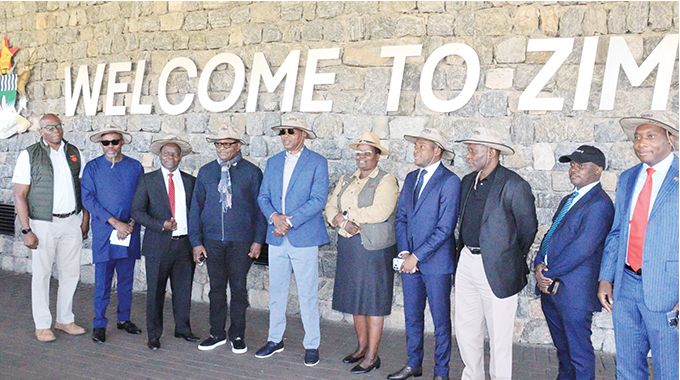
Zimbabwe sets pace as Beitbridge becomes Africa’s model border
Thupeyo Muleya, [email protected] The new state-of-the-art Beitbridge Border Post is changing how people and goods move between Zimbabwe, the region and the rest of the world. Backed by cutting-edge technology,…