

 Online Reporter
Thupeyo Muleya, [email protected]
The new state-of-the-art Beitbridge Border Post is changing how people and goods move between Zimbabwe, the region and the rest of the world.
Backed by cutting-edge technology, expanded capacity, and stronger security, the US$300 million project has turned a border that was once a major bottleneck into a gateway now being studied by governments across Africa.
For years, Beitbridge was known for long queues, congestion and delays that frustrated travellers, truck drivers and traders. Services were run from containers and a single administration block.
Cargo could take 24 to 72 hours to clear. Some transporters even started avoiding the port and taking longer routes through less-busy crossings. That has changed. The facility now has three new terminals dedicated to freight, buses, pedestrians and private vehicles.
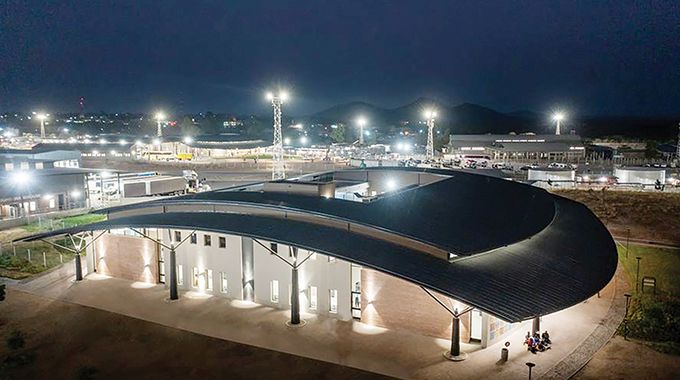
It processes close to 200 000 commercial trucks and more than seven million travellers annually. On any given day, it can handle 400 buses and 4 000 light vehicles.
Most importantly, 60 percent of commercial cargo arriving at the border is now cleared in under three hours.
The transformation was delivered through a robust Public Private Partnership between the Government and the Zimborders Consortium. After years of planning with little action, the New Dispensation moved to address a problem that had grown since the original infrastructure was built around 1992. Trade and human movement increased sharply after South Africa’s independence in 1994, but the border did not keep pace. The new project, conceived under the SADC treaty, began in 2016 with civil works starting in 2017 and completion in 2023.
Beitbridge sits at the heart of regional movement. It is the nexus for trade and travel for citizens of Malawi, Angola, the Democratic Republic of Congo, Mozambique, Tanzania, Zambia, Botswana, Zimbabwe and South Africa, and for tourists entering the region by road through South Africa. When this one border works better, the whole corridor works better.

The impact is already visible. Clearance times have dropped from days to hours. The border now operates 24 hours. More than 10 Government agencies operate under one roof through a Coordinated Border Management approach, which has cut duplication. Technology is at the centre of operations.
The port has fast cargo mobile scanners, baggage scanners, biometric access, 500 CCTV cameras and a Facial Recognition System. Traffic is separated with automated boom gates and digital signage. Traders can pre-clear using a Single Window and Single Payment System. An Electronic Cargo Tracking System monitors transit goods to reduce fraud. There is also an electronic Temporary Import Permit for visitors.
The results have been increased revenue collection, improved security and better working conditions for cross-border traders and staff. Zimra has recalibrated its services to match the investment made by the Second Republic.
The scale of the change is why Beitbridge is now attracting study visits from across the world. This week Zimbabwe hosted a high-level delegation from Benin, Cameroon, Nigeria and the African Export-Import Bank for a benchmarking visit. The team came to assess how the country is implementing regional trade facilitation protocols and to see first-hand how a modern border can work.

The delegation was led by the Comptroller-General of the Nigeria Customs Service, Mr Bashir Adewale Adeniyi. After touring the freight, bus, pedestrian and light vehicle terminals, he said the visit was about learning best practices.
“We are part of the international customs family, the World Customs Organisation family with more than 180 member administrations. It is necessary to undertake these benchmarking missions to learn best practices from each other,” he said.
“The visit to Beitbridge is to see how Zimra is conducting a modern border operation. To present a good experience of a border post, the infrastructure is excellent. It is a border post that is transparent, efficient and able to improve cross-border services.”
He was direct in his assessment. “First, a modern border post requires state-of-the-art infrastructure, and we have seen it here. As representatives from three delegations, we can say this can rival any border in Europe. It is world-class. Second, we have seen how Zimra, as the lead agent, is getting things moving in an organised and structured manner. This is something that should be replicated in other border posts all over the world.”
Mr Adeniyi said the delegation, which included representatives from Cameroon and other West African countries, was grateful to Afreximbank for promoting transformative projects. He also pointed to lessons on process reform.

“We have seen through the state of affairs at Chirundu that infrastructure alone is not enough. We have to match processes with infrastructure to deliver services better. We can replicate this in West and Central Africa.”
Among the delegation’s recommendations was deeper system harmonisation between South Africa and Zimbabwe.
“The border between South Africa and Zimbabwe should harmonise systems. The systems must speak to each other for easy trade. For example, an export document from Zimbabwe can be used as an import document in South Africa. The processes are built on trust, and there is a need for deployment of ICT,” he said.
He also commended Zimbabwe’s efforts to curb transit fraud through electronic tracking and data sharing. “When you see a border working like this, you know Africa can trade with itself efficiently. We are taking these lessons home,” he said.
The Zimbabwe Revenue Authority’s Acting Commissioner for Customs, Mrs Lonto Ndlovu, said the border has been attracting a lot of attention from stakeholders in the region and across the African Union.
“So far, President Mnangagwa has hosted his South African counterpart, President Cyril Ramaphosa, whose Government intends to modernise its border infrastructure at six ports of entry in an almost similar fashion,” she said.

“We have also played host to a delegation from the African Continental Free Trade Area, the South African Revenue Service, the Zambian Ministry of Industry, a delegation from Mozambique and learners from different schools.
“As customs administrations that belong to the World Customs Organisation, we are encouraged to identify those administrations that have modernised and have better infrastructure. Zimra has been identified by the West African countries for this benchmarking programme. So they are here to learn from us the best practices that we have employed and the technology that we have. This is very critical for us to host peers on such a mission. We have learnt a lot. They shared that we need to make use of AI, which they are already using to improve services at our borders. Benchmarking is a two-way street.”
She confirmed that the Government intends to upgrade the Chirundu and Forbes border posts using the Beitbridge model. At Chirundu, a One-Stop Border Post (OSBP) with Zambia is already operational and provides lessons for the proposed OSBP at Beitbridge with South Africa.
Zimborders Consortium General Manager Mr Nqobile Ncube said the visit was further affirmation that Beitbridge is now a continental reference point for PPP and BOT projects.
“This is an affirmation of the impact of this project, which rightly is used as a flagship model for PPP and BOT projects in Zimbabwe,” he said.
“We are glad to note that the impact of this project has gone beyond the SADC region and is now being understood across Africa. You are aware that other SADC countries have been here to benchmark our operations. We have had so many delegations benchmarking the developments the project has brought.
“We also learnt a lot from their country and regional experiences. For example, how they are streamlining operations and clearing at least 1 400 trucks daily with only five border agencies. We need to learn how they are doing it with less than 10 percent of the agencies we currently have on the ground. We believe we have good examples to replicate this model around Zimbabwe. The benchmarking has proven that we have done something excellent.”
The border was also designed to accommodate the envisaged OSBP concept between Zimbabwe and South Africa.
Afreximbank representative Dr Gainmore Zanamwe said the developments at Beitbridge directly support intra-Africa trade under the African Continental Free Trade Area.
“We have been working to support intra-Africa trade and the AfCFTA. We may not increase trade unless we look at borders which are congested due to lack of infrastructure and poor processes,” he said.
“We had good engagement with the visiting delegations who are keen to support us through a corridor approach. So we took the delegation to see what Afreximbank has done working with Zimborders Consortium and other South African banks.
“Zimra conceded they benefitted from benchmarking because new ideas started coming up. The One-Stop Border Post concept here is now due, and we are seeing the Government working to upgrade other borders, including at Chirundu where a one-stop border post is already in existence with Zambia. The ideas can be replicated, and we need to position Zimbabwe as a logistics hub. We need to modernise for us to realise that dream. We will take this to West Africa and the Africa trade corridors.”
The story of Beitbridge is also a story about people. Cross-border traders who used to spend nights in queues now complete trips in a day. Truck drivers report lower costs because they spend less time idle. Bus operators say passengers no longer abandon travel because of border delays. For families, it means less time apart and more time for work and business.
Government officials say the model is replicable. By combining infrastructure with systems, coordination and technology, a border can move from being a barrier to being a facilitator. That is critical as Africa implements the AfCFTA. Tariffs are coming down, but delays at borders remain one of the highest costs to trade. Cutting clearance times at a port like Beitbridge directly reduces that cost and makes African goods more competitive.
The attention from Nigeria, Cameroon, Benin and Afreximbank shows that the message is getting through. When a customs chief says a border in southern Africa can rival one in Europe, it signals a shift in how the continent sees itself. It is no longer only about seeking solutions elsewhere. It is also about sharing solutions within Africa.
As Zimbabwe moves toward Vision 2030, Beitbridge stands as the most visible example of what is possible when political will, private investment and regional cooperation align. The port that once symbolised delay now symbolises speed. The port that once frustrated trade now facilitates it. And the port that was once a local problem is now a continental classroom.
For the thousands who pass through every day, the change is simple. Less waiting. More certainty. Faster trade. In a region where movement of goods and people drives growth, that is a big step forward.



 Blessing Chizhande