Moffat Mungazi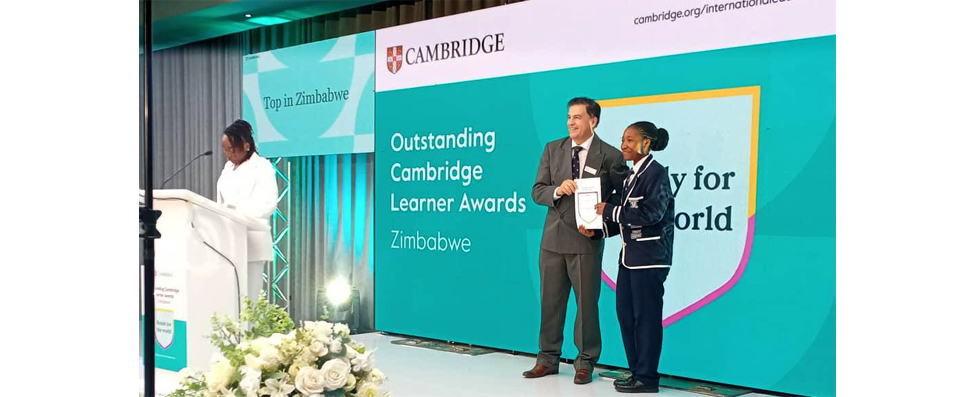
Ray Bande
Senior Reporter
AMATEURS practice until they get it right and pros practice until they can’t get it wrong; whichever way, it is perfect practice that makes perfect and no wonder for Maranatha Mautsa clinching the Cambridge Best Results award in Zimbabwe for IGCSE First Language English October-November, it was all about nothing but perfect practice!
Mautsa’s achievement is an epitome on new principal, Mrs Sarah Shoesmith’s stance to turn Hillcrest College into a top learning institution, not only in Zimbabwe, but the region, inspired by her experience at, both local ATS schools like Peterhouse College, and international experience, having worked at top UK institutions.
Speaking during a recent Diamond FM’s Groove Theory programme about her recent achievement, Mautsa said: “There are many ways to study English, most of it is really about practice. Practice, practice, practice because practice makes perfect. Of course, there is need for guidance, and the guidance I got from my teacher, Mrs Chidembo was very helpful.”
On her love for the English subject, Mautsa said: “I grew up here in Mutare. I have always been in Mutare my whole life. I developed my love for English ever since I was I was in Grade Four.
“My English teacher was just amazing. She encouraged us so much. She encouraged me specifically so much. This was at Hillcrest Prep. She loved my stories, and developed new skills in me. This love for English just developed until I got to college.”
For Mautsa, determination was also a huge factor.
“The marks that you get from the first composition, and telling yourself you need to get a higher mark from one composition to the other. You keep scoring higher and higher, and that is how one gets better,” she said.
Asked about the composition of the English Language paper and how she tackled it, Mautsa said: “For English papers there is Paper One and Paper Two. It is just important for one to know how to do their extended writing, that is directed writing where one is told how to go about their writing.
“There is descriptive writing and the narrative writing where one if given a short title on what one is supposed to include in their story. So it is all about creativity and good, strong English entails using imagery. Then there is composition part of it where you read a text and answer the best way you can.
“There is also a question on text analysis where one is given a story and from that story one tells the reader how one perceives the way the writer wrote the story as well as the way one sees the use of language, the effect it has. That sums up the English language papers. It is really made up of complex layers and it is important to nail each aspect in order to get a 90 percent and above.” Naturally, there are parts of the English Language paper that she found easy, some challenging and some that she fell in love with.
“For me, the text analysis was very challenging, but it was also fun. It is all about knowing the imagery that could have been used, the hyperboles, knowing about personification. This entail being able to identify where it has been used. When one identifies it, one also needs to explain the effect.
“It is a lot of work, but it can only be overcome through practice, and it is actually quite fun. I love descriptive writing, looking at a scenario and describing it to the best of my ability. It connects one with the reader,” Mautsa said.



 Online Reporter