admin
admin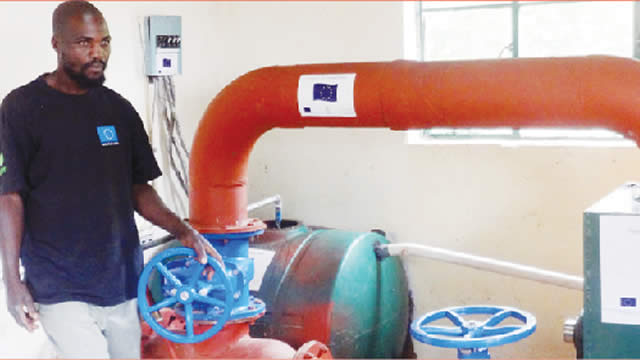

Walter Mswazie Masvingo Correspondent
A TRIP to the Himalaya community in the Eastern Highlands takes one through undulating slopes, giving away little to the many water bodies that lie beyond. Himalaya village is a mountainous and remote area endowed with many rivers and water bodies. The community, a predominately resettlement farming area, has mastered the art of harnessing water for irrigation farming through an irrigation scheme sustained by electricity generated at a local power plant, the Himalaya Micro-Hydro Power Scheme.
Himalaya Micro-Hydro Power Scheme is a community driven initiative sustaining about 3,000 rural families in Mutare South constituency, Manicaland province. A twin project sponsored by the same funder exists in neighbouring Chipendeke Village. The mini-hydro power plant — facilitated by Practical Action Zimbabwe (PAZ) in conjunction with Oxfam — was funded by the European Union (EU) at a cost of $2,2 million.It generates 80 kilowatts.
Through the energy initiative, communities in Ward 22 are now proud owners of two thriving irrigation projects which are situated on a 14-hectare piece of land. Villagers’ lives have undergone a metamorphosis, moving from a community that relied on non-governmental organisations’ aid to a self-reliant lot, ever since the mini-hydro plant was set up. The community now own a timber farm, sawmill, general dealer shops and grinding mills.
Project secretary, Eutious Chirara, said the mini-hydro power project was a springboard to prosperity as it boosted household and community food security as well as creating employment in line with the country’s economic blue print, Zim-Asset.
Beneficiation is also taking place at the grinding mills, timber project and the peanut butter making projects. “There is potential for the community to live up to the aspirations of Zim-Asset. Most families are making a living through selling their crops from the irrigation schemes. Families have managed to build good modern houses for themselves. All this is in line with Zim-Asset,” said Chirara. Presently, five villages are benefitting from the scheme, although it remains open to new members.
The benefitting villages are Village 7, 8A and B, 9A and B. Villagers have come up with committees for each project and have a binding constitution which spells out how members should conduct themselves. There is a committee for irrigation, sawmill, grinding mill and the micro hydro-power plant. The biggest committee is the hydro-power plant committee which oversees all subcommittees for the smooth running of the sustainable energy project.
This is in line with the country and United Nations’ objective of achieving sustainable energy for all by 2030 under the Sustainable Development Goals (SDGs) pencilled for pronouncement in September. Plans are at an advanced stage for the Himalaya community to venture into timber export, once the sawmill resumes operating. The four- kilowatt machine briefly stopped operating after its blade became worn-out. Chirara said they were waiting for a new blade which would be secured soon.
“We’re already trading in treated gum tree poles which we sell in Mutare and other areas in Manicaland. We’ve also received inquiries from Mozambican and Madagascan companies who want eucalyptus timber and we’re already working towards supplying that market. “At present the blade we’re using needs replacement and we’re going to do that very soon. In the interim we’re selling untreated poles at $2,400 per 30 tonnes,” he said.
Chitora irrigation scheme, which is 800m from the river, used to rely on gravitational force to allow water to flow and irrigate the plots. The irrigation project produces vegetable crops three times a year that include potatoes, tomatoes, peas, green beans and cereals, mostly maize.
Chirara said they were resettled in the Himalaya area in 1984 under the government’s popular land reform programme. Each farmer was given a five-hectare plot. “The area was occupied by a white settler, a Captain Hampshire, who had a dairy farm and had constructed a canal through which he drew water from Nyarukwetu River.
When we occupied the farm, we used water from the same canal to irrigate our plots and a community-owned timber plantation but the activities were at a smaller scale given that the pipes were dilapidated. The irrigation infrastructure had been installed in 1953 by Hampshire, who left after independence paving way for us to move in,” said Chirara.
Hampshire had constructed his own micro-hydro power plant specifically for his dairy and cattle ranching projects but the infrastructure was destroyed during the war of liberation. “When we occupied this farm water was flowing in canals by gravitational force given the steep gradient. Nyarukwetu River is uphill and this allowed us to draw water easily for irrigation without electricity since the power plant was no longer working. However, our pipes and canals were now dilapidated and we were losing water through leakages. We later managed to repair them with the help of well-wishers,” said Chirara.
In 2012, Practical Action Zimbabwe came to the rescue of the Himalaya villagers when they offered to assist them set up a mini-hydro plant to generate electricity.
For many years, the community had struggled to develop owing to lack of electricity despite the area being endowed with good soils, flora and fauna and many water sources. The area was fast turning into a desert as villagers were cutting down trees for firewood before the hydro-plant was set up.
“After a series of meetings with development partners and our local authority, the Mutare Rural District Council, we finally secured funding for this project. We received material for the project and we were also assisted by the power utility, Zesa, who gave guidance and their technical personnel. The community actively participated in the project through offering labour. Builders came from the villages,” said Chirara.
A volunteer technician, Knowledge Matsauke, lamented the underutilisation of the mini-hydro-power station. Out of the 80 kilowatts, the community was making use of only 25 kilowatts, he said. “This is a big project which has gone a long way in improving our living standards. However, it’s under-utilised as we’re using less than half of the amount of power generated. We only use 25 kilowatts since many households in the village are still to be connected. Mostly, the power is used for lighting and refrigeration since there is no industry save for a sawmill and grinding mill,” said Matsauke.
A member of Simbe Ngadzibve Himalaya Irrigation Scheme, Hazvinei Mutore, 30, of Village 8 A, was ecstatic over the project. She said access to sustainable energy like electricity is a rare achievement by the Himalaya community.
Simbe Ngadzibve Irrigation Scheme benefits more than 30 households. “This project has helped us a lot. We’re now able to preserve our food in fridges and sell freezits as income generating projects. We also have lighting in our homes and now have electrical stoves. We don’t miss city life at all. Some of our children are using computers and watching television just like kids in the city, thanks to the mini-power plant,” said Mutore, a mother of three children.
Village head, Zondayi Chamwanyisa, hailed the development partners for helping the government in its quest towards improving people’s lives through access to sustainable energy. He, however, bemoaned the poor road network and appealed to the government to address the issue as a matter of urgency and help the community develop.
“Our roads are in a poor state. They’re a major hindrance to agricultural production as famers from Himalaya and Chipendeke village pay through the nose when transporting their produce to the market in Mutare. We’re appealing to the government to attend to the problem as soon as they can so that we can achieve ZimAsset objectives,” said Village head Chamwanyisa. Practical Action advocacy officer, Chiedza Mazaiwana, urged the Himalaya community to continue working closely with development partners for the development of their communities.
She applauded the Himalaya and Chipendeke communities for their commitment to hard work and ability to work with developmental partners from outside.
“We’re happy to be associated with a community like this which has embraced sustainable energy as part of its existence. The positive effects of such initiatives on community development are evident. I hope there’ll be extensive utilisation of the schemes,” said Mazaiwana.
Hivos Energy Advocacy Programme Officer, Reginald Tapiwa Munyaradzi Mapfumo, urged the villagers to safeguard their infrastructure against vandalism. “We hail communities like Himalaya, Chipendeke and Nyafaru in Nyanga’s Chief Rekai Tangwena area who’ve managed to embrace energy programmes. This is in line with the theme, ‘sustainable energy for all by 2030’. We hope they’ll protect the schemes against unscrupulous people who may vandalise the machinery,” said Mapfumo.
Mutare District Administrator, Cosmos Chiriga, applauded Himalaya and Chipendeke communities for living up to the government’s expectations of promoting self-sustenance among communities. He expressed gratitude to development partners for helping the government develop communities.
“I’ve been to the two energy projects, Himalaya and Chipendeke. I’m impressed by the community involvement in addressing ZimAsset aspirations. I also want to thank Practical Action for assisting government in addressing some developmental gaps. We cherish the good work they’re doing and giving the necessary support,” said Chiriga.
He said the government is seized with the issue of poor road network and promised that a solution was in the pipeline. “We had a meeting recently over the state of the roads and the need for another health centre near Himalaya. I’m glad to say the Mutare Rural District Council said they’re going to do something over the matter. As government we appreciate that. The issue of road network has remained a sticking issue for long and it doesn’t do farmers any good. There is great potential in this irrigation project. We’ll also assist farmers in Himalaya with training under Agricultural Extension services (Agritex) programmes,” said Chiriga.
Practical Action Zimbabwe, Oxfam and the EU helped set up a solar power plant in Gutu’s Ruti Irrigation scheme in Masvingo province. If all rural communities could gain access to sustainable energy like hydro and solar power, Zimbabwe will develop fast and certainly arrest the rural-urban drift.



 Online Reporter