

 Online Reporter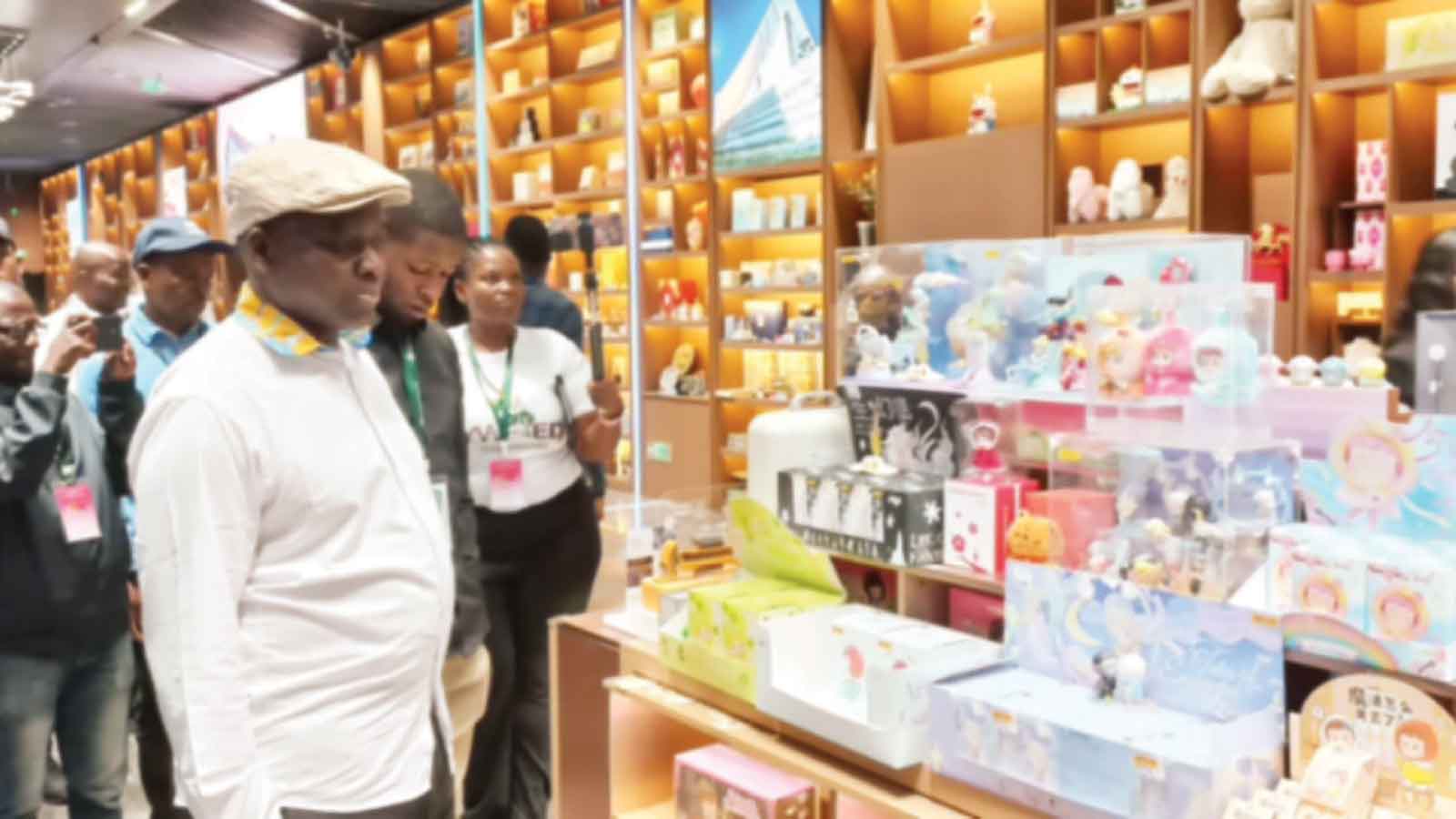
Mabasa Sasa
The energy Beijing exudes is difficult to fully describe. It must be experienced.
It is not merely the scale of a city of 20 million inhabitants, nor the speed and order in which it moves. It is the feeling that everything — from infrastructure, technology, commerce, logistics to culture — is connected to a larger national understanding.
That quiet yet purposeful energy was palpable on last Sunday during an engagement between members of the Zimbabwean delegation attending the seminar for Media Professionals, and the China Association of Development Zones at the world-renowned Hongqiao Market in Beijing.
Led by the Minister of Information, Publicity and Broadcasting Services, Dr Zhemu Soda, the delegation is in China under a programme organised by China’s Ministry of Commerce through the Academy for International Business Officials (AIBO). But what unfolded at Hongqiao was more than a routine exchange of diplomatic courtesies.
It was a glimpse into the mechanics of China’s development model and, more importantly, into the opportunities now opening for countries like Zimbabwe.
Hongqiao Market itself tells a story.
To call it a market is an understatement. Of course, it is a commercial hub of astonishing scale and diversity. But it is also a cultural meeting point, one of those uniquely Chinese spaces where commerce, hospitality and international exchange blend seamlessly.
Heads of state, royalty, diplomats, tourists and entrepreneurs from across the world pass through its halls daily.
It is perhaps one of the best demonstrations of how China has mastered the art of connecting production, trade, logistics and human interaction in a coherent ecosystem.
That ecosystem is what Zimbabwe is now being invited to integrate into in a deliberate and sustainable manner.
The interaction facilitated by the China Association of Development Zones centred on a simple but profound question: how can Zimbabwean enterprises — public and private — position themselves within China’s vast global supply and value chains?
China today occupies a unique position in the global economy. It is the only country in the world with full industrial coverage across all United Nations-recognised industrial categories — from power generation and transport infrastructure to biopharmaceuticals, water systems, agri-machinery, recycling technologies and advanced manufacturing.
The legal, technical, financial and diplomatic architecture supporting this is breath-taking in both scope and ambition.
China’s production networks are not inward-looking. They are deeply integrated across borders, connected to more than 200 countries through trade, logistics and investment cooperation frameworks painstakingly built over decades and continuously enhanced as global tides ebb and flow with the changing times.
The issue is how Zimbabwe plugs into that capacity in ways that create jobs, transfer skills, grow exports and improve livelihoods at home.
Timing matters here.
On 1 May 2026, China’s zero-tariff policy for African countries came into effect. The implications of this major trade development have not yet been fully appreciated.
For Zimbabwe, this is not merely a trade concession. It is an invitation into one of the world’s largest consumer and industrial markets. There is need to move with sufficient speed and strategic clarity to take advantage of this.
This is where platforms such as the one offered by the China Association of Development Zones become important.
The association’s philosophy is straightforward: cooperation is the road to prosperity. But unlike many international platforms that remain trapped in rhetoric, its approach is practical and deeply operational.
Through its Belt and Road Initiative Think Tank, the association connects more than 20,000 political leaders, scholars, technical experts and professionals from around the world in a system designed around matchmaking, investment facilitation and two-way promotion.
In simpler terms, it tries to connect needs with solutions.
Zimbabwe, for instance, has agricultural potential, mineral wealth, a young population and a strategic regional position. China has industrial capacity, financing mechanisms, technological ecosystems and established global distribution channels.
The challenge, and indeed the opportunity, lies in creating structures that allow these strengths to complement one another effectively.
What became clear during the Hongqiao engagement is that China sees cooperation not as charity but as integration.
This is an important distinction.
For many years, Africa’s relationship with external powers has often been defined through extraction on one side and dependency on the other. China’s approach, while not without its complexities, increasingly emphasises industrial participation, infrastructure connectivity and market integration.
Zimbabwe must approach this with sophistication befitting any country that is serious about a prosperous future.
With China’s supply chains opening up, Zimbabwe must think strategically about where it can insert itself. The opportunities are almost limitless: agro-processing, lithium beneficiation, manufacturing inputs, tourism services, logistics, digital services and cultural industries all present possibilities.
And none of this will happen automatically, or just because Zimbabwe and China have been friends for a long time. It requires vision, policy coordination and institutional preparedness.
The significance of the ongoing seminar organised through Academy for International Business Officials lies partly in this broader exposure. It allows Zimbabwean officials and professionals to observe not just China’s achievements, but the systems thinking behind them. It opens a window into China’s integration of commerce, governance, technology and planning, and how all these merge in a national development philosophy.
The lesson to be learnt is that China’s rise did not happen through isolated projects. It happened through connectivity between ideas, sectors, institutions and execution.
For Zimbabwe, the path forward may well depend on learning how to build similar forms of coordination while leveraging partnerships.
The conversations at Hongqiao Market may appear modest in the grand scheme of geopolitics. But for a nation trying to construct a meaningful future, these are crucial building blocks.
Because often times, the foundation of the future lies in simple and practical conversations about how nations can grow together.
Mabasa Sasa is a Harare-based Zimbabwean geopolitical analyst and international affairs commentator.



