Online Reporter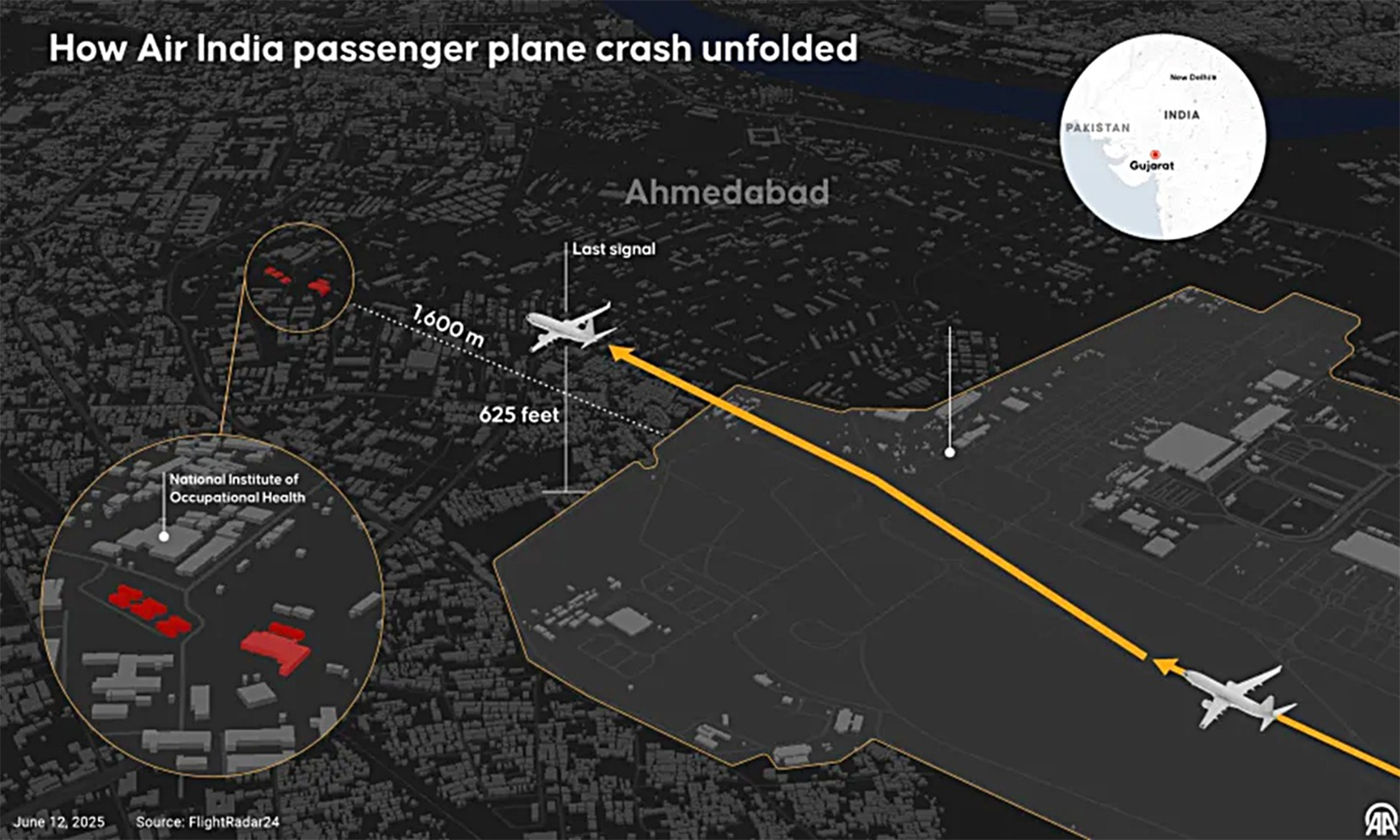
At 9.48am on Thursday, Air India flight 423 took off from New Delhi bound for Ahmedabad.
It was an entirely normal day and a wholly normal flight, except for the fact that the plane, an 11-year-old Boeing Dreamliner, landed 20 minutes early.
After more than two hours on the tarmac parked at Terminal 2 of the Sardar Vallabhbhai Patel International Airport, Captain Sumeet Sabharwal taxied onto the single runway and prepared for take-off.
Captain Sabharwal’s destination was London’s Gatwick airport, and onboard for the 10-hour flight were 12 crew and 230 passengers – mostly Indian nationals, with 53 British citizens, some Portuguese and a Canadian too.
In Seat 11A, next to the emergency door on the left side of the plane, was Vishwash Kumar Ramesh, a 40-year-old man from London who was in Gujarat visiting family with his brother, who was sitting in 11J.
CCTV and mobile phone footage showed what happened immediately after take-off at 1.38pm.
First, the Dreamliner climbed about 160 metres, reaching a speed of 322km/h, according to the minimal flight data available. Then, 10 seconds after leaving the ground, its upward motion stalled and the plane began to lose height.
Nose up, tilting slightly, it sank steadily downward for five seconds before crashing in the crowded neighbourhoods surrounding the airport.
Captain Sabharwal had issued a distress call to air traffic control but made no further communication.
The massive blast as the plane’s full fuel tanks exploded was heard across the city, and sent flames and a column of thick black smoke into the sky.
Keyur Prajapathi, a 27-year-old doctor at Ahmedabad Civil Hospital, about a kilometre from the airport, was on duty.
“I looked outside the window and saw black smoke. Within seconds, our phones started to ring. It took me another two to three minutes to understand what had happened,” said Prajapathi.
The Dreamliner, weighing more than 200 tonnes and carrying more than 100 000 litres of fuel, had crashed into accommodation for doctors at the hospital, including a hostel where medical students live.
With as many as 200 lunchtime diners in the hostel’s canteen, there were fears of mass casualties among the medical students. The exact toll was still unclear on Thursday evening as emergency workers were unable to distinguish between victims on the ground or in the plane.
A doctor named Krishna said: “The nose and front wheel landed on the canteen building where students were having lunch.”
One survivor was soon identified – the British man who had been in seat 11A and had somehow escaped the crash almost unharmed except for cuts and bruises.
Ramesh was able to walk away from the crash in a ripped T-shirt with his phone in his hand and boarding card in a pocket. Guided to an ambulance, he was taken to hospital.
“Thirty seconds after take-off, there was a loud noise and then the plane crashed,” Ramesh told local reporters from his hospital bed. “It all happened so quickly … When I got up, there were bodies all around me. I was scared. I stood up and ran. There were pieces of the plane all around me.”
On Thursday night, Air India confirmed that the other 241 on the plane had all been killed.
Boeing said it was working to gather more information on the incident, while the UK and US said they were dispatching air accident investigation teams to support their Indian counterparts. – Guardian