Chronicle Editor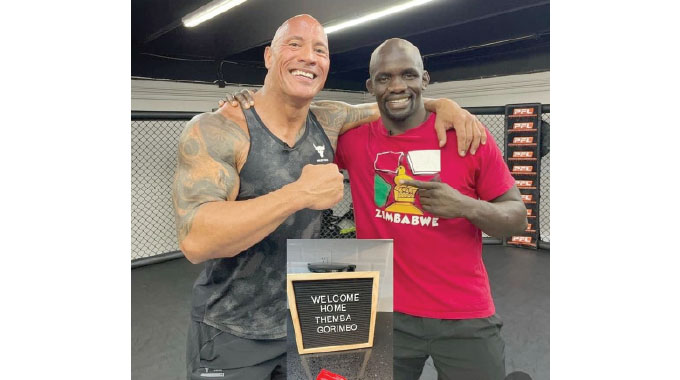
Bruce Ndlovu, Sunday Life Reporter
WHAT does a man bred in Honolulu in Hawaii have in common with one who grew up in Masvingo, Zimbabwe?
At face value, one could say little or nothing connects these two worlds.
While Masvingo possesses the medieval architecture of the Great Zimbabwe, Honolulu, boasts scenic views and tranquil weather, attractions that make both coveted destinations for tourists.
However, when Dwayne “The Rock” Johnson shared a video of Themba Gorimbo leaping into his arms last Thursday, one could not tell that these two men in such enthusiastic embrace, are from different worlds.
According to reports, The Rock had just gifted Gorimbo a fully furnished home in Miami.
The Rock, after all, is a fully fledged Hollywood star, having been crowned the highest-paid male actor of 2019 Forbes, earning an eye-watering $89,4 million over the course of that year.

He was also named top earner in 2016, while coming second place in both the 2017 and 2018 rich lists. In 2010, Forbes estimated that he has made as much as $594m. Since then, his considerable accumulation of wealth has not showed any signs of taking a pause.
This of course, is in sharp contrast to Gorimbo, who until only a couple of months ago was scrapping together a living, with barely enough in his account to afford a place to live.
In May, after his first victory in the UFC, the biggest Mixed Martial Arts (MMA) league in the world, Gorimbo opened up about the hardships he faced on his journey to America. He revealed that upon arriving, he had no money and struggled to make ends meet.
With limited funds, he could barely afford transport to the gym and was only bailed out by a friend who sent him $200, which provided the much-needed support and helped him survive during those challenging early weeks.
It was this confession that brought him to the attention of The Rock, who in Gorimbo, saw a kindred spirit with whom he shared similar struggles earlier in life.
“After the fight, he sold his fight gear (trunks & gloves) on line and made US$7 000,” The Rock said of Gorimbo on social media last Friday.

“Instead of using the money to find a place to live, he built a bush pump so his village back in Zimbabwe can have clean water. He never asked me for anything, but I just wanted to help the guy out. $7 Bucks ya know. And I felt the MANA & emotion in every hug. Very good and very special day,” the former WWE star wrote.
At that moment, it felt as if the Hollywood star had been placed at the right place, at the right time by a higher power in order to help a fellow fighter in need.
However, a look at both men’s history suggests that The Rock had not only met a man who has the same determination he had growing up, but also the troubled upbringing that landed him in trouble a few times before he wore the WWE championship belt around his waist.
Gorimbo, who was orphaned at 14, found himself in trouble with the law at the age of 16 when he went illegally scavenging for minerals in Marange. It is this environment that he has said bred the fighter in him.
“That environment changed my mind about life and I think my toughness is from that. Fighting is like nothing for me. I obviously get nervous for fights, but it’s not something that feels like a do or die situation. I fight because it’s the only thing I am good at. It’s the only thing that can change my life and the lives of people around me,” he said.
Arrests were also once a staple of The Rock’s life, as himself on his own at around the same age Gorimbo lost his parents.
“At 14 when I started training, at 14 is when I also started getting arrested — for fighting, theft, all kinds of stupid (expletive) that I shouldn’t have been doing,” he told Muscle and Fitness Magazine in one interview.
“But I still found time to go to the Boys Club every afternoon to hit the speed bag, hit the heavy bag, hit the iron. I was building my body because again, it’s that eviction mentality. But, I would still (expletive) around, get in trouble and get arrested. I got arrested eight or nine times I think by the time I was 17,” he said.
Meanwhile, Gorimbo’s struggles would not stop in the illegal mining fields, but instead would deepen when he decided to make the trek across the crocodile-infested Limpopo.
While he made it across the first time, he was soon deported. On his second attempt though, he was not so lucky, as he nearly lost his life.
“It was just like a decision, either you want to be here, or you want to be there,” Gorimbo said.
“I didn’t have a passport. I came through the river. It was just one of those times you take the sacrifice, which is dangerous to do that. A lot of people died. For a young guy — I was about to turn 18 — it was very difficult. It just showed me what kind of person I was. They deported us around 4 to 5pm in the evening. By 7pm I was back in South Africa illegally.
“The second time was way harder because I almost got killed. Obviously in the diamond field I used to see lots of nasty things . . . People used to get killed in front of me, while running from the police. But this was the first time someone actually held a knife on me. When you cross illegally into South Africa it’s not just the police you are running from, you are also running from criminals — they rob people crossing because they know you have money. The criminals saw us and trapped us. I remember seeing this big knife and I passed out. It’s like a movie. I fell on the ground and the rest of the guys ran away. The guys who were robbing us ran after them and left me there. When I came back to normal, I realised there was a fence. I decided I have to go . . .”
As the son of a former wrestler, The Rock seemed to have been always destined for the ring. Brawling it seems, has always been in his blood. While his own father was not a recognised fighter, Gorimbo believes that the spirit of a fighter runs in his veins too.
It was this same spirit that encouraged him to take a crack at professional fighting at 19. It is this spirit that brought him to the attention of The Rock, a former fighter who now seems destined to change Gorimbo’s life.
“I’m like, ‘This a sport, fighting? OK, cool, I think I can do that’,” he said. “I come from a fighting family — all my cousins, even my father, used to always fight. It’s in our nature. I got my first fight three months after training. I won it with a seven-second knockout.”


 Online Reporter