Online Reporter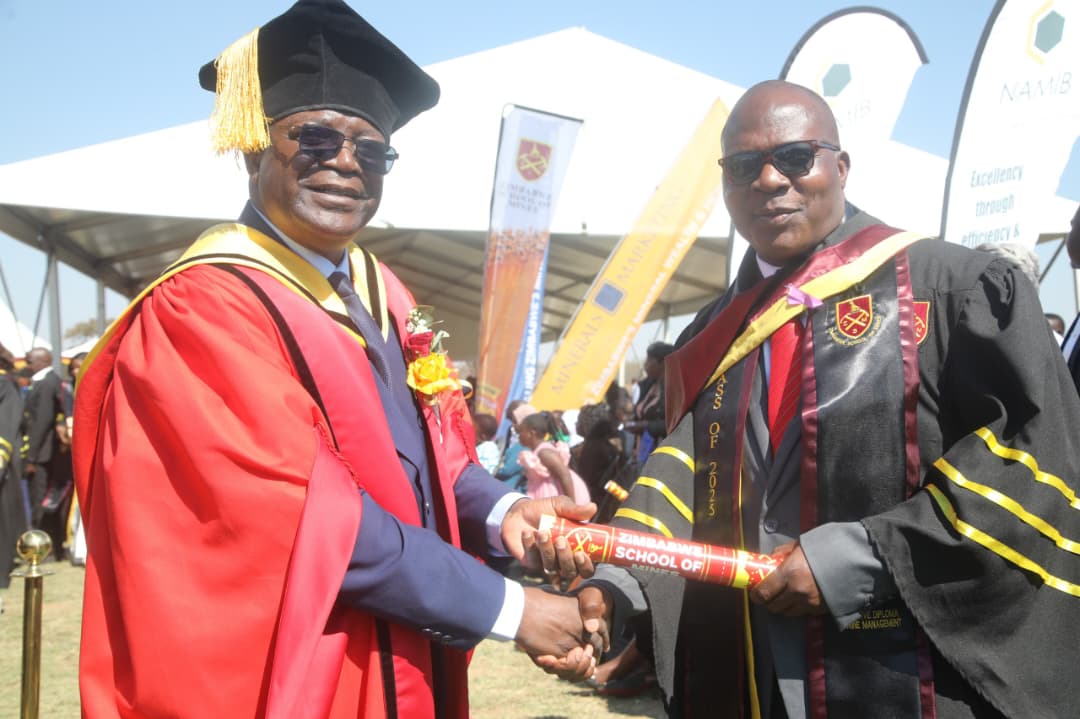
Judith Phiri [email protected]
AS Zimbabwe’s mining sector continues to expand, the Ministry of Mines and Mining Development has said human capital plays a critical role in achieving national economic targets and Vision 2030.
The country’s mining remains the anchor of the economy, contributing over 60 percent of national export earnings and approximately over 25 percent directly to the national gross domestic product (GDP).
In a keynote address delivered on his behalf by his deputy Dr Caleb Makwiranzou at the 32nd Graduation Ceremony of the Zimbabwe School of Mines (ZSM) in Bulawayo on Friday, Mines and
Mining Development Minister Dr Polite Kambamura said the mining economy growth constraint was no longer geological but human capital related.
“We require mining engineers, metallurgists, geologists, surveyors, assayers, safety practitioners and technicians in far greater numbers and with skills that were not on the curriculum a generation ago,” he said.
“This include mine digitalisation and automation, resource modelling and 3D design, drone survey and remote sensing, hydrometallurgy and lithium chemical conversion, and mine environmental management.
“The industry contends with the high cost of capital, power supply and energy costs, an ageing equipment base, commodity price volatility, and an unacceptable incidence of mine accidents in the small-scale sector,” said Minister Kambamura.
“Graduands, every one of those constraints is a problem statement addressed to you. That is what today’s theme means in practice.”
He said the theme: “Innovation, Limitless Possibilities”, was well chosen as Zimbabwe holds over 60 economically exploitable minerals, but endowment alone has never made any country prosperous.
Minister Kambamura said what converts geology into national wealth was capability, the skill to find the ore, the technology to extract it safely and the ingenuity to add value before it leaves our borders.
“That capability is manufactured in institutions such as this one. Mining remains the anchor of our economy, contributing over 60 percent of national export earnings.
“In the first half of 2026, mineral exports reached approximately US$5,73 billion, with growth of about 84,7 percent excluding gold and silver. Gold deliveries stood at some 21,4 tonnes, close to 70 percent of it from small-scale and artisanal producers, against a national target of 50 tonnes for the year,” he added.
Minister Kambamura said policy has moved with equal decisiveness and noted that since February 2026 the export of unbeneficiated lithium has been prohibited with producers investing in downstream processing on Zimbabwean soil.
He said the Mines and Minerals Bill was advancing, while the Mining Cadastre Information Management System will bring order to title administration and the governing principle was now settled, as the country shall progressively export smaller volumes of higher value.
“Enrolment has grown from 1 121 students in 2022 to 1 223 in 2026, the highest in the period, comprising 832 male and 391 female students. On output, the school caps 369 graduands today, following 405 in 2025 and a peak of 428 in 2024 on the strength of new programmes. “Against 188 graduands in 2020, the school has roughly doubled its annual output in six years,” said Minister Kambamura.
“I challenge the board and the principal to set a published target for female enrolment and graduation and to report against it at each successive ceremony.”
On industrial attachment, the School placed 305 students in 2026, or 78 percent of those requiring placement, following 91 percent in 2025 and 93 percent in 2024.
Minister Kambamura, however, bemoaned how the figure has fallen, making a direct appeal to the industry to absorb students and clear the outstanding backlog.
“The school has also placed before us a portfolio of projects, which, if capitalised, would transform both its training capacity and its financial self-sufficiency. An area for the centre of excellence has been identified, paperwork has been done with my ministry and the special grant has been approved requiring some US$1 million,” he said.
This will train students on a live operation, ease the attachment burden and give practical effect to Education 5.0.
Related to it, the Minister commended the partnership with Fidelity Gold Refinery for a US$1,5 million Gold Service Centre, whose plans and environmental impact assessment are complete.
“My appreciation goes to the Minerals Marketing Corporation of Zimbabwe (MMCZ) for partnering in its equipping and I note the progress towards ISO certification, which will allow it to serve the industry as a second-opinion laboratory,” he said.
Minister Kambamura said the ZSM Innovation Hub, at concept stage, required some US$600 000, built around robotics, sensing hardware and CAD workstations for Industry 4.0 mining and foundry beneficiation.
He said for the Drone Training School, an Air Service Permit has been granted and corrective actions instituted following last year’s surveillance audit.
Minister Kambamura said aerial data capture was standard practice in modern mining and Zimbabwe should train its own operators.