Online Reporter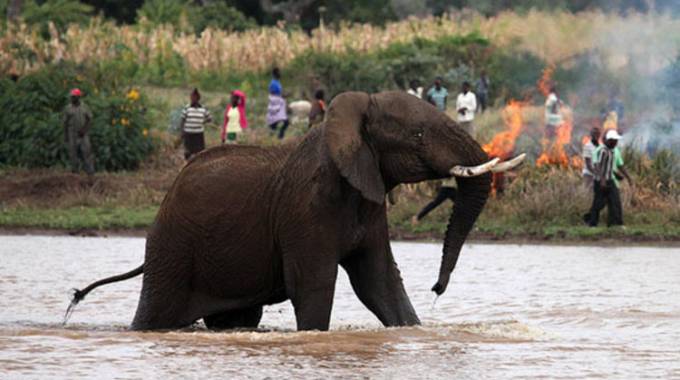
Ivan Zhakata
Herald Correspondent
Zimbabwe has recorded 12 374 human-wildlife conflict incidents over the past decade, resulting in 486 deaths, 554 injuries and the loss of 4 025 livestock, prompting the formulation of a National Human-Wildlife Co-existence Strategy to address the growing crisis.
The figures were revealed by Zimbabwe Parks and Wildlife Management Authority (ZimParks) director of operations, Mr Arthur Musakwa, in a presentation read on his behalf by the head of management services, Mr Givemore Mukuya, at the National Human-Wildlife Co-existence Strategy Development Workshop in Harare on Tuesday.
In the presentation, Mr Musakwa said the increasing human-wildlife conflict was driven by recurring droughts, population growth and habitat encroachment, which were bringing communities and wildlife into closer contact.
“Human-Wildlife Conflict is any interaction between humans and wildlife that results in a negative impact on human social, economic or cultural life, on conservation of wildlife, or on the environment,” he said.
Mr Musakwa said Zimbabwe’s protected areas allowed free wildlife movement, escalating conflicts in Kariba, Hwange, Chiredzi, Mbire, Hurungwe, Nkayi and Binga.
“Over 12 000 human-wildlife conflict incidents were recorded between 2016 and 2025. A national coordinated framework is urgently overdue,” he said.
The presentation showed that 486 people were killed and 554 injured during the period, while 4 025 livestock were lost to wildlife attacks.
Mr Musakwa said crocodiles and elephants remained the leading causes of fatalities.
“Crocodile and elephant attacks account for 83 percent of all human-wildlife conflict fatalities recorded over the past decade,” he said.
Mr Musakwa said crocodiles were responsible for 173 deaths, while elephants accounted for 114. Crocodiles also caused the highest number of injuries, with 155 people injured, followed by buffaloes with 73 and elephants with 55.
The presentation identified Binga, Hwange, Chiredzi, Hurungwe, Mbire, Muzarabani, Nyaminyami, Chipinge, Gokwe North, Gokwe South, Tsholotsho, Bulilima and Kusile as the country’s major human-wildlife conflict hotspots.
Mr Musakwa attributed the increase in conflicts to habitat encroachment, climate change, population growth and inadequate barriers between wildlife and communities.
“Settlements are expanding into buffer zones and migration corridors, while droughts are forcing wildlife closer to human settlements in search of food and water,” he said.
He said although ZimParks has introduced rapid response teams, community liaison desks, problem animal control protocols, wildlife translocation programmes, beehive fences, chilli barriers and CAMPFIRE initiatives, major challenges remained.
“The strategy must close critical gaps, including the absence of a unified national human-wildlife conflict management strategy, fragmented mandates, inadequate funding, inconsistent data collection, delayed compensation mechanisms, limited community early-warning infrastructure and insufficient fencing along wildlife-community interfaces,” Mr Musakwa said.
Human-wildlife conflict has become one of Zimbabwe’s biggest conservation challenges, particularly in communities bordering national parks, safari areas and conservancies.
Recurrent droughts linked to climate change, coupled with expanding settlements and increasing competition for land and water, have intensified interactions between people and wildlife, resulting in loss of life, destruction of crops and livestock, and growing pressure on conservation efforts.
Mr Musakwa urged stakeholders to develop practical solutions to reverse the trend.
“The data is clear. The urgency is real. Four hundred and eighty-six lives lost, 554 people injured and over 4 000 livestock killed. This workshop is the moment to act. Build a strategy that works for people and wildlife,” he said.
The three-day workshop, which ends tomorrow, has brought together Government ministries, conservation agencies, traditional leaders, development partners and community representatives to formulate Zimbabwe’s first National Human-Wildlife Co-existence Strategy.