Online Reporter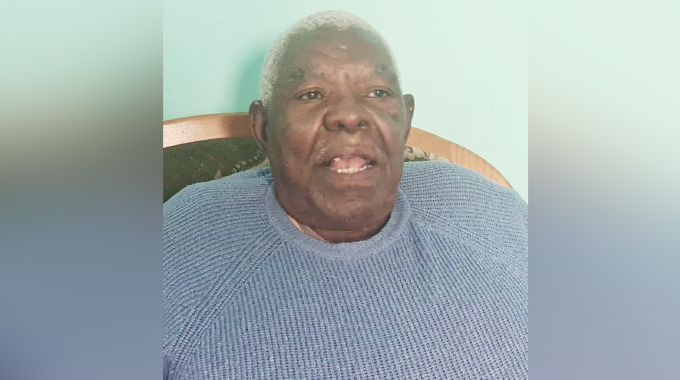
Yesteryears greats with Lovemore Dube
WITH a hectic work schedule crushing his long-held ambition of playing football, Joseph Nelson Mthethwa was left at the age of 21 to be a fulltime football spectator.
He probably got to travel and see all the stadia and urban centres he would have been to if his career had taken off.
But he has an impressive recollection of some of the best talents to grace local stadia.
Born on 6 June 1934 and raised in Umzingwane District in Matabeleland South Province where he graduated from Mzingwane Government School with a carpentry diploma after three years of training, Mthethwa became a traveling Highlanders fan in 1955.
“Because of a busy work schedule I could not continue with playing football. It is a game I had played as a forward while growing up. We played football using tennis balls, we perfected our skills through the use of tennis balls. I started being a Highlanders supporter in 1955, it was the only thing we looked forward to during weekends and spare time,” said Mthethwa.
While growing up he said he was lucky to watch founding players Siphambaniso Khumalo who played as a centre-back and left winger Nsele Hlabangana turning out for Bosso.
“Nsele later played as a goalkeeper but they were now far much older than the guys they were playing with,” said Mthethwa.
Among the teams of that era were clubs like Mashonaland FC, which split into Mashonaland FC and United in 1965, as well as Mutambara, Northern Rhodesia, Gaza, and Matabeleland Highlanders. There were also inter-city games to cherish.
“We stayed in Makokoba and watched football at places like Barbourfields, Greenspan, Makokoba and Matshobana. Most of the suburbs were not there, we had teams organised along where people came from, the railways and brewery had their teams too.
“There were many good players in the 1950s, stars like Jesto Rice who played as a fullback, Ndege Number 10 and the Northern Rhodesia giant goalkeeper John Chipukula Phiri better known as Malalaphayiphi or John Walker, he was big, had big hands and would even save penalties.
“There was Jambok who played as a striker, Scholar 11 wing, Gibson Makhanda and his brother Chester who were strikers, defenders Edward Dzowa, John Vera, Canaan and Mackenzie Sibanda, they were good players who excelled for their clubs and Bulawayo Select — Red Army,” said Mthethwa.
Back then he said each city had its own league and at the end of the year select teams would play in the Osborne Trophy with Red Army and Yellow Peril from Harare dominating.
The arrival of the national professional league in 1963 he said had its own drama.
Dynamos came into being, Highlanders, Saints and Northern Rhodesia, the city’s top three clubs lost a big number of players to Cobras after the Big Three clubs failed to agree on some issues as Harare teams merged to form DeMbare. The split left Highlanders weakened.
“We soldiered on and saw the birth of a new era, a Highlanders with juniors playing Bulawayo Amateur Football Association action after refusing to play in the new league. However, Mashonaland FC and Cobras played there.
“We always wished as Highlanders supporters to see our players play at that level. Who would not love to see the best players in action, we wanted to watch our team play Arcadia, Dynamos, St Pauls, Sables and other big clubs,” said Mthethwa.
He said the national league exposed them to exciting football but felt the refereeing had not moved a standard up.
The top players of that time were St Paul’s George Shaya, Paul Tsumbe, James Nxumalo, Wankie’s James Mwape Sakala, Daniel Rendo, Buddy Sibanda, John Garatsa, Sam Mutende and Posani Sibanda. Mashonaland FC had Gibson Homela, William Sibanda, Alick Mwanza and John Sando.
Dynamos Obadiah Sarupinda, Jimmy Finch, Freddy Mukwesha, George Shaya after his return from St Paul’s via Zimbabwe Saints.
At that time the country had great players such as Robert Donga, Square from Mutare, Ndege, Rice, Chester and Gibson Makhanda, Dusty King, Matthew “303”Marume, ABC Rusike, Canaan Zulu, Fry Nyathi and Soul Dube from Gwanda.
“We got to watch football at Callies and Trade Fair, we were discriminated upon and the police protected everyone in such cases, maintaining law and order at matches. Highlanders pioneered in bringing multi-racial football,” said Mthethwa.
Highlanders eventually decided to join the Rhodesia National Football structures at the end of 1968 and playing Division Two football in 1969.
“We were happy to see our team playing other clubs around the region and the prospect of someday playing the big guns, we also remained steady fast with Matabeleland High City who remained at Bafa,” said Mthethwa.
Bosso won the Division Two title and were promoted to the elite division in 1971 but it turned out to be a disastrous excursion with the team finishing at the bottom with just seven points.
Silas Ndlovu took over in 1972 and the club finished second to Rangers to earn promotion to the Rhodesia National Football League Division One which was played as North and South Regions up to end of 1975.
“We were losing players to clubs some of them going to South Africa. Daniel ‘Dididi’ Ncube moved to Dynamos in Harare after he had come from Eastlands the club we would later snatch Tymon Mabaleka from,” said Mthethwa at his Mpopoma home on Friday.
In 1973 things took a twist for the better and a giant was born.
Mthethwa credits that to Silas Ndlovu, a former player who had retired in 1972 to concentrate on coaching Highlanders.
Ndlovu with the aid of a few senior players, he had managed to impress on the club bosses on a leaner executive and a coach who would also be a manager of welfare and technical matters.
“He was a genius, very intelligent and knew how to convince people through campaigns, he was calculating and he is the best coach and manager in the club’s history, so much happened under his watch and he assembled a very good team.
“He would go and watch other clubs in Harare and Mhangura and convince players to come to Highlanders, see the likes of Stanley Nyika, Itai Chieza, Isaac Mafaro, Chutika Tembo and Bruce Grobbelaar, joined Bosso and made it the best team in the land. We believed in Silas and he delivered,” he said. With the Chibuku Trophy in 1973, runners-up spot and the national play off title in 1974 and a runners-up gong in 1975, Mthethwa said Ndlovu had grown the Bosso brand so many folds in a short space of time.
Mthethwa said the split to form Olympics in 1977 had shown the true supporters’ resolve and that had forced them to come up with a rallying song, “Ayisoze Yabulawa” and that saw unwavering loyalty by both the fans and players.
But before that in 1976, Highlanders had a crashing 4-0 loss to Zimbabwe Saints in the Chibuku Trophy Final at Rufaro Stadium.
“Silas’ game plan crashed, Homela decided to play as an attacker as previously Douglas Mloyi had bullied their little forwards like Max Tshuma. Homela had been in the UK and probably our players were shocked to see him in the line-up which could have upset Silas’ game plan,” said Mthethwa who added that their drive back home had been hell.
They could not have stopovers to fill their beer bottles because they were gutted by Saints’ stunning performance in which Max “Shaluza” Tshuma and Homela each scored a brace.
He still recalls one of the goals as having been a banana kick from near the corner flag where Homela had gotten the better of Lawrence Phiri.
Mthethwa is torn between the 1980s team and 1970s one as to which one was the best.
“Those two teams played very beautiful football, the Nxumalos, Cavin Duberley, Tommy Masuku, Boet Van Ays, Tymon Mabaleka, Barry Daka, with Silas as coach and young Bruce Grobbelaar, what a team! But the team that had Madinda Ndlovu with his brothers coming later, Willard Khumalo, Mercedes Sibanda, Titus Majola, Douglas Mloyi, Tito Paketh was very good too. I liked it and enjoyed every bit about it,” said Mthethwa.
He said football had taken him around the country and had gotten to appreciate the beauty of Zimbabwe.
Players like Scholar and Jambok he said could have played abroad if they had been in action in recent years. He compared them to Barcelona’s Yamal, Lionel Messi and Cristiano Ronaldo.
A widower and father of five, Mthethwa who retired from Bulawayo City Council in 1999, said he had stopped watching local football because standards had plummeted.
His Best XI
Bruce Grobbelaar, Tommy Masuku, Mercedes Sibanda, James Nxumalo, Netsai Moyo, Willard Khumalo, Peter Ndlovu, Dumisani Nyoni, Madinda Ndlovu, Jeffrey Mpofu, Adam Ndlovu.