

 admin
admin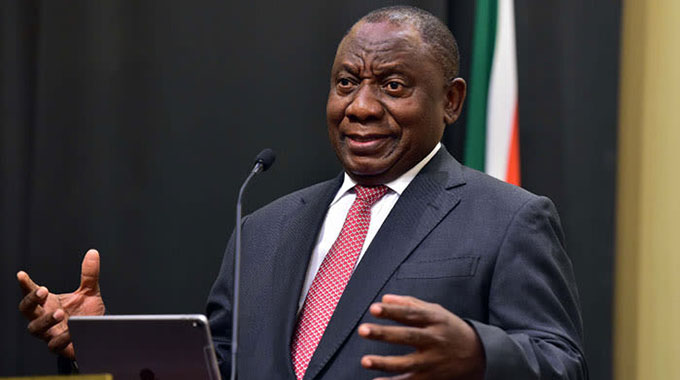
President Mnangagwa has jokingly been accused of copying South Africa President Cyril Ramaphosa’s response measures to the coronavirus pandemic.
This started after President Ramaphosa was the first between the two to announce a Taking Stock Kudzanai Sharara
21-day nationwide lockdown.
Despite this procedure being implemented globally, President Mnangagwa, who announced Zimbabwe’s 21-day lockdown a few days later, was jokingly accused of copying and pasting South Africa’s response plan.
This is in spite of the fact that it makes sense that Zimbabwe conducts a response plan that in a way mirrors South Africa’s.
Not only is South Africa, Zimbabwe’s largest trading partner, but also a gateway to other regional countries up to the Democratic Republic of Congo.
The cross border human traffic, between the two countries, is also massive that it would not make sense to have a response plan that is different from the other.
Spreading of the coronavirus has to be effectively dealt with in South Africa as it should be in Zimbabwe and indeed other regional countries’ interest.
Any suspicion that one of these countries is lacking in dealing with the spread of the virus, will result in stringent and inconvenient measures being put in place at ports of entry, long after the lockdown periods are over.
The joke that President Mnangagwa is copying president Ramaphosa was reignited when the latter announced that South Africa was going on a two-week extension of the lockdown.
To many it was a given that Zimbabwe would follow suit.
And to his credit, President Mnangagwa explicitly explained why there was need for an extension at the same time admitting Zimbabwe’s inadequacies.
“Zimbabwe is yet to achieve optimum capacity to trace, isolate, and treat coronavirus cases.
“Infections should be under control for us to consider lifting the lockdown,” he said.
The jokes, however, did not stop with the lockdown extension but have continued following President Ramaphosa’s announcement of an unprecedented R500 billion social and economic support package to mitigate the impact of the coronavirus pandemic on the South African economy.
The stimulus package comes to some 10 percent of South Africa’s GDP.
Will President Mnangagwa come unstuck this time around?
Like the South African economy, and many others across the world, the already fragile Zimbabwean economy has been decimated by Covid-19. There are companies that might never return, let alone recover from the impact of this pandemic.
The tourism sector might never be the same for probably another year or two.
The Zimbabwe National Chamber of Commerce (ZNCC) in its proposed interventions to the impact of Covid-19, projects that workforce will be made redundant as some businesses will not be able to adapt to the effects of Covid-19.
“There is going to be loss of employment, 25 percent of permanent formal jobs will be lost and 75 percent of casual/temporary formal jobs will be lost as businesses lay off workers given the sharp contraction in many sectors,” said ZNCC.
Government will have a leading role in getting the economy working again, at least to the pre-coronavirus levels.
The private sector cannot go it alone. Just like in normal times, the private sector can only flourish if Government puts in place enabling policies and measures. Just like in normal times, the private sector can only summon its skills, capital, and entrepreneurship if Government puts in place incentives and policies that are attractive. Just like in normal times, the private sector can only flourish when the doing business environment is not restrictive.
South African President Ramaphosa did his part this week with a stimulus package that was described as unprecedented.
In his own way, President Mnangagwa is supposed to come up with a plan to get Zimbabwe working again if not better than what it was like before Covid-19.
We must, however, be aware that unlike President Ramaphosa, who said he might have to approach international lenders for part of the bailout package, President Mnangagwa does not have the luxury to approach global lenders.
Sanctions and debt arrears to global lenders have come back to haunt President Mnangagwa’s Government even at this time of need. The World Bank and the IMF have doled out billions of dollars across the world, but nothing for Zimbabwe, whose long term debt over hang and illegal sanctions by the United States have remained an albatross.
So if President Mnangagwa wanted to copy President Ramaphosa, as per the jokes, the past haunts him.
There are no billions or even millions of dollars that he is going to get from global lenders.
But what else is in Ramaphosa’s response plan that President Mnangagwa could copy.
Ramaphosa said 26 percent of the R500 billion will be supported by reprioritising funds from South Africa’s existing Budget.
This is something President Mnangagwa can easily emulate.
In fact, Mnangagwa is a step ahead. The Ministry of Finance has already announced that it is redirecting capital expenditure allocations under the 2020 National Budget towards health-related expenditures including water supply and sanitation programmes.
The 2020 National Budget has a budget for infrastructure projects amounting to $25,9 billion with at least $12,1 billion coming from revenue generation and $8,8 billion coming from loans. That’s within the Ramaphosa range, well at least in nominal terms.
The Ministry of Finance, however, said Government will continue implementation of selected priority programmes and projects to sustain the economy and these includes roads and dam construction, irrigation and water sanitation projects, among others.
So it’s not clear exactly how much else will be redirected in response to Covid-19.
Also in Ramaphosa kitty is a R200 billion loan scheme with major banks and this constitutes 40 percent of the total response package. The R200 billion loan guarantee scheme will be introduced in partnership with major banks, National Treasury and the South African Reserve Bank to help companies with operational costs, salaries, rentals and supplier payments, among other things.
Something along those lines can be worked out this side of the Limpopo. Since the pandemic started, we have not heard much from local banks, apart from operational directives from the Reserve Bank of Zimbabwe.
Loan guarantees can be worked out between Government and local banks at reasonable interest rates.
As we report elsewhere in this publication, some 76 percent of businesses identified working capital as the biggest challenge they will face post lockdown, according to a CZI survey, based on the responses of 129 firms across all sectors of the Zimbabwe economy. There are some good companies out there that are likely to struggle with working capital but might be helped through a Government guaranteed loan scheme at reasonable interest rates.
Ramaphosa also had a R50-billion boost for grant recipients covering, child support grant, Social Relief of Distress grant and other grant beneficiaries.
Emulating this will be a tough task for the Zimbabwe Government which even before the Covid-19 pandemic, was already grappling with food insecurity brought by consecutive years of drought.
Prior to coronavirus, Zimbabwe was already looking for resources to provide for more than 5 million food insecure people. Some of the measures already in place include the maize subsidy where a 10kg bag now costs $70 instead of the average $230.
760 000 households, mostly in the rural areas are also receiving grain support. In addition $200 million per month has been earmarked for a Cash Transfer programme for vulnerable groups in society and more than 1 million individuals have already been identified.
For job protection, President Ramaphosa has R100 billion, again something President Mnangagwa could do without much difficult. Government can engage experts who can help put in place packages that can assist in the form of loans, grants and debt restructuring to small businesses and other informal businesses.
Also forming Ramaphosa’s mega response plan is R70 billion worth of tax relief. A four-month holiday will be granted for companies’ skills development levy contributions; VAT refunds will be fast-tracked; and a delay will be granted for the filing and payment of carbon tax.
Businesses will also be given some relief measures, including an increase in the turnover threshold for tax deferrals, while the proportion of PAYE payments that can be deferred will be increased to 35 percent.
Moreover, no penalties will be applied for late payments if taxpayers can show they were disadvantaged by the coronavirus pandemic. Lastly, taxpayers who donate to the Solidarity Fund will qualify for a tax break.
There is nothing extraordinary about these tax relief measures that President Mnangagwa’s Government cannot replicate and even better.
Already the Ministry of Finance has already instructed ZIMRA to expedite processes on VAT refunds and requests for extension of the time period within which tax is payable without accruing interest and penalties for companies that shall experience Covid-19 related cash flows.


 Online Reporter